Guided Missiles in Bajaur, Dead Children in Khost — Operation Ghazab lil-Haq's Civilian Toll Keeps Rising
ISLAMABAD / KHOST, March 16, 2026
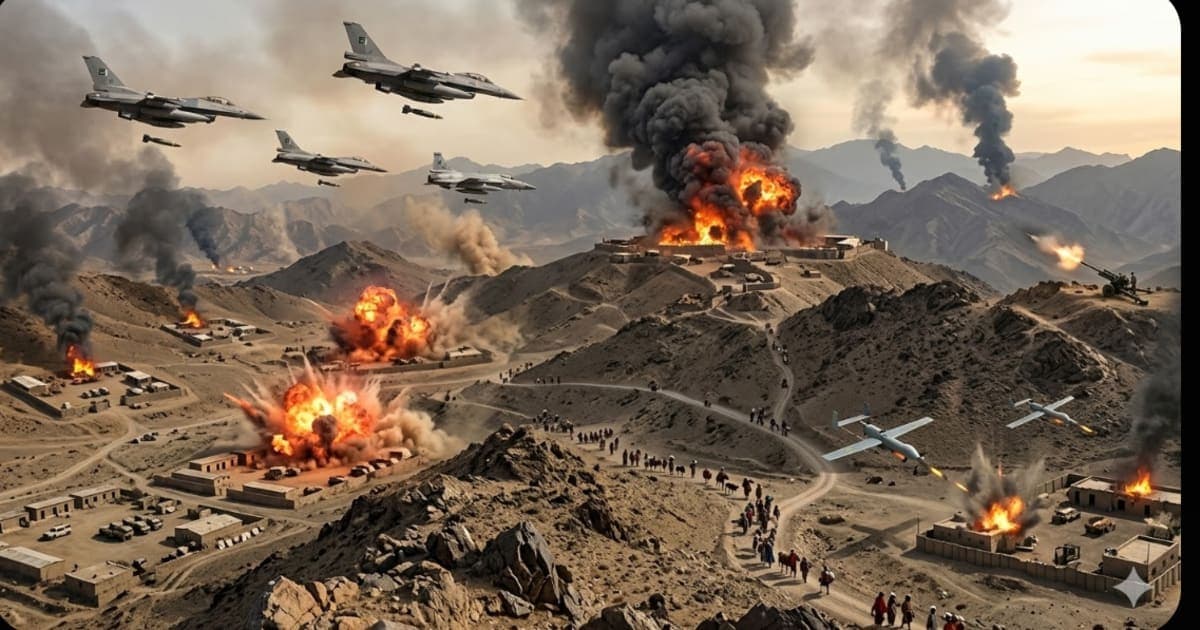
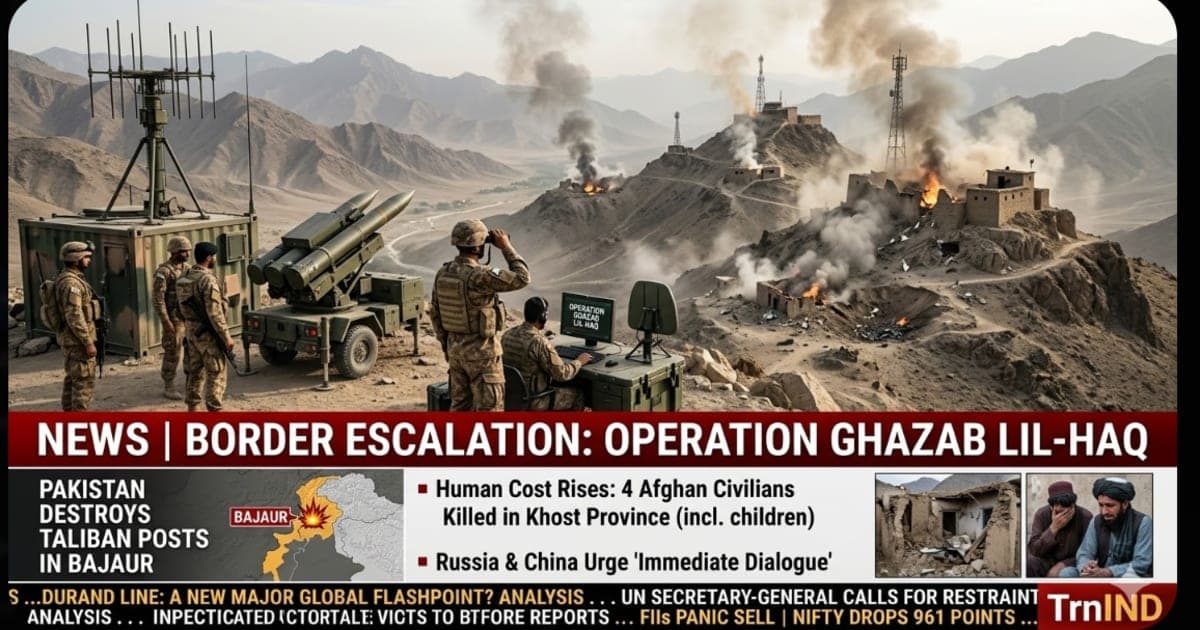
Pakistani security sources confirmed today that armed forces destroyed multiple Afghan Taliban posts in the Bajaur sector overnight, using guided missiles to neutralise what they described as "technical support infrastructure." [web:258] The operation is now in its nineteenth day. Pakistani officials say it will continue until all objectives are met. [web:260]
In Khost province, 21 miles across the Durand Line, a Pakistani mortar shell struck Nari village in Gurbuz district at midnight on Sunday. A woman and a child were killed. Shells also landed on a market, a health clinic, and a second village, wounding four more people — two critically. [web:262] In the Afghan Dubai area of Khost, two children were killed by separate shelling on Sunday night. One person died in Nuristan province when a shell hit a civilian home. [web:262]
Three children and a woman. A market. A health clinic. This is what Operation Ghazab lil-Haq looks like from the Afghan side of the border on March 16, 2026.
The Verified Civilian Toll
The numbers from UNAMA — the UN Assistance Mission in Afghanistan, which has the most credible independent tracking capacity in the country — are stark. Between February 26 and March 5 alone, 185 civilian casualties were recorded in Afghanistan, including 56 deaths from indirect fire and aerial attacks. [web:266] By March 12, UNAMA had confirmed at least 75 civilians killed and 193 injured since the operation began. [web:267]
These are minimums. UNAMA access to conflict-affected areas in eastern Afghanistan is restricted by active military operations and road damage. Every figure it publishes carries an implicit caveat: the actual toll is higher. By how much is not knowable until access improves.
Pakistan's position is consistent: the targets are Taliban military infrastructure and TTP positions, not civilian areas. [web:258] The gap between that position and the UNAMA data — children dying in nomadic shelters and village markets — is the fundamental credibility problem that Islamabad has not resolved in nineteen days of operations. Precision guided missiles can hit the target they are aimed at. Artillery and mortar shells fired into border areas with civilian populations do not carry the same precision guarantee. [web:269]
UNAMA has urged both sides to immediately halt the fighting to prevent further civilian harm. [web:267] Neither side has responded to that request.
What "Guided Missiles" in Bajaur Actually Signals
The use of guided missile systems against Taliban posts in the Bajaur sector is a deliberate operational and messaging choice. [web:258]
Operationally: guided munitions reduce collateral damage compared to unguided artillery by hitting specific coordinates rather than area targets. Pakistan is using them partly because the terrain in Bajaur — dense mountain ridgelines, mixed civilian and military infrastructure — makes area fire tactically counterproductive and diplomatically costly.
As a message: the use of precision guided weapons signals to both the Taliban and international observers that Pakistan has the capability and intent to strike specific, identified targets inside Afghanistan with accuracy. It raises the technological baseline of the conflict and signals that Pakistan is not operating at the limits of its capability — it is choosing from a range of options.
The Taliban's response in Bajaur has been cross-border small arms and mortar fire. The technological asymmetry is real. But as today's Khost civilian deaths demonstrate, Pakistan's guided missiles in Bajaur do not prevent Pakistan's conventional artillery from killing civilians in Khost simultaneously. The operation is being conducted across a 2,640-kilometre border simultaneously, and not every strike in every sector carries the precision of the guided missile headline.
Is the Durand Line the Next Global Flashpoint?
The question is worth answering seriously rather than rhetorically.
A "global flashpoint" in the analytical sense means a conflict with the potential to draw in major powers, disrupt global systems, or escalate beyond bilateral containment. By that standard, the Durand Line conflict has specific characteristics that elevate it above a typical bilateral border dispute — and specific constraints that limit its escalation ceiling.
The nuclear dimension. Pakistan is a nuclear-armed state. Afghanistan is not. This asymmetry is both a deterrent and a risk amplifier. Pakistan's nuclear status means the Taliban cannot escalate to a level that threatens Pakistan's territorial integrity without triggering a response that would be existential for any Afghan state. It also means that any third party — India, Iran, Russia — calculating whether to involve itself in the conflict must factor in the nuclear backdrop. The conflict's escalation ceiling is effectively set by the presence of Pakistani nuclear weapons.
The proxy dimension. The TTP is not merely a group that operates from Afghan territory — it is a group with ideological, familial, and operational ties to the Afghan Taliban that make the Afghan government's claimed neutrality structurally implausible. [web:163] For Pakistan, this conflict is not really about the Durand Line boundary. It is about whether a hostile government will continue to provide operational sanctuary to a domestic insurgency that has killed thousands of Pakistani civilians and soldiers. That makes a negotiated resolution significantly harder than a simple border demarcation dispute.
The great power involvement. Russia and China have both called for immediate dialogue. [web:162] Neither has leverage sufficient to compel it. China has the most concrete interest — CPEC — but has not used it publicly. The US is currently consumed by the Iran conflict. India, which has historically maintained functional relations with both Islamabad and Kabul, is managing its own crisis. The diplomatic bandwidth available for Durand Line mediation is at its lowest point in years precisely because every major power with regional influence is dealing with a simultaneous crisis elsewhere.
The conflict is not a global flashpoint in the sense that it will draw in US, Chinese, or Russian military forces directly. It is a regional flashpoint with global implications: 115,000 displaced Afghans straining humanitarian systems, CPEC infrastructure at risk, a nuclear-armed state in open warfare with its neighbour, and a humanitarian toll that is rising daily with no negotiation in sight.
The Line That Both Sides Are Approaching
Pakistan's stated objective — verifiable guarantees that Afghan territory will not be used for TTP attacks — requires the Taliban to publicly commit to acting against groups they regard as ideological allies, under military pressure, in a way that their domestic constituency would read as capitulation to a neighbour they fought for twenty years.
The Taliban's stated position — that Pakistan's strikes violate Afghan sovereignty and that Taliban forces will defend Afghan territory — requires them to absorb continued Pakistani precision strikes on their military infrastructure until either Pakistan runs out of will or a mediator provides a face-saving exit.
Neither position has moved in nineteen days. The guided missiles are still flying toward Bajaur. The mortar shells are still landing in Khost. The children are still dying on both sides of the line that neither government formally agrees is a border.
Until something changes that calculation — and as yet, nothing has — this is not a conflict approaching resolution. It is a conflict finding its new normal.