A Drone Hit a Fuel Tank Near Dubai Airport Today — and the Gulf War Just Got Harder to Ignore
DUBAI, March 16, 2026
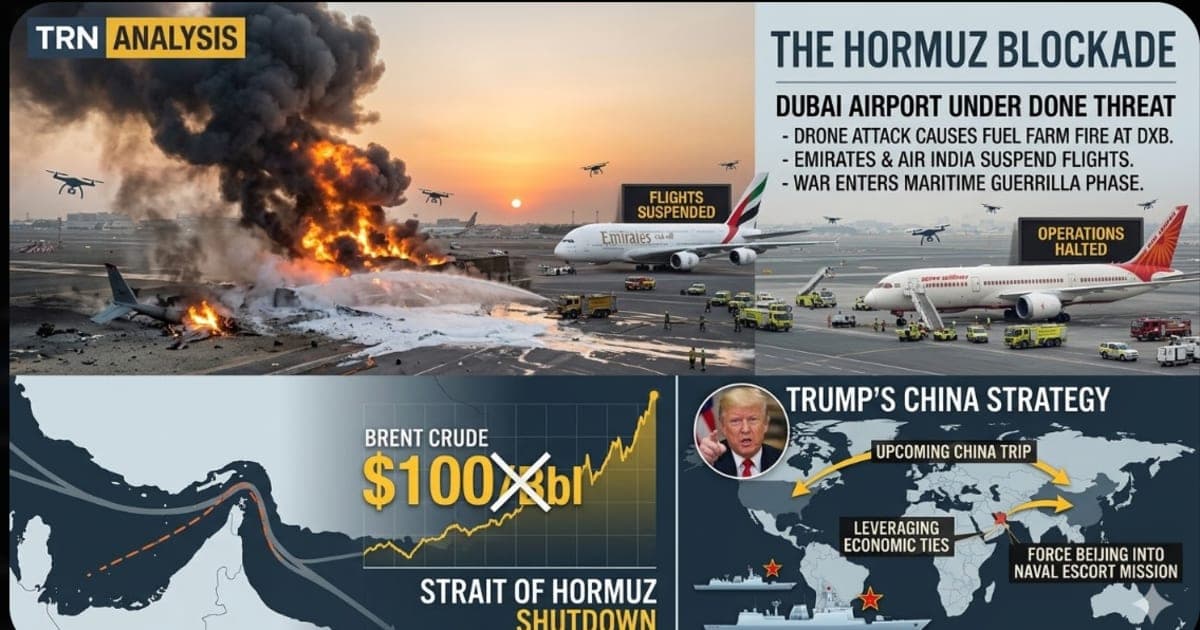
Dubai International Airport — the world's busiest international airport by passenger numbers, the hub through which roughly 3.5 million Indians travel every year — suspended all flight operations today after an Iranian drone struck a fuel tank in its vicinity and set it ablaze. [web:187]
Thick black smoke rose over the airport. Civil defence teams brought the fire under control. Dubai Media Office confirmed no injuries. [web:187] Emirates suspended all flights until further notice. [web:181] Air India and Air India Express cancelled every Dubai flight for the day. [web:181] IndiGo suspended its UAE operations. [web:183] Oman Air cancelled flights to nine destinations. [web:178]
For the millions of Indian workers, families, and travellers whose connection to the Gulf runs through Dubai Terminal 3, today was the moment the US-Iran war stopped being a geopolitical abstraction and became a cancelled boarding pass.
What Actually Happened — The Verified Facts
The drone struck a fuel storage tank in the vicinity of Dubai International Airport in the early hours of March 16. [web:188] Dubai Civil Defence confirmed the fire was at a fuel tank and was brought under control. No injuries have been reported by UAE authorities. [web:187]
This was not an isolated event. On the same day, UAE air defences intercepted 21 drones and 6 ballistic missiles launched from Iran targeting multiple UAE locations. [web:177] Bahrain, Kuwait, Qatar, and Saudi Arabia all reported drone and missile intercepts. [web:187] A rocket strike in Abu Dhabi killed at least one Palestinian national. [web:178]
The Fujairah Oil Industries area — location of the UAE's only crude oil export terminal on the Indian Ocean coast, the facility that was designed specifically to bypass the Strait of Hormuz — was struck in a separate drone attack. [web:177] A fire broke out there as well. The strategic significance of that target is not accidental: Fujairah exists precisely as an alternative to Hormuz transit. Striking it is Iran signalling that it intends to close every exit, not just the Strait.
Reuters confirmed: Dubai airport resumed some flights after the drone attack caused the fuel tank blaze. [web:186] As of the time of writing, operations are partially restored but a full return to normal scheduling has not been confirmed.
Dubai as a Target — Why This Escalation Is Different
The UAE has maintained a careful public posture throughout the US-Iran-Israel conflict. Abu Dhabi and Dubai have been attempting to balance their deep economic integration with the West — the US Fifth Fleet is based in Bahrain, US military assets operate from UAE bases — against their geographic reality of being 150 kilometres across the Gulf from Iranian territory.
Iran striking Dubai International Airport is a direct message to that balancing act: there is no neutral ground in this conflict. The UAE's decision to host US military assets, to participate in the coalition protecting Gulf shipping, and to remain open to Western commercial traffic makes it a target.
Dubai International is not just an airport. It is the economic engine of a city whose GDP is built on being the world's most accessible transit hub. Every day DXB is closed costs the UAE economy billions in tourism, trade, and financial services revenue. Every day it is operationally uncertain — even if flights are technically possible — drives airlines to reroute, corporates to cancel meetings, and travellers to choose different connections.
That is the strategic logic of the attack. Iran does not need to destroy Dubai. It needs to make Dubai feel expensive and uncertain enough that the economic pressure on Gulf states to demand de-escalation outweighs their alignment with Washington.
The India Dimension — What Today Means for 9 Million People
There are approximately 3.5 million Indian nationals living in the UAE. Add the broader Gulf diaspora — Saudi Arabia, Qatar, Kuwait, Bahrain — and the Indian community dependent on Gulf aviation connections exceeds 9 million people. Dubai is the single most important aviation hub connecting India to the world for a significant portion of the country.
Air India and Air India Express cancelled all March 16 Dubai flights. [web:181] IndiGo, which had already reduced UAE operations on March 15 due to earlier restrictions, suspended further. [web:183] Air India Express' ad-hoc flights from Abu Dhabi, Ras Al Khaimah, and Sharjah continued — meaning the airline was actively routing Indian passengers around Dubai to other UAE airports to maintain some connectivity. [web:181]
Passengers with cancelled flights are being offered rebooking or full refunds. [web:181] That is the airline's correct commercial response. It does not address the worker in Kochi who was scheduled to fly back to a construction site in Dubai tomorrow, the family in Hyderabad waiting for a relative's return flight, or the small business owner whose supply chain runs through Dubai's Jebel Ali port.
The Rupee, already at 92.3 and under pressure from the oil shock, does not benefit from an event that disrupts remittance flows, raises travel insurance costs, and signals further Gulf instability. Indian workers in the UAE send approximately $19 billion in remittances annually. Any sustained disruption to their ability to work, travel, and transfer money lands directly in India's balance of payments.
The Fujairah Strike — The Target That Actually Matters More
The Dubai Airport fire is the dramatic image. The Fujairah strike is the strategically significant one.
Fujairah port sits on the UAE's east coast, facing the Indian Ocean, outside the Persian Gulf entirely. It was deliberately developed as a bypass facility: pipelines run from Abu Dhabi's oil fields across the UAE to Fujairah, allowing crude to be loaded onto tankers without those tankers ever entering the Strait of Hormuz. The Abu Dhabi Crude Oil Pipeline has a capacity of 1.5 million barrels per day. In a normal Hormuz crisis, Fujairah is the pressure valve.
Iran hit it today. [web:177]
This is either a demonstration of intent — showing that Iran can reach Fujairah and will use that capability if the UAE continues to host coalition forces — or an operational strike designed to physically degrade the bypass capacity that reduces the leverage value of Hormuz closure. Probably both.
If Fujairah's export capacity is degraded, the Hormuz bypass disappears. That leaves Saudi Aramco's East-West Pipeline to Yanbu on the Red Sea as the only significant alternative crude export route in the region — and Yanbu's capacity cannot absorb the full volume that normally transits Hormuz.
The energy market implications of a successful Fujairah strike are larger than the flight disruption at Dubai Airport. Brent crude crossing $100 was already happening before today. [web:189] The Fujairah attack pushes the ceiling higher.
Trump's China Leverage Play — What Beijing Is Being Asked to Do
The Trump administration is using the President's upcoming China visit to press Beijing into a specific ask: join a naval escort mission through the Strait of Hormuz for Chinese-flagged and neutral vessels.
The logic is straightforward. China imports approximately 40% of its crude oil from the Gulf. The Hormuz disruption is costing China real money — in higher oil prices, longer shipping routes, and supply uncertainty. China also has a significant naval capability and a Pacific naval posture that has been expanding into the Indian Ocean. And China has the most direct leverage over the Iranian economy of any major power, given that Chinese purchases of Iranian oil — in defiance of US sanctions — have been Iran's primary source of hard currency income for the past three years.
The American ask: use that leverage to either restrain Iran's Hormuz tactics, or join the coalition escort mission, or both.
Beijing's dilemma: openly joining a US-led coalition against Iran — a country Beijing has cultivated as a strategic partner, an energy supplier, and an anchor of its Middle East positioning — carries costs that the White House's framing of "protecting Chinese shipping" does not fully offset. China's regional relationships are built on the narrative that it is a neutral development partner, not a military actor. Joining an escort mission alongside the US Fifth Fleet erases that narrative.
What China has actually done so far: arranged for Chinese-flagged tankers to be given safe passage by Iranian naval forces, in a bilateral arrangement that has been confirmed by multiple shipping intelligence sources. That arrangement is pragmatic, bilateral, and does not require China to take any public stance on the conflict. It also creates the "AIS spoofing" problem — non-Chinese vessels disguising their signals as Chinese-flagged to benefit from that safe passage — which the US-led coalition is now dealing with as an additional risk factor for accidental engagement.
Trump's leverage is that the China visit is an opportunity for a different kind of arrangement — one that turns Beijing's bilateral Iran relationship into a mechanism for broader de-escalation, in exchange for something Washington can offer. What that something is has not been publicly stated. Trade concessions, Taiwan signalling, South China Sea posture — all of these are on the table in a visit at this level of geopolitical tension.
Whether Beijing calculates that the offer is worth the cost of publicly aligning with the US on Iran remains the central unknown of the upcoming visit.
The Pattern That Is Now Established
The escalation sequence since February 28 has followed a clear pattern. Each round of US-Israeli strikes produces an Iranian response that targets Gulf infrastructure — shipping, ports, now airports. Each Iranian strike on Gulf infrastructure expands the coalition of affected parties and increases economic pressure on everyone in the region. Each expansion of the conflict's geographic footprint makes de-escalation harder because more parties now have direct grievances and losses to account for.
The Dubai Airport fuel tank fire is not the peak of that pattern. It is a data point within a pattern of escalation that has not found its ceiling.
The WMO is watching El Niño develop in the Pacific. India's Rupee is at 92.3. Pakistan is fighting the Taliban on its western border. Ethiopia is counting its dead from landslides. The BCCI is scheduling IPL matches around state elections.
And Dubai — the city that built itself on being the place that connects everything to everything — had its airport shut down today by a drone that crossed the Gulf from Iranian territory, hit a fuel tank, and started a fire that took civil defence teams hours to control.
The tankers are not moving freely. The planes were not flying today. The price of oil is above $100 and climbing.
This is what the third week of the 2026 Iran War looks like on the ground.