Operation Ghazab lil-Haq: Pakistan's Border War With the Taliban Has No Exit Ramp in Sight
ISLAMABAD / KABUL, March 16, 2026
The name translates to "Wrath for the Truth." It was launched on the night of February 26, while much of the world was watching the Hormuz standoff. It has now been running for eighteen days. It has displaced over 115,000 Afghans. It has produced Pakistani airstrikes on Kandahar — the spiritual capital of the Afghan Taliban movement. And as of today, there are no negotiations scheduled. [web:171]
Pakistan has been fighting a two-front war that nobody in the international press is covering adequately: one front faces west toward Iran and the global energy crisis, the other faces north toward a 2,640-kilometre border with the Afghan Taliban that has been deteriorating since 2021 and has now broken into open military confrontation. Understanding what is happening on the Pakistan-Afghanistan border — and why it matters for CPEC, for regional stability, and for the specific question of who controls what along one of Central Asia's most strategically important corridors — requires starting from the beginning.
How It Started — The February 26 Escalation
The proximate trigger was cross-border fire on the night of February 26. [web:163]
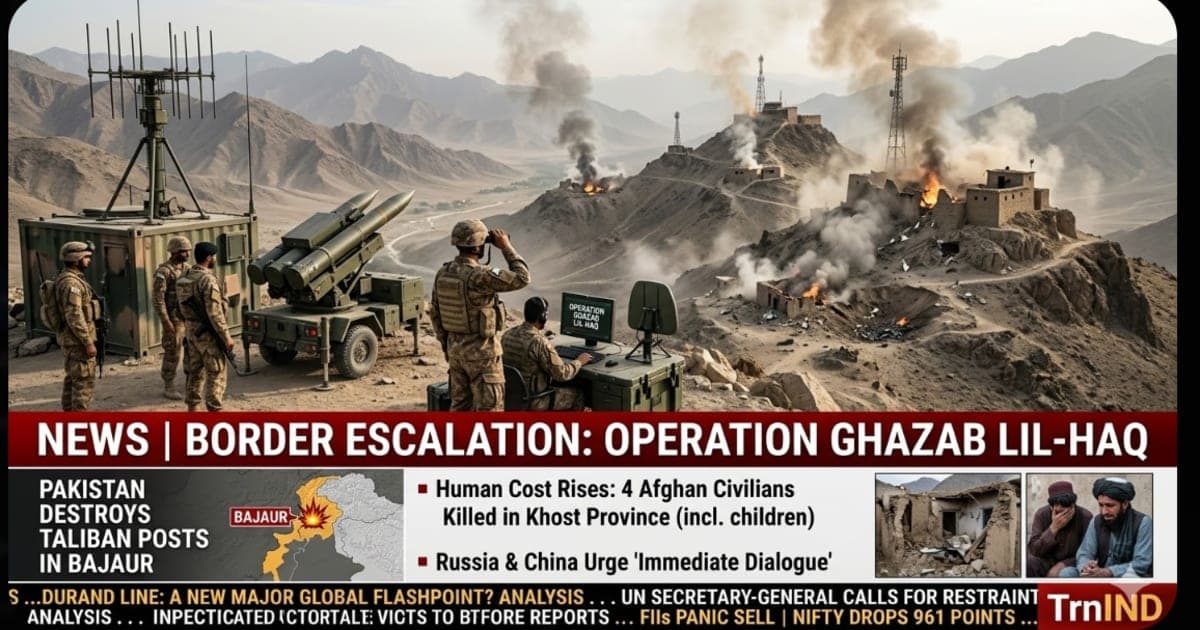
Pakistan's account: Afghan Taliban forces launched "unprovoked firing" on Pakistani border posts across multiple sectors — Chitral, Khyber, Mohmand, Kurram, and Bajaur — simultaneously. Pakistan retaliated with airstrikes and ground operations, framing the response as counter-terrorism action against TTP (Tehreek-e-Taliban Pakistan) infrastructure that it says the Afghan Taliban has been sheltering on Afghan soil. [web:163]
Afghanistan's account: Pakistan had struck Afghan territory days earlier, killing women and children. The February 26 operation was retaliatory. Afghan forces targeted Pakistani military posts along the Durand Line near Paktika, Paktia, Khost, Nangarhar, Kunar, and Nuristan — a four-hour operation that, Kabul claimed, destroyed two Pakistani military bases, 19 posts, and captured a military transport vehicle. [web:164]
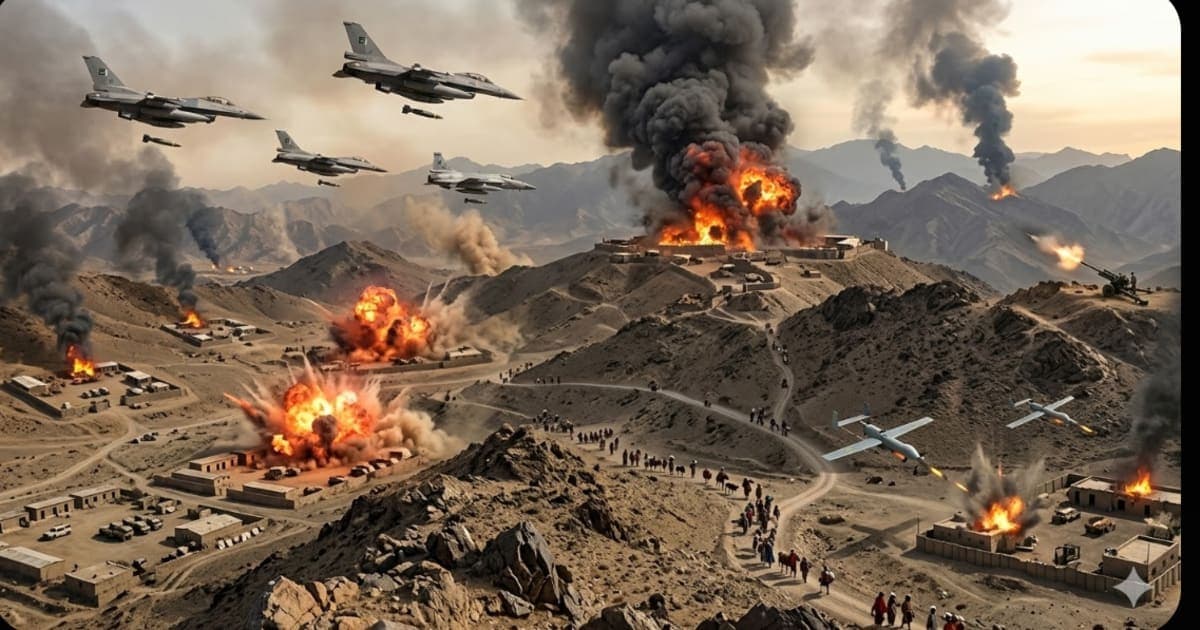
Pakistani Defence Minister Khawaja Asif, the next day, announced a state of "open war" with Afghanistan and confirmed Pakistan was escalating its airstrikes to strike targets throughout Afghanistan including Kabul. [web:162] That declaration — "open war" — by a nuclear-armed state against its neighbour is an extraordinary statement that received a fraction of the international attention it warranted, partly because the Hormuz crisis was dominating every headline simultaneously.
What Operation Ghazab lil-Haq Has Actually Done — The Verified Numbers
Pakistan's security sources, as of March 15, claim the following: [web:170]
- 684 Afghan Taliban operatives killed
- 912 injured
- 252 posts destroyed
- 44 posts captured and demolished
- 229 tanks, armoured vehicles, and artillery pieces destroyed
- 73 locations linked to terrorist infrastructure struck in aerial operations
These are Pakistani military figures and are unverifiable independently. Al Jazeera noted explicitly that it has been unable to confirm casualty figures from either side. [web:168] Afghanistan's Defence Ministry has offered its own numbers: approximately 150 Pakistani troops killed and over 110 Afghan civilians dead including women and children. [web:168]
What is independently verified:
The UN's International Organization for Migration counted 115,000 displaced Afghans and 3,000 displaced Pakistanis by March 6. [web:171] Al Jazeera put the figure at nearly 66,000 displaced Afghans by March 4, with the IOM warning of further escalation. [web:168] The UN Assistance Mission in Afghanistan recorded 42 civilian fatalities it could independently verify — a figure that is almost certainly an undercount given access limitations. [web:168]
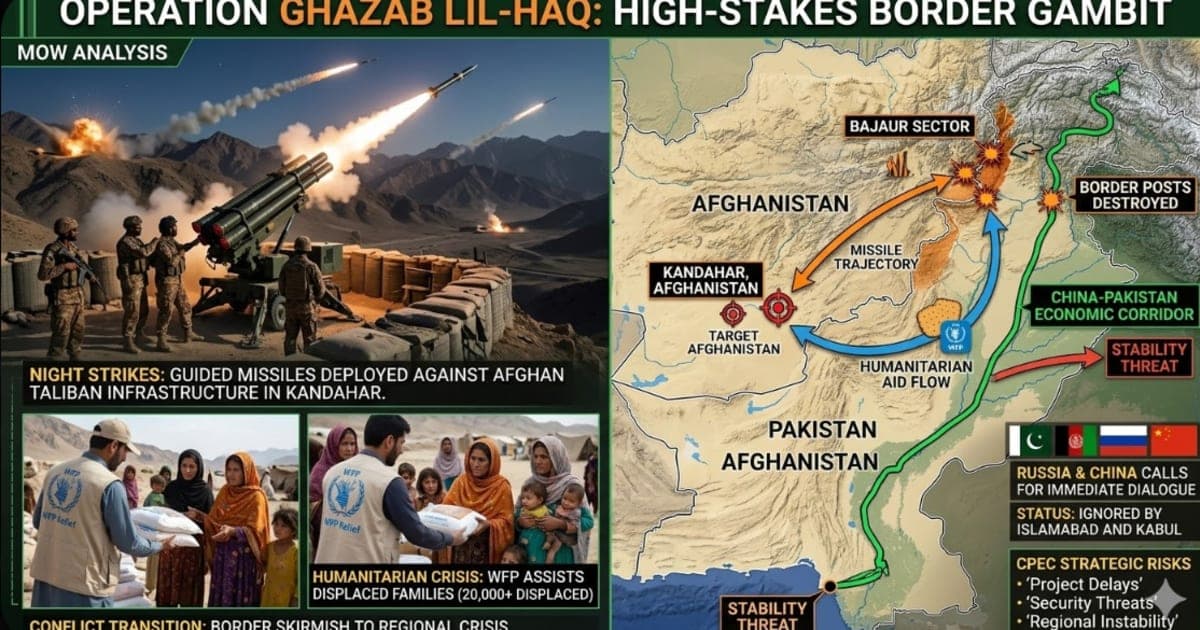
Pakistan struck Kandahar province on the night of March 14-15, targeting what it described as terrorist hideouts, military installations, equipment storage facilities, and "technical support centres." [web:170] Specifically: two underground tunnels — one storing technical equipment for militant activities, one housing weapons. In the Chitral sector, ground forces destroyed a Taliban launch point near the Badani post using small arms, heavy weapons, and quadcopter drones. [web:170]
Afghanistan's spokesman Zabiullah Mujahid disputed Pakistan's description of the Kandahar targets, saying Pakistan hit a site used by security guards that was empty at night and a drug rehabilitation centre that suffered slight damage, with no casualties. [web:167]
On March 15, a mortar shell — reportedly fired from Afghan territory — landed on a house in the Salarzai Tehsil of Bajaur district, killing four brothers: Sajid, Ayaz, Riaz, and Muaz. One person was seriously injured. [web:170] Pakistan's information ministry publicly accused the Afghan Taliban of "deliberately targeting civilian populations." [web:167]
Why the Durand Line Is the Fault at the Centre of This
Every Pakistani-Afghan confrontation eventually comes back to the same underlying fact: Afghanistan has never officially recognised the Durand Line as its international border. [web:164]
The 2,640-kilometre line was drawn in 1893 by British colonial administrator Mortimer Durand and the Amir of Afghanistan. It cuts through Pashtun tribal areas, splitting communities, families, and cultural networks across a political boundary that many on both sides of it regard as illegitimate. Every Pakistani government has insisted it is the internationally recognised border. Every Afghan government — including the Taliban — has refused to formally acknowledge it.
This is not an abstract diplomatic dispute. It means that when Pakistan builds a border fence, the Taliban sees it as an encroachment on Afghan territory and attacks it. When Afghan Taliban fighters cross into KP and FATA to link up with TTP cells, Pakistan sees it as state-sponsored terrorism using disputed territory as cover. When Pakistan strikes inside Afghanistan, Kabul frames it as a violation of Afghan sovereignty over land that Pakistan claims is merely the other side of an internationally recognised border.
The TTP — Tehreek-e-Taliban Pakistan, the organisation responsible for the majority of terrorist attacks inside Pakistan including the ongoing insurgency in KP and the 2023 Peshawar mosque bombing — has been operating from Afghan territory with what Pakistan says is the Afghan Taliban's knowledge and tolerance, if not active support. [web:163] Islamabad's stated objective for Operation Ghazab lil-Haq is to destroy TTP infrastructure and obtain "verifiable evidence" that Afghan land will not be used for future attacks against Pakistan. [web:168]
The Afghan Taliban's stated position: they have no obligation to act against groups they do not regard as terrorists, particularly on behalf of a Pakistani state whose military they fought and defeated. The ideological bond between the Afghan Taliban and TTP — both products of the same Deobandi religious tradition, the same tribal networks, the same anti-state ideology — makes the demand that Kabul suppress the TTP not just operationally difficult but theologically and politically awkward.
Why Russia and China's Calls for Dialogue Are Being Ignored
Both Russia and China have issued calls for "immediate dialogue" and de-escalation. Neither has had any visible effect on the conduct of either party. Understanding why requires understanding what each side gains from continuing the military pressure.
Pakistan's calculus. The Pakistani military's credibility — domestically and regionally — depends on demonstrating that cross-border attacks on its posts and civilian areas will produce a proportionate and sustained response. A ceasefire that produces no verifiable change in the Afghan Taliban's posture toward TTP is, from Pakistan's perspective, a ceasefire that simply gives TTP time to regroup. Rana Sanaullah, political advisor to PM Shehbaz Sharif, stated explicitly: operations continue until Pakistan receives "credible guarantees, concrete steps" from Kabul. [web:168]
The Taliban's calculus. The Afghan Taliban took power in August 2021 having defeated both the Afghan National Army and the US-led international coalition. Their entire identity is built on the narrative of military resistance to external pressure. Accepting Pakistani demands for action against TTP — groups with whom they have ideological and personal ties — under the pressure of Pakistani airstrikes is reputationally catastrophic domestically and within the broader jihadist movement they lead. More practically: they fought Pakistan's military for twenty years as the TTP. They know how to absorb strikes and continue operating.
Russia and China's actual leverage. Russia has significant relationships with both Islamabad and Moscow's commercial interests in the region, but it is currently managing the Iran situation, Ukraine's ongoing reconstruction, and its own domestic pressures. China has the most direct stake through CPEC — which runs through Pakistani territory and whose long-term extension toward Central Asia requires Afghan stability — but Beijing's leverage over the Afghan Taliban is limited. China was among the first to establish diplomatic relations with the Taliban government, but that relationship is transactional, not hierarchical. Beijing cannot tell Kabul what to do. It can withdraw investment and recognition, but doing so strengthens the Taliban's narrative of foreign pressure and weakens China's regional positioning simultaneously.
Turkey has offered mediation and has been the most active third party. The offer has not been taken up. [web:171] Several Gulf states that had expressed willingness to assist have had their attention diverted by the Iran war. [web:171] The diplomatic bandwidth that might otherwise be directed at the Pakistan-Afghanistan conflict is currently consumed by the Hormuz crisis.
What This Means for CPEC
The China-Pakistan Economic Corridor — $65 billion in infrastructure investment connecting Gwadar port to western China through Pakistan — is already under significant strain from TTP attacks on project sites and the security costs of protecting Chinese workers in KP and Balochistan.
Operation Ghazab lil-Haq creates three specific new risks for CPEC:
Direct infrastructure threat. The northern route of CPEC passes through KP and connects to the Karakoram Highway near the Afghan border. Active hostilities along the Durand Line in Bajaur, Chitral, and Khyber sectors put the security environment around key CPEC infrastructure nodes under additional stress. A mortar shell that kills four brothers in Bajaur is fifty kilometres from road and tunnel infrastructure that Chinese investment built.
The extended corridor ambiguity. China's long-term vision for CPEC includes eventual extension through Afghanistan to Central Asia — giving Beijing a land route to Central Asian markets and reducing dependence on the Malacca Strait for energy imports. That extension requires Afghan territory and Afghan government cooperation. A Pakistan-Taliban war that entrenches mutual hostility between Islamabad and Kabul sets the extended corridor back by years, if not permanently.
The reputational risk for Chinese workers and investment. The TTP has specifically targeted Chinese nationals in Pakistan on multiple occasions — the 2022 Karachi University attack, the 2024 Bisham bus bombing. Active war conditions along the Afghan border increase the operational freedom of TTP cells operating inside Pakistan and increase the risk to Chinese nationals working on CPEC projects. China has been quietly pressing Pakistan for improved security guarantees. A war that expands the zone of instability rather than contracting it is the wrong direction from Beijing's perspective.
China's response has been to call for dialogue and continue monitoring. This is the correct diplomatic posture given the constraints. It is not a response that changes the military situation.
The Humanitarian Situation — What the WFP Is Actually Dealing With
The World Food Programme and IOM are operating in conditions of active conflict along one of the world's most difficult terrains — the mountains of eastern Afghanistan and KP.
115,000 displaced people as of March 6. [web:171] The majority are in eastern and southeastern Afghanistan — Nangarhar, Kunar, Paktia, Paktika, Khost — the provinces along the border that have been most directly affected by the strikes. [web:168] These communities were already "strained and lacking resources" before the conflict began, according to IOM's own characterisation. [web:168]
The displacement pattern is typical of border conflict: people move away from the fighting, into provincial centres and district towns that have minimal absorption capacity. They arrive without food stocks, without cash, without the documentation that would allow them to access the minimal formal support systems that exist in Taliban-governed Afghanistan. Many will be living in makeshift camps or with host families who are themselves resource-constrained.
WFP is distributing high-energy biscuits and basic rations as an emergency response. This is crisis-mode humanitarian assistance — the minimum nutritional support for populations that cannot access their own food production because they have been displaced from their farms during planting season. A displacement that continues through March and April will disrupt the spring planting cycle for thousands of families, creating food security impacts that extend well beyond the immediate emergency.
The WFP's access inside Taliban-governed Afghanistan is constrained by the Taliban government's restrictions on female aid workers — a policy that limits the WFP's ability to reach women and children through female-staff house visits, the standard methodology for nutritional assessment and targeted food distribution. Operating in a conflict zone with those access restrictions simultaneously is the operational challenge the WFP is managing.
The Endgame Question That Nobody Has An Answer To
Pakistan has stated its objective clearly: verifiable guarantees that Afghan territory will not be used for attacks against Pakistan, and concrete steps against TTP. [web:169] Pakistan has also said the operation will continue until "credible guarantees and concrete steps" are provided by Kabul. [web:169]
The Taliban government has no incentive to provide those guarantees under military pressure, for the reasons outlined above. Their incentive structure runs in the opposite direction: yielding to Pakistani demands under fire is domestically illegitimate. They need either a face-saving framework that allows them to act against TTP while claiming it is their own decision rather than Pakistani coercion — which is what diplomacy is for — or they need to wait Pakistan out.
Pakistan's economy is under severe simultaneous pressure: Rupee depreciation, oil price shock from Hormuz, international investor concern about a country with nuclear weapons in open war with its neighbour. The cost of sustained military operations in difficult mountain terrain is not insignificant for an economy that was already in IMF programme territory before the crisis.
The 18-day duration of Operation Ghazab lil-Haq, and the continued cross-border fire from both sides as of March 15, suggests that neither party has yet concluded that continuation is more costly than compromise. When that calculation changes — and something will change it, whether economic pressure, third-party mediation, or escalation that makes the cost undeniable — the diplomatic framework will need to be ready.
Turkey is the most credible potential mediator with access to both parties. China has the most direct economic stake. Saudi Arabia and Qatar have historically played roles in intra-Afghan and Pakistan-Taliban mediation but are currently focused on the Iran situation.
The window between "ongoing military operations" and "negotiated framework" is where the conflict currently sits. How long that window stays open — and whether the 115,000 displaced people return to their homes this spring or are still in temporary shelters in autumn — depends on decisions being made in Islamabad and Kandahar by people who are, at this moment, still shooting at each other.