The Man Nobody Has Seen Is Holding the World's Oil Supply Hostage
TEHRAN / WASHINGTON D.C. — March 14, 2026
Mojtaba Khamenei has not appeared in public since the war began.
His first decree as Iran's Supreme Leader was read by a state media anchor, not delivered in person. His location is unknown to the public and reportedly to most of his own government. There are rumours — unconfirmed by any official source — that he was wounded in the initial U.S.-Israeli strikes that killed his father. What is confirmed is that a man who has spent his entire career in the shadows of the IRGC's intelligence apparatus is now running Iran from somewhere unknown, and has decided that his opening move as Supreme Leader is to close the most important maritime chokepoint on the planet.
That decision is now the central fact of global energy markets, international shipping, and the most urgent diplomatic conversations happening anywhere in the world.
How Mojtaba Khamenei Got Here
Ayatollah Ali Khamenei — Supreme Leader of Iran for 36 years, architect of Iran's nuclear programme, patron of its proxy network from Lebanon to Yemen — was killed on February 28 in a coordinated U.S.-Israeli airstrike on Tehran. The strike targeted leadership compounds with a precision and scale that the regime had not anticipated.
His son Mojtaba was named Supreme Leader on March 8 by Iran's Assembly of Experts, in an emergency session conducted under wartime conditions.
The choice was controversial within Iran's clerical establishment, and that controversy matters. Mojtaba lacks the traditional religious credentials of a Grand Ayatollah — the scholarly standing that gives a Supreme Leader legitimacy within the Shia clerical hierarchy. His father had those credentials. Mojtaba does not. What he has instead is something more immediately useful in wartime: the deep loyalty of the IRGC's internal security and intelligence wings, built over decades of quiet operational work inside those institutions.
In a normal transfer of power, the absence of religious credentials would be a significant political liability. In an active war, with the IRGC as the primary power base and the clerical establishment in disarray from the strikes on Tehran, it is less immediately disabling than it would otherwise be. Whether it becomes a crack in his authority as the war continues is one of the central questions analysts are watching.
His first public statement: "The leverage of blocking the Strait of Hormuz must certainly continue to be used. We will not neglect avenging the blood of our martyrs."
What Closing the Strait Actually Did to Markets
The numbers from the past two weeks are not projections. They are recorded market movements.
Crude oil went from $71 per barrel to over $105 in less than two weeks. That is a 48% increase. Brent is currently trading above $100 and has been volatile within a $10 range as markets respond to each new development — a ship attacked, a diplomatic breakthrough, a military escalation, a bounty announcement.
Maersk, one of the world's largest container shipping operators, implemented what it is calling an "Emergency Freight Increase" of up to $1,800 per container for routes affected by the Hormuz closure. Every manufacturer who ships components through the Gulf is absorbing that increase. Every retailer receiving those goods will eventually pass it through.
Maritime war-risk insurance for Gulf transit has become, in the words of one Lloyd's underwriter quoted in the shipping press, "virtually unobtainable at commercially viable rates." The practical effect: most commercial operators are either anchoring in the Indian Ocean waiting for conditions to change, or routing via the Cape of Good Hope — adding 12 to 15 days to journey times and the associated fuel and crew costs.
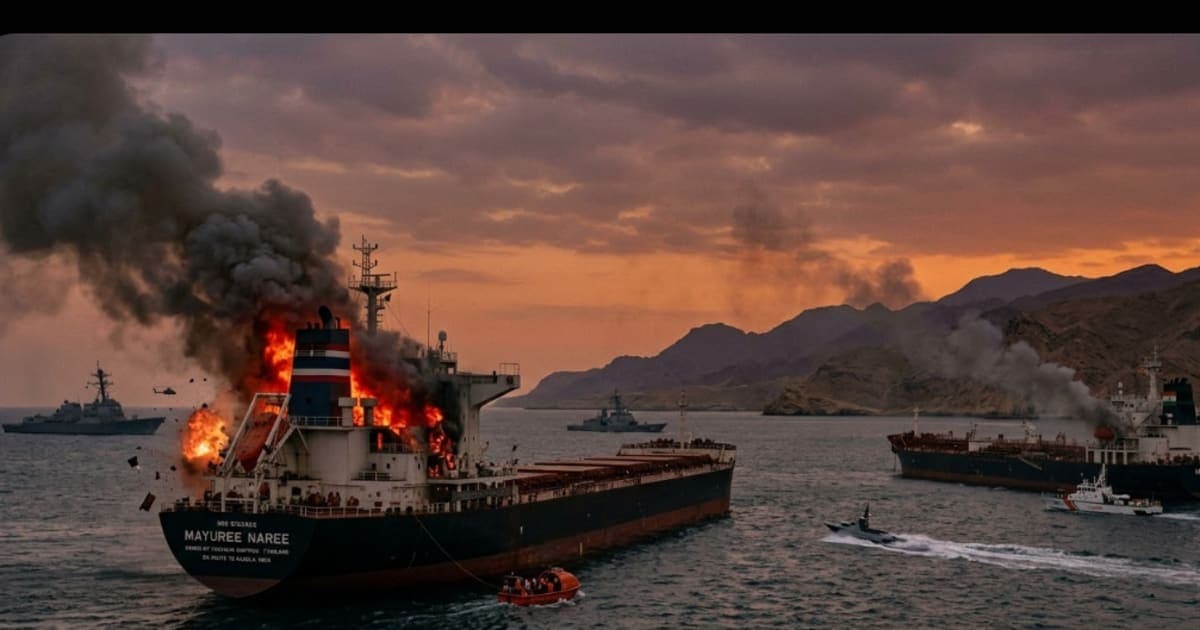
The U.S. Navy is escorting some commercial vessels through the strait. The IRGC's counter-strategy is built around making that escort too costly to sustain — fast-attack boats operating in swarms, shore-based anti-ship missiles covering the narrowest points of the passage, and mines that can be laid faster than they can be swept. The strait is not fully closed in the sense that nothing moves through it. It is closed in the sense that most commercial operators have decided the risk-adjusted economics don't work.
The $10 Million Bounty — What It's Actually For
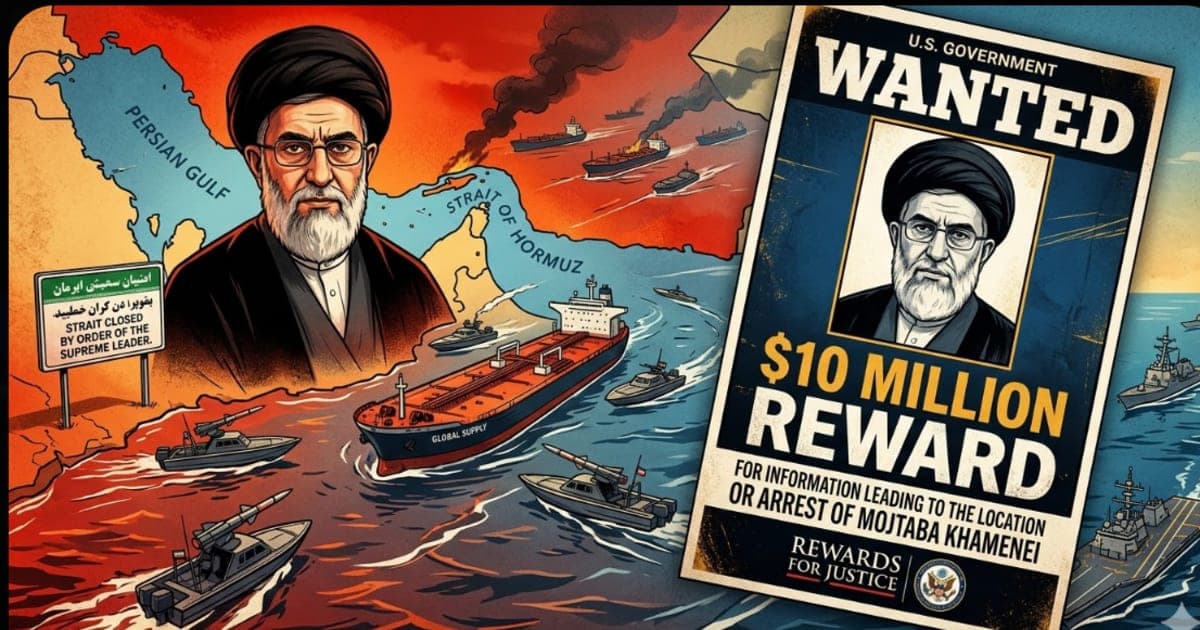
On March 13, the U.S. State Department's Rewards for Justice programme released a digital poster with Mojtaba Khamenei's face and those of several senior IRGC officials, offering $10 million for information on their whereabouts.
The Trump administration's public framing — "finish the job," let them "fight it out" — suggests a preference for military resolution over diplomatic negotiation. The bounty fits that framing. But the operational logic behind it is more specific than the headline suggests.
The bounty does three things simultaneously.
First, it targets defection. Iran's wartime leadership is operating in extreme secrecy — Mojtaba hasn't been seen publicly, his intelligence minister Esmail Khatib is at large, Ali Larijani and Interior Minister Eskandar Momeni are similarly underground. $10 million is a life-changing sum for anyone with access to location information. The calculation is that someone in the inner circle, or with proximity to it, decides the money and the opportunity to leave Iran are worth more than loyalty.
Second, it forces deeper concealment. Every resource Mojtaba and his commanders spend on personal security and movement security is a resource not spent on coordinating military operations. An IRGC leadership that has to move safe houses every 48 hours and limit communications to avoid signals intelligence is a leadership that cannot run complex operational planning efficiently.
Third, it signals delegitimisation. By placing a Supreme Leader — a head of state — in the same Rewards for Justice framework used for designated terrorist leaders, Washington is formally stating that it does not recognise the clerical government as a legitimate sovereign actor. That is a significant diplomatic position with implications for what a post-war settlement looks like, if one is ever negotiated.
Whether the bounty produces any of these outcomes is an open question. It has not produced any publicly acknowledged result as of today. What it has done is end any remaining possibility of Western-led diplomacy with Tehran in the short term. You cannot simultaneously offer $10 million for a head of state's location and conduct negotiations with his government.
China's Position — and the AIS Spoofing Problem
China has not been a bystander in this crisis.
Beijing officially condemned the U.S.-Israeli strikes on Tehran. It has also, less officially, been coordinating with the Iranian Navy to allow Chinese-flagged vessels to transit the strait. China's energy dependency on Gulf oil is significant — roughly 40% of its crude imports come from the Middle East — and Beijing is not prepared to absorb a sustained closure any more than India is.
The secondary effect of China's bilateral transit arrangement is one of the stranger maritime phenomena of the crisis: AIS spoofing at scale. Several non-Chinese vessels have reportedly begun broadcasting false AIS signals identifying themselves as Chinese-owned to attempt to secure passage. AIS spoofing is illegal under international maritime law and was already a known problem in sanction-evasion contexts. It is now happening for a different reason — survival rather than sanctions evasion — and at volumes that maritime traffic monitoring agencies have not previously encountered.
The practical danger from this is acute. Coalition naval forces in the strait are using AIS data as one input in identifying vessels. A vessel broadcasting false Chinese identification while coalition forces are conducting operations creates conditions for accidental engagement. The U.S. Navy has been aware of the spoofing problem and is operating under rules of engagement that attempt to account for it. "Attempting to account for" is not the same as "has solved."
Saudi Arabia and the UAE — Profiting and Terrified Simultaneously
The Gulf monarchies are in an impossible position.
Higher oil prices increase their revenues directly. Saudi Aramco's per-barrel profit at $105 crude is substantially better than at $71. From a pure fiscal perspective, a prolonged period of high oil prices is financially beneficial to Riyadh and Abu Dhabi.
Mojtaba Khamenei has explicitly threatened "revenge strikes" on Gulf energy infrastructure if the war continues. Saudi Arabia's air defence systems have already intercepted missiles and drones targeting energy fields and military airbases in this conflict cycle. The Abqaiq attacks of 2019 — drone and missile strikes on Saudi Aramco facilities that briefly took 5% of global oil supply offline — demonstrated what a successful strike on Saudi infrastructure looks like for global markets. Under current conditions, Iranian motivation and capability to conduct such strikes are both elevated.
The UAE faces a version of the same calculation, with Dubai's financial district adding another dimension — Iranian threats against U.S. and Israeli-linked economic institutions in the region have prompted corporate evacuations and security escalations that are costing the emirate in reputation and operational disruption even before any strike materialises.
Both countries are publicly calling for de-escalation while privately running their military systems at maximum readiness. That is the only coherent position available to them.
What's Happening Inside Iran
The information coming out of Iran is fragmentary and difficult to verify independently. What multiple sources are reporting:
Supply chain disruption inside the country is severe. The same Hormuz closure that is strangling global energy markets is also strangling Iran's own import supply chains. Medicine, basic goods, and industrial inputs that Iran imports are not moving in or out. A country already under decades of sanctions pressure is experiencing an acute additional shock.
Political dissent inside Iran has been suppressed with the wartime security apparatus, but it exists. Mojtaba Khamenei's lack of clerical legitimacy is a real political liability that opposition figures inside and outside the country are already articulating. The IRGC's loyalty to him is the current answer to that liability. Whether that loyalty holds under sustained military pressure and economic deterioration is the question that nobody outside the IRGC can answer with confidence.
Cities in western Iran that are closer to the operational areas have seen civilian displacement. The death toll that Iranian state media reports diverges significantly from what human rights organisations and independent journalists are documenting. The honest position is that the civilian cost of this war inside Iran is substantially higher than official figures acknowledge and substantially lower than the most inflated estimates circulating on social media.
The Two Gambles
Mojtaba Khamenei's calculation: the world's dependency on Gulf oil will eventually force Western governments — whose populations are paying record petrol prices and watching inflation rise — to negotiate on Iran's terms. Every week the strait stays closed, the domestic political pressure on Washington increases. At some point, Trump's base, which does not have an unlimited appetite for foreign wars with no visible end, will push back. That is the bet.
Washington's calculation: the bounty, the continued strikes on Iranian military infrastructure, and the blockade of Iranian ports will break the regime's operational capacity and internal cohesion before the global economy fractures badly enough to force a negotiated settlement. That is the other bet.
Both of these bets have historical precedents. Neither has a guaranteed outcome. The Iran-Iraq War lasted eight years. The Iranian regime survived that. It also survived the 2019-2020 maximum pressure campaign. American administrations have overestimated the speed of Iranian regime collapse before.
What has not happened before is a U.S.-Iranian conflict at this direct level of military engagement, with a new and untested Iranian Supreme Leader making decisions from an undisclosed location, with global oil markets already above $100 per barrel at the start of what could be a prolonged standoff.
The Strait Itself
The Strait of Hormuz is 55 kilometres wide at its narrowest. The shipping lanes — the actual channels deep enough for tankers — are much narrower: two 3-kilometre-wide lanes with a 3-kilometre separation zone between them. At any given time, those lanes are either moving the circulatory fluid of the modern global economy, or they are not.
Right now, they are mostly not.
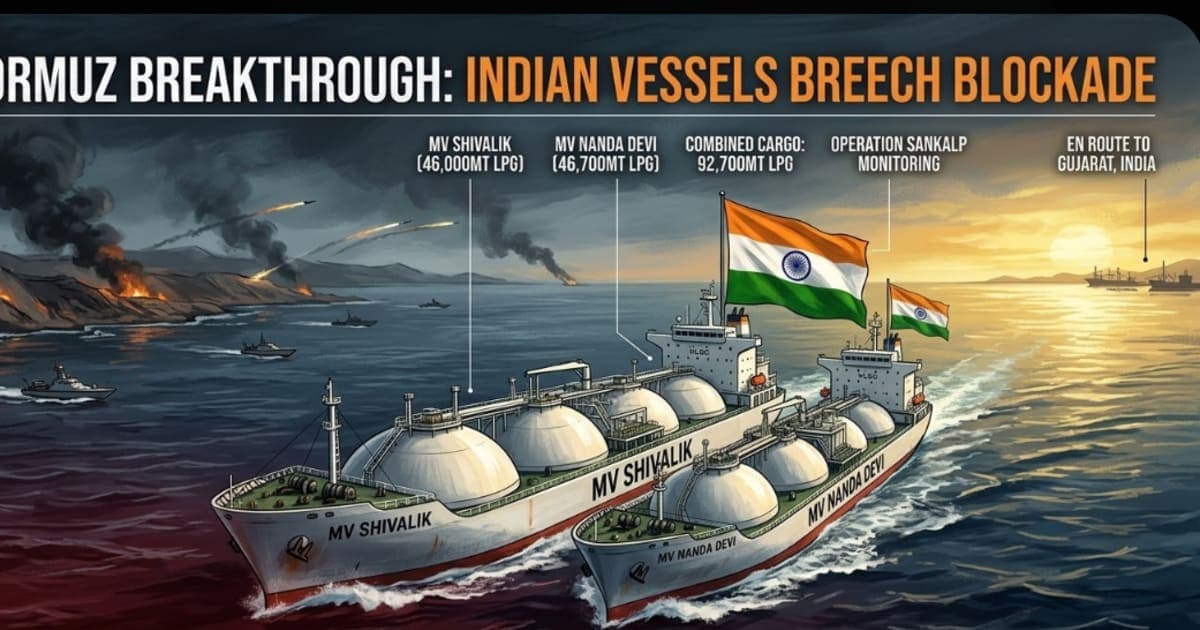
The U.S. Navy is present. The IRGC is present. Indian ships are moving under bilateral diplomatic clearance. Chinese ships are moving under their own arrangement. Everyone else is either at anchor in the Indian Ocean or on their way around Africa.
The question is not whether the strait will eventually reopen. It will. The question is what it costs — in lives, in economic damage, in political capital consumed — before it does, and whether the outcome resembles any of the scenarios the parties involved planned for when this began.
Mojtaba Khamenei is somewhere in Iran, unseen, making decisions that are moving oil markets in real time.
The strait is 55 kilometres wide and currently worth more per nautical mile than any waterway in human history.
Neither of those facts has a quick resolution.