The Strait of Hormuz Is Barely Moving — and You're Already Paying For It
There is a 21-mile-wide strip of water between Iran and Oman that you have probably never thought about. You are thinking about it now, whether you realise it or not, every time you check petrol prices or look at your LPG cylinder bill.
The Strait of Hormuz handles roughly 20% of the world's entire oil and LNG supply. Every barrel of crude leaving Saudi Arabia, the UAE, Kuwait, Iraq, and Qatar for Asian and European markets moves through that corridor. Every LNG cargo heading to Japan, South Korea, China, and India passes through the same 21 miles. There is no pipeline alternative at scale. There is no viable rerouting that does not add weeks and billions of dollars to the journey. The Strait is not a convenience — it is a structural dependency that the global economy built itself around over fifty years and cannot undo in a crisis.
Right now, it is barely functioning as a commercial shipping route. And the consequences are landing on Indian consumers faster than most people expected.
What "Largely Impassable" Actually Means
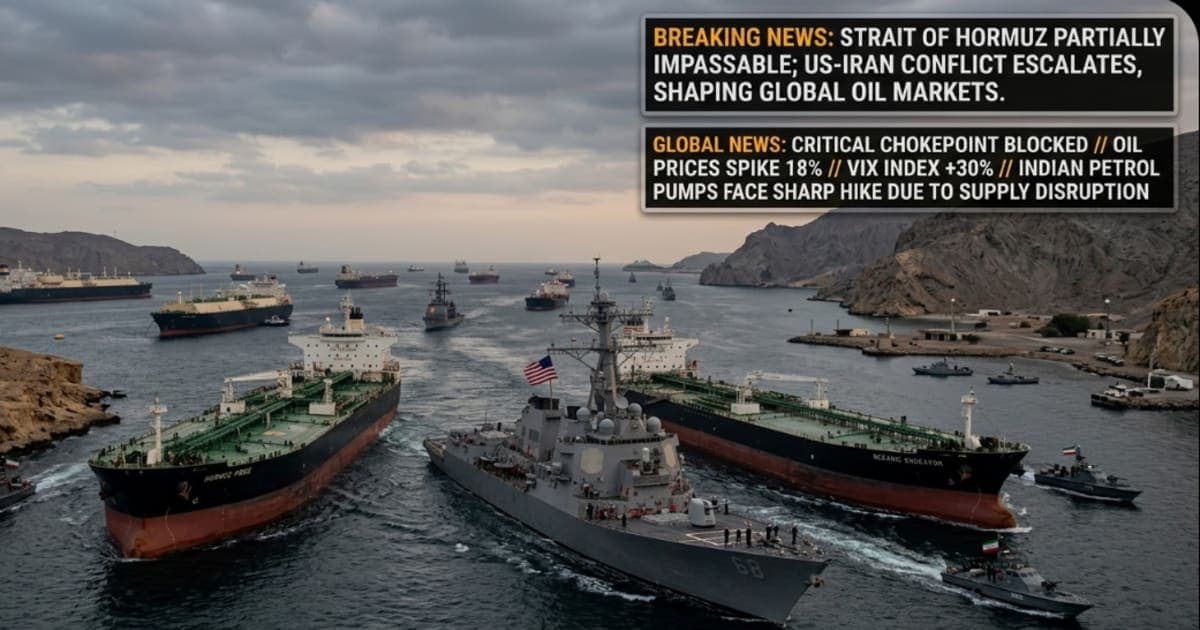
The Strait has not been physically blocked in the way a dam blocks a river. Iranian naval forces have not stretched a chain across the water. What has happened is more insidious: the combination of IRGC fast-boat harassment, shore-based anti-ship missile threats, sea mine risks, and the near-impossibility of obtaining war-risk insurance at commercially viable rates has made the risk-adjusted economics of transit unworkable for most commercial operators.
The US Navy and an international coalition are escorting some vessels through. But "some" is not "most." Tanker operators are making individual risk assessments, and the majority are currently deciding that the Indian Ocean anchorage or the Cape of Good Hope reroute is preferable to running a gauntlet where one wrong decision ends in a burning ship and a total insurance loss.
The VIX — the Chicago Board Options Exchange's volatility index, the financial market's most widely watched fear gauge — spiked 30% when the Hormuz situation escalated. That number is not about oil traders being dramatic. It reflects the genuine uncertainty that spreads through every asset class when the world's most important energy corridor becomes unreliable. Equities fall. Currencies in oil-importing countries weaken. Commodity prices spike. All of it, simultaneously.
The Number That Explains Your Petrol Bill
Every $1 increase in the price of a barrel of crude adds approximately ₹1.1 billion to India's annual oil import bill. Oil has moved from $71 per barrel before the crisis to oscillating between $102 and $108 this week. That is a $31 to $37 per barrel increase sustained over weeks.
Run the arithmetic: between ₹34,000 crore and ₹41,000 crore in additional annual import costs at current prices. Spread across every litre of petrol, every LPG cylinder, every diesel-powered truck route, every aviation fuel uplift, every petrochemical feedstock — that cost is working its way through the Indian economy in real time.
The Rupee at 92.3 against the Dollar is making it worse. India pays for oil in dollars. When the Rupee falls, the dollar cost of oil gets multiplied by a worse exchange rate. An oil marketing company buying crude today is paying more per barrel in dollar terms and more per dollar in Rupee terms simultaneously. That is a double compression that has no good outcome for the retail fuel price.
The oil marketing companies — IOC, BPCL, HPCL — are absorbing some of this through under-recoveries, which means the government will eventually have to decide between a retail price hike, an excise duty cut, or subsidising the losses. All three options have costs. The excise cut reduces fiscal revenue. The price hike hits consumers directly. The subsidy accumulates as a liability on the OMC balance sheets. There is no clean exit from an oil shock of this duration and magnitude.
Why Iran's Position Matters More Than the US Navy's
The conventional read on the Hormuz situation is military: can the US Navy and coalition forces keep the shipping lanes open? The more important variable is economic: how long can Iran sustain the current posture?
Iran's economy was already under severe stress before the war began. International sanctions have constrained its oil exports, its access to the dollar financial system, and its ability to import technology and capital goods for years. The war has added direct infrastructure damage from US-Israeli airstrikes, domestic supply chain disruption, and a humanitarian crisis as medicine and basic goods imports have been blocked.
Mojtaba Khamenei's gamble — that closing the Strait forces the West to the negotiating table before Iran's economy completely fractures — has a time limit. The question is whether that time limit comes before or after the global economic damage forces a different kind of political response from Washington.
This is the wildcard that markets cannot price with any precision. A regime that is genuinely fragile economically may crack faster than the military situation suggests. Or it may hold together through nationalist cohesion and IRGC internal discipline for longer than its balance sheet warrants. Nobody outside Tehran's inner circle knows which of these is closer to the truth — and the $10 million US bounty on Mojtaba Khamenei's location suggests Washington doesn't know either.
Until that uncertainty resolves, markets will remain on high alert. The VIX spike is not a prediction. It is a measurement of how wide the range of possible outcomes currently is.
What Changes If This Goes On Another Month
The immediate impact is already visible: fuel surcharges on IndiGo and Air India tickets, freight rate increases from transport companies, food price spikes in mandis as the diesel cost of the cold chain rises. These are the first-order effects.
The second-order effects take longer but are larger. If the Hormuz disruption continues through April and into May:
Rabi crop movement costs rise. The March-April harvest of wheat, mustard, and pulses relies on diesel-intensive trucking from farm to mandi to storage. A 15-20% freight rate increase — which AIMTC has already warned is coming — hits the economics of agricultural supply chains in the middle of peak movement season.
Manufacturing input costs compound. Petrochemicals, plastics, synthetic fibres, fertilizers — every industry that uses petroleum-derived inputs is managing rising costs that do not go away when crude spikes. They go into product prices with a lag of four to eight weeks.
RBI's room to manoeuvre narrows. If inflation rises due to fuel and logistics costs, the RBI faces pressure to raise rates to contain it. Higher rates slow growth and attract capital back toward the Rupee but depress investment and consumption. Lower rates support growth but allow inflation to run. An oil shock of this scale removes the policy space that normal economic management requires.
None of this is catastrophic if the Strait reopens within the next few weeks. All of it becomes significantly more serious if it remains disrupted through the June onset of the monsoon and into the second half of 2026.
The One Thing Worth Watching
The single most important variable for Indian consumers over the next thirty days is not the US Navy's escort operations or the latest airstrike. It is whether commercial shipping operators — Maersk, MSC, Evergreen, and the major tanker fleets — begin voluntarily resuming Hormuz transits without military escort.
That will only happen when war-risk insurance rates drop to commercially viable levels. Insurance rates will only drop when underwriters assess the risk of ship loss as manageable. That assessment will only change when either the military situation stabilises or diplomatic signals emerge that the conflict is moving toward resolution.
Watch the insurance market. It is the canary in the coal mine for when the Hormuz crisis is actually easing, regardless of what official statements say. When Lloyd's war-risk premiums for Gulf transit start falling, the tankers will start moving. When the tankers move, the oil price will soften. When the oil price softens, the pressure on the Rupee, the petrol pump, and the LPG cylinder begins to ease.
Until then: the world's most important 21 miles of water remains the most expensive geography on earth.