This image is generated using AI
The Jerusalem Embrace: Strategy Meets Sentiment as
PM Modi Receives Knesset Honour and Netanyahu's "Kurta Surprise"
Date: February 26, 2026 Dateline: Jerusalem Author: Foreign Affairs Correspondent
There are two kinds of moments in diplomacy.
The kind that get written into bilateral agreements — co-production frameworks, defense protocols, technology transfer clauses — and the kind that get screenshotted, captioned, and shared by forty million people before the dinner plates are cleared.
Today in Jerusalem, India and Israel managed both in the same twelve hours.
The Knesset Ceremony
The formal part of the day came first.
PM Modi was conferred the Speaker of the Knesset Medal — a rare institutional honour extended to few global leaders — in a ceremony at Israel's parliament in Jerusalem. Knesset Speaker Amir Ohana presented the award, which recognises individuals who have made extraordinary contributions to strengthening democracy and building significant international relationships with the State of Israel.
The citation language was warm but the gesture itself was the more important signal.
Israel's political landscape is, to put it diplomatically, not known for easy consensus. The Knesset contains multitudes — coalitions that fracture, parties that spend more time in opposition than government, ideological distances that make Westminster look harmonious. For Speaker Ohana to confer this medal is a statement that the India-Israel relationship enjoys cross-party support in that fractious parliament. It isn't a gesture from one Israeli government to one Indian Prime Minister. It's an institutional signal that this partnership is locked in regardless of which parties are running things in Tel Aviv.
Ohana spoke of an "unbreakable bond" between two "ancient civilizations and modern democracies," and of Modi's role in bringing the relationship "out of the shadows and into the sunshine" — a reference to the decades when India, wary of Arab world sensitivities and non-aligned positioning, kept its Israel ties deliberately quiet.
That era is over. Has been for a while. But the medal made it official in a way that a bilateral statement or a joint press conference cannot.
Modi's acceptance speech extended the honour outward. "This medal is not just mine," he said. "It is a recognition of the 1.4 billion people of India and their deep affection for the people of Israel." He spoke of shared democratic values, of complex neighborhoods, of terrorism as a threat both countries understand from direct experience rather than from policy papers.
"This medal is a testament to a friendship that has withstood the test of time and is now poised to shape the future."
What Netanyahu Did at Dinner
And then came the evening.
Netanyahu hosted a private dinner for Modi at his official residence in Jerusalem. State dinners in Israel, like state dinners everywhere, follow a predictable visual grammar: western suits, formal ties, the same photographic composition that has appeared at roughly every bilateral dinner in every capital for the last fifty years.
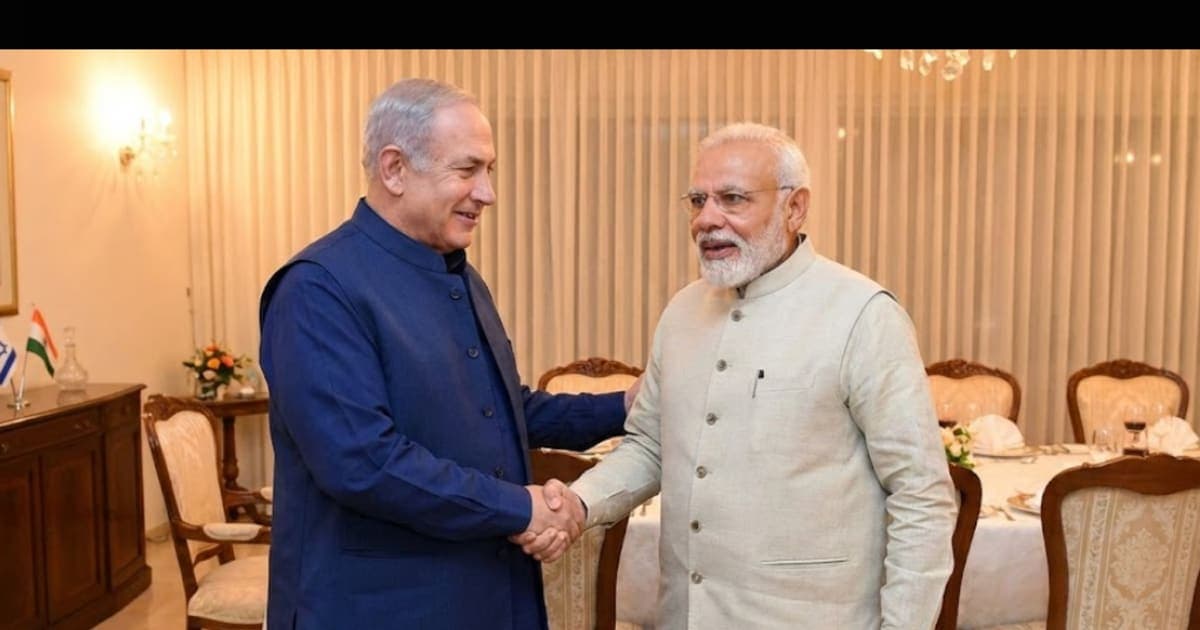
Netanyahu did not wear a suit.
He came out in a sharply tailored traditional Indian kurta-pyjama — deep blue, sleeveless Modi jacket over it — and greeted his guest at the door.
Sources present said Modi's reaction was genuine surprise followed by visible warmth. Netanyahu, by all accounts, was comfortable and relaxed in the attire, reportedly joking that he hoped he'd got the style right.
He had.
The photographs were released within minutes. The internet, predictably, lost its composure. The images trended across India and across every diaspora community with a WhatsApp group — which is to say, everywhere. "Kurta Diplomacy" was coined as a phrase before the main course had been served. "Bibi and Modi" trended on X for hours. The caption that appeared most frequently, in roughly forty variations, was some version of: this is what genuine respect looks like.
In the highly choreographed theater of international relations, where every handshake angle and every flag placement is deliberate, a moment that reads as unscripted — whether it actually is or not — carries disproportionate weight. Netanyahu wearing a kurta to greet Modi says something that no joint statement could. It says: I did this for you specifically. Not for the cameras, for you.
Whether that message was calculated or instinctive doesn't change how it landed.
What the Visit Is Actually About
The medal and the kurta captured the headlines. The actual work of the visit is harder to photograph but more consequential.
Over the past two days, delegations from both sides have been finalizing agreements that represent a structural shift in how the two countries approach defense cooperation. The previous framework — India as buyer, Israel as seller — is being replaced by something more substantive: joint co-development and co-production.
The focus areas tell you where both governments see the threat landscape pointing. AI-driven defense systems. Next-generation drone technology — an area where Israel's operational experience is unmatched. Semiconductor manufacturing cooperation, where Israel's innovation ecosystem and India's manufacturing scale are being treated as genuinely complementary rather than competitive.
The I2U2 framework — India, Israel, UAE, USA — has also been a substantive part of the discussions, deepening India's architecture in West Asian economic and security affairs beyond the bilateral relationship into something that involves two of the most significant regional powers in the Middle East.
This is not a symbolic visit. The symbolism is real and it matters — the Knesset medal, the dinner, the images that will be replayed every time someone writes about this relationship for the next decade — but the substance underneath the symbolism is what both governments came here to build.
Nine Years On
Modi's first visit to Israel in 2017 was, at the time, historic simply for happening. No Indian Prime Minister had ever made an official visit. The relationship existed but had been kept carefully in the margins of Indian foreign policy for decades.
That visit broke the pattern. This visit is the confirmation that what broke in 2017 stayed broken — that the hesitation is gone and what replaced it has roots.
The Knesset Medal is the institutional expression of that. A parliament saying: this partnership is permanent, not contingent.
The kurta at the dinner table is the human expression of it. A head of government saying, in the most direct non-verbal language available: I see you, I respect where you come from, and I wanted you to know that tonight before we sat down to talk.
Both things happened today. Both things were needed.
This article is a foreign policy and diplomatic analysis piece based on publicly available statements, official ceremony records, and reported details of PM Modi's February 2026 state visit to Israel.