Sonam Wangchuk Walks Free — and the Government's Retreat Tells You Everything
JODHPUR / LEH, March 14, 2026
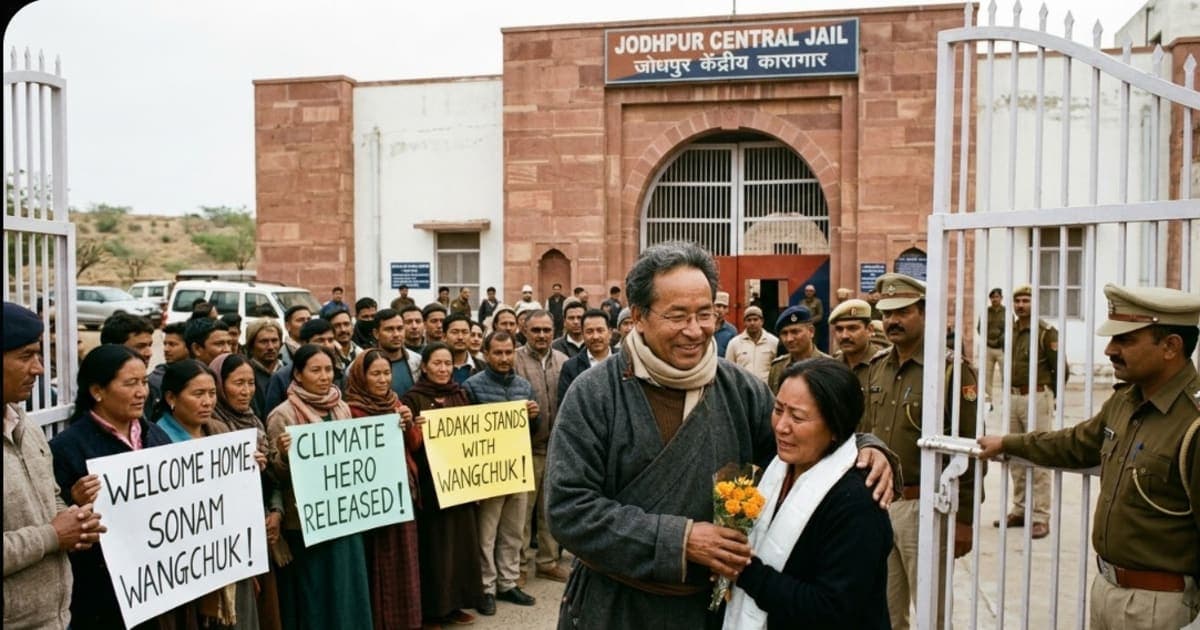
At approximately 1:30 PM today, Sonam Wangchuk walked out of Jodhpur Central Jail. He had been there for nearly six months, held under the National Security Act — a preventive detention law that allows the government to imprison someone without trial for up to twelve months.
He is 59 years old. He invented the Ice Stupa — artificial glaciers that store winter water for Himalayan communities through dry spring months. He won the Ramon Magsaysay Award, often described as Asia's Nobel Prize. He was detained 1,000 kilometres from Ladakh, in the desert heat of Rajasthan, accused of being the "chief provocateur" of unrest in his homeland.
Today, the Ministry of Home Affairs revoked that detention with "immediate effect." No trial. No conviction. No formal acknowledgment that the original detention was wrong. Just a notification that he was free to go.
The question Ashok Gehlot asked this afternoon is the right one: "If he was a threat to national security six months ago, how has he suddenly become safe today?"
How It Started — September 26, 2025
Wangchuk's arrest came two days after what has been called "Black Wednesday" in Leh — September 24, 2025, when a peaceful march for Ladakh's statehood turned into the worst civil violence the Union Territory had seen since it was carved out of Jammu and Kashmir in 2019.
Four civilians were killed in police firing. Over 160 people were injured, including 22 security personnel. The administration needed someone to hold responsible for the spiral from peaceful march to fatal confrontation, and Wangchuk — whose viral videos and speeches had been driving the statehood movement's momentum — was the most prominent figure available.
The specific accusations under the NSA: that his speeches had referenced the Arab Spring and the youth-led uprisings in Nepal and Bangladesh, allegedly inciting equivalent unrest in Ladakh. The NSA does not require charges to be proven in court. It requires an administrative determination that detention is necessary to prevent actions "prejudicial to public order or the maintenance of essential services." Under that standard, the government detained him and transferred him to Jodhpur — physically removing him from the region where his movement had its base.
The move was legally available to the government. It was also, in the view of the Supreme Court bench that was reviewing his case, built on grounds that required closer examination.
Why Today — The Two Factors
The timing of today's release is not coincidental and the government has not suggested otherwise. Two specific developments created the conditions for the Centre to order the release.
The Supreme Court. A bench of Justices Aravind Kumar and P.B. Varale had been reviewing Wangchuk's detention and had recently questioned what they described as "vague imputations" in the NSA order. The next hearing was scheduled for March 17 — three days from now. Legal observers familiar with the bench's line of questioning assessed that the government was facing a significant probability of a public judicial rebuke, potentially including observations about the misuse of preventive detention law for political purposes. Releasing him before March 17 removes the case from active consideration and avoids that outcome.
The Gitanjali Pledge. Wangchuk's wife, Dr. Gitanjali J. Angmo, had recently made a public statement committing the movement to "sincere dialogue" rather than street agitation as the path forward. This gave the Centre what diplomats call an "off-ramp" — a face-saving mechanism to release him without appearing to capitulate to street pressure. The government can frame the release as a response to the movement's commitment to dialogue rather than an admission that the detention was unjustified.
Both factors are real. The combination of judicial pressure and a movement leadership willing to provide a face-saving formulation is exactly the set of conditions that allows a government to execute a strategic retreat while maintaining the public position that it acted correctly throughout.
What Wangchuk Said at the Gates
He spoke briefly. He was visibly thinner than when he went in. He was not visibly broken.
"Prisons can hold a person, but they cannot hold an idea. The glaciers of Ladakh are melting faster than the government's heart, but today, I see a glimmer of hope. We do not want conflict; we want the promises made to the tribal people of the mountains to be kept."
The glaciers line is characteristic Wangchuk — he is a climate activist first, a political figure second, and he centres the ecological crisis of the Himalayas in almost every statement he makes. The glaciers of Ladakh are in documented retreat. The communities that depend on glacial meltwater for agriculture and drinking water are facing a real, measurable, accelerating crisis. That is the frame he returns to even in a statement about his own detention.
"The promises made to the tribal people of the mountains to be kept" is the political core. When Ladakh was bifurcated from J&K in August 2019, the BJP government made specific assurances to Ladakhi leaders — about protecting tribal land rights, about constitutional safeguards, about meaningful self-governance. Whether those assurances constituted legal commitments or political promises is disputed. What is not disputed is that they have not been delivered in full.
The Four Demands — Where They Stand
The Leh Apex Body and the Kargil Democratic Alliance — the two main civil society organisations representing Ladakh's two districts — have been unified in pushing four specific demands since 2020. Each of them is at a different stage of resolution.
Statehood for Ladakh. This is the central demand — converting Ladakh from a Union Territory without a legislature into a full-fledged state with an elected assembly. The Centre has rejected this. The official position is that Ladakh's strategic sensitivity as a border territory requires direct central administration. Critics note that Jammu and Kashmir — which shares the same strategic context — is on a path to statehood restoration, making the argument for permanent UT status for Ladakh increasingly difficult to sustain on principle.
Sixth Schedule protections. This is the most substantively significant demand from a rights perspective. The Sixth Schedule of the Constitution provides specific protections for tribal communities — autonomous district councils with legislative powers over land, forest, and cultural matters, protection against non-tribal land acquisition, safeguards for traditional community rights. Ladakh's tribal communities are seeking these protections specifically because they fear that without them, their land and resources are vulnerable to acquisition by outside interests — corporations, defence establishments, and migrants. The Centre has described this as "under discussion" without a resolution timeline.
Separate Lok Sabha seats for Leh and Kargil. Currently, Ladakh has one Lok Sabha constituency covering both Leh and Kargil districts — geographically vast, culturally and religiously distinct (Leh is predominantly Buddhist, Kargil is predominantly Shia Muslim), and with different political priorities. The demand is for dedicated representation for each district. This is pending delimitation and has no committed resolution date.
A dedicated Public Service Commission for Ladakh. Local employment in government services is currently routed through the JKPSC — the J&K Public Service Commission — which was a legacy arrangement from before bifurcation. A dedicated Ladakh PSC would give local graduates a pathway to government employment that reflects Ladakh's specific administrative context. The Centre has partially agreed on this demand, and some movement has been made, though a fully functional Ladakh PSC has not yet been established.
The NSA Question — Was It Legal? Was It Right?
These are two different questions and they have two different answers.
Was the detention legal? Under the NSA's text, yes. The statute gives the government broad administrative discretion to detain individuals deemed threats to public order. The Supreme Court has historically given governments significant deference in NSA matters, though it does review whether the grounds of detention are sufficiently specific and not "vague." The bench's concern about "vague imputations" suggests the legal case was weaker than a sound NSA detention should be, but the detention was not immediately struck down — it was under review.
Was it right? That is the question the opposition is asking and the government is not answering. Wangchuk is a Magsaysay Award winner whose work on Ice Stupas has been internationally recognised as a genuine innovation for climate adaptation in mountain communities. He was detained without trial, moved far from his home and support network, and held for six months on the basis of speeches that exercised — by any reasonable reading — the fundamental right to peaceful protest and political expression guaranteed by Article 19 of the Constitution.
The government's position — that the detention was necessary, and that the revocation now reflects "fostering peace and mutual trust" rather than an error — is the standard administrative formulation. It answers the legal question while declining to engage with the rights question.
The Supreme Court was three days from potentially providing its own answer to that question. The government blinked first.
What Happens in Leh in the Next 48 Hours
Wangchuk is expected back in Leh within two days. A large public reception is being organised. The movement's leadership — Sajjad Kargili of the KDA has already welcomed the release as "a victory for democracy" while noting the struggle for Sixth Schedule protections continues — will use the moment to reestablish momentum.
The Centre is reportedly preparing for a new round of talks through a High-Powered Committee on Ladakh's aspirations. The Gitanjali Pledge — the commitment to dialogue over street agitation — is the movement's side of that bargain. Whether the committee produces movement on the Sixth Schedule and the PSC, or becomes another forum for structured delay, is what Wangchuk and the Leh Apex Body will be watching.
The broader context matters too. The government is managing the Hormuz crisis, a falling Rupee, fuel surcharges, and election campaigns across multiple states simultaneously. Releasing Wangchuk closes one domestic pressure point at a moment when the government cannot afford to have Ladakh — a strategic border region with China on one side and the ongoing pressure of unresolved civil demands on the other — become additionally volatile.
That is a pragmatic reason to release him. It does not change the fact that he should not have been detained in the way he was.
The Idea That Prisons Cannot Hold
The Ice Stupa man is out of jail. The glaciers are still melting. The Sixth Schedule is still unresolved. The statehood demand is still rejected. The Ladakh PSC is still partially functional at best.
Wangchuk's release is a moment. The movement is a project. The government has closed one chapter by releasing him. It has not resolved anything that caused the chapter to open.
He told the media at the gates that the glaciers are melting faster than the government's heart. He has been saying that for years — from Phyang village, from TEDx stages, from climate conferences, and now from the gates of Jodhpur Central Jail.
The idea that prisons cannot hold — that one is true. What happens when he gets back to Leh and the dialogue table is set is the next chapter. Whether it produces a different outcome than every previous dialogue with Ladakh's civil society leadership is the question that matters more than today's release.
He is free. The work is not done.