Modi in Kolkata — ₹23,550 Crore, Street Violence, and the Battle for Bengal That Starts Today
KOLKATA / SILCHAR, March 14, 2026
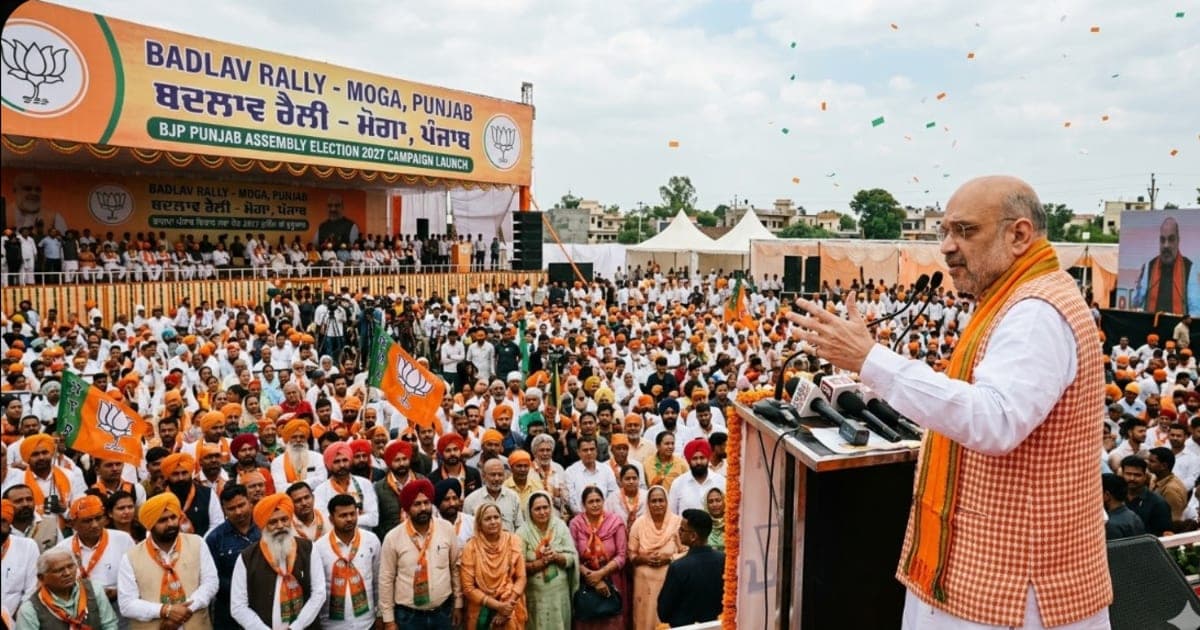
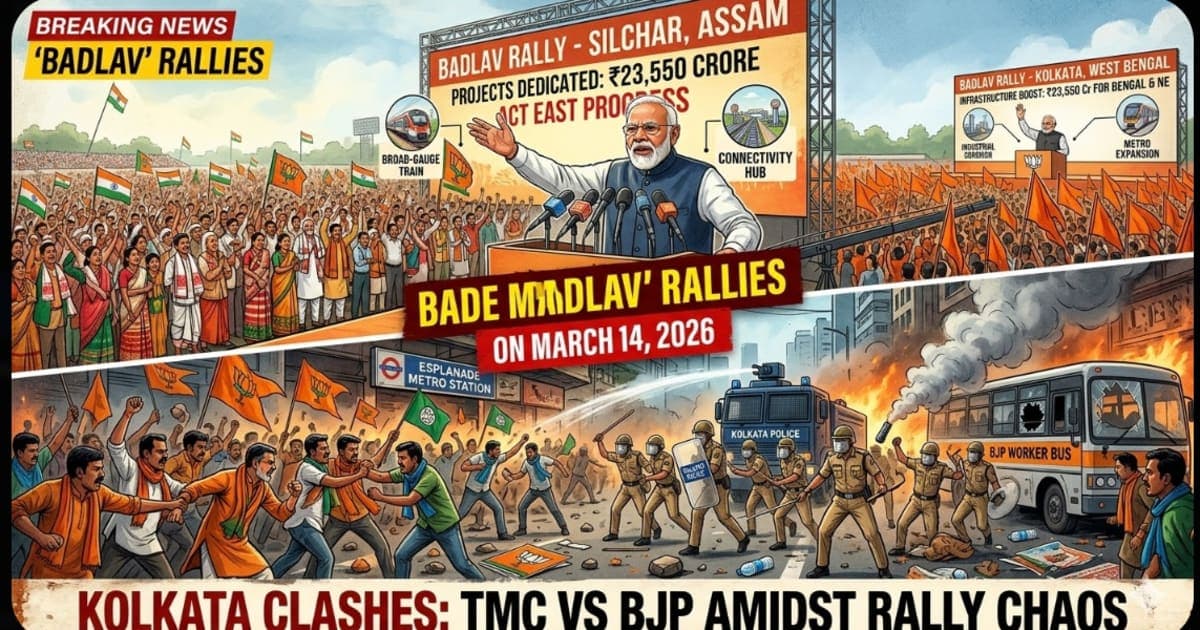
The Prime Minister landed at Brigade Parade Ground this afternoon to a sea of saffron and chants of "Modi, Modi." Three kilometres away, near Esplanade metro station, BJP supporters and TMC workers were throwing stones at each other. Fourteen people were injured, including six police officers. Tear gas and water cannons were deployed.
Welcome to West Bengal politics in 2026. The "Badlav" campaign has officially begun.
What Happened at Esplanade
Before the rally started, the street situation was already bad.
A bus carrying BJP supporters heading to Brigade Parade Ground was intercepted near Esplanade by TMC workers. Accounts of what triggered the initial confrontation differ between the two parties — they always do in Bengal. What is documented: stone-pelting broke out, it spread, and Kolkata Police had to use tear gas and water cannons to bring it under control.
Fourteen injured. Six of them police officers who had no stake in the political dispute and were trying to stop people from hurting each other.
The political responses came within minutes. BJP state president accused the TMC of a "state-sponsored conspiracy" to prevent BJP workers from reaching the venue, claiming the targeting of the bus was coordinated and deliberate. TMC's response was that BJP had brought in "outsiders" from other states to manufacture a confrontation on Kolkata's streets.
Both of these claims are standard operating procedure for West Bengal political violence communication. Both may contain partial truth. Neither is independently verified at the time of writing. What is verifiable is the injury count and the deployment of tear gas, which are not interpretive facts.
Twenty-five thousand paramilitary personnel were deployed across Kolkata today. That is the number required for a Prime Ministerial visit in a state where political violence is not a fringe phenomenon — it is a documented feature of every election cycle.
What Modi Said
The framing of the speech was "Vikas versus Vinash" — Development versus Destruction. This is the BJP's standard Bengal template, and it has been refined over multiple election cycles.
The specific attacks on the TMC were:
The "cut-money" culture — the widely documented practice in Bengal where local TMC workers allegedly take a percentage of government scheme payments as a condition of delivery. This has been reported, investigated, and is a genuine grievance among beneficiaries of central government schemes in the state. Modi referenced it directly: "The money meant for the poor is being siphoned off by 'Tolabaaz' (extortionists). We are sending crores for roads and schools, but the cut-money culture swallows it all."
MGNREGA fund stoppages — the Centre has repeatedly withheld MGNREGA wage payments to Bengal over compliance disputes, which the state government presents as the Centre weaponizing funds against a non-BJP government. The BJP presents it as accountability for fund misuse. This dispute has been running for years and has a direct impact on rural employment in the state.
The broader framing — "Bengal saw the darkness of the Left and the corruption of the TMC" — is positioning the BJP as the only untested option in a state that has cycled through two long governments without the BJP ever being the primary ruling party. Whether that framing translates into votes depends on factors no rally can determine.
The ₹23,550 Crore Package — What's Actually Being Built
The PM dedicated or laid foundation stones for four major project categories today.
₹12,000 crore: Industrial corridor connecting Haldia port to North Bengal. This is the most economically significant item on the list. Haldia is Bengal's primary port. North Bengal — the districts stretching toward Sikkim, Bhutan, and the Chicken's Neck corridor — is agriculturally productive but historically disconnected from the port economy. A logistics corridor linking them would allow tea, timber, and agricultural output from North Bengal to move to export markets more efficiently, and would bring industrial investment into a region that has seen relatively little.
₹4,500 crore: East-West Metro expansion. Kolkata's East-West Metro — connecting Howrah to Salt Lake via an underwater tunnel under the Hooghly River — has been one of the most delayed infrastructure projects in Indian history. New segments to ease the city's transit pressure are a genuine urban need that the political noise around today's rally cannot obscure.
₹3,200 crore: Haldia Refinery upgrade. Modernisation to produce BS-VI grade fuels. In the context of a global oil crisis where India's refining capacity is under pressure, a Haldia upgrade has both immediate operational relevance and longer-term strategic significance.
₹3,850 crore: Har Ghar Jal rural water missions. Clean drinking water access in Bengal's rural districts — particularly in areas where groundwater contamination is a documented public health issue — is a welfare commitment that is less politically flashy than the industrial corridor but more immediately relevant to the quality of daily life for the people it reaches.
The TMC's response to the project announcement was to publish a data sheet claiming that several of these projects were state-funded initiatives for which the Centre was taking credit. This claim requires project-by-project verification that is not possible to complete in the hours since the announcement. It is a standard political counter-move, and it may be partially accurate — the Centre and state have genuine disputes about funding attribution for Bengal infrastructure. What is clear is that ₹23,550 crore worth of project announcements in one day is designed to dominate the economic conversation in the state for the coming weeks regardless of attribution disputes.
Silchar: A Different Register
After Kolkata, the PM flew to Silchar in Assam's Cachar district. The tone was entirely different.
Silchar sits in the Barak Valley — Assam's southern Bengali-speaking region, which has historically felt marginalised relative to the Brahmaputra Valley that hosts Guwahati and the political mainstream of the state. BJP holds this region firmly, and the Silchar rally was about consolidation and delivering on connectivity promises rather than challenging an opponent's stronghold.
The projects dedicated here were the Broad-Gauge Conversion of remaining metre-gauge rail lines in the Barak Valley, and new highway stretches linking Assam with Manipur and Mizoram. These are not glamorous projects. They are the infrastructure that determines whether a region stays economically integrated with the rest of the country or slowly disconnects.
The PM's framing was geopolitical and forward-looking: "Silchar is not the end of India's map; it is the beginning of India's gateway to Southeast Asia." This is the Act East Policy translated into a constituency speech. Silchar's proximity to Myanmar and Southeast Asia through the Northeast corridor is real strategic geography. Whether the infrastructure investment follows the rhetoric at the speed the region needs is the question that residents of the Barak Valley have been asking for twenty years.
Mamata's Counter-Move
Mamata Banerjee did not cede the day's narrative to the PM. She held a "Jan Sangyog" rally in Howrah simultaneously, which was close enough to Kolkata to put both events on the same evening news cycle.
Her attack was direct: "He comes when there is an election, but where is he when Bengal suffers from floods or when the Centre stops our MGNREGA funds?"
The MGNREGA reference is the sharper of the two points. The Centre's withholding of MGNREGA wages to Bengal — framed by the Centre as compliance enforcement and by the state as political targeting — is a documented, ongoing dispute with real consequences for rural employment. It is not a hypothetical grievance. It has affected wage payments to millions of workers.
The "tourist excursion" framing of Modi's visit is dismissive and is meant to be. It is also strategically calibrated: Mamata is betting that Bengal voters will see through what she characterises as election-season project announcements from a Centre that she argues has consistently underfunded and obstructed the state in between election cycles. Whether that framing lands depends on whether voters connect the ₹23,550 crore announcements to actual changes in their lives.
What the "Badlav" Campaign Is Actually Attempting
The BJP's challenge in West Bengal is structural and has been for years.
The party has never governed the state. It came close in the 2021 Assembly elections — winning 77 seats against TMC's 213 in a 294-seat house — but close is not government. TMC's organisation at the booth level in rural Bengal, the personal loyalty to Mamata Banerjee among a significant portion of the electorate, and the documented history of political violence that disadvantages opposition mobilisation in TMC strongholds are real obstacles that a single rally cannot dissolve.
What "Badlav" is doing is establishing a narrative architecture for the election campaign. The infrastructure projects create a concrete, visible answer to "what would be different under BJP?" The direct attacks on TMC's cut-money culture are designed to activate the grievances of people who have experienced government scheme delivery filtered through local party workers. The violence at Esplanade — regardless of who initiated it — becomes campaign material for BJP's argument that TMC runs a state on coercion.
TMC's counter-narrative is equally coherent: the Centre withholds funds, takes credit for state projects, deploys central agencies against Bengal politicians, and only shows up with announcement money when votes are needed. Mamata Banerjee has won on that narrative twice.
The election is not today. What happened today is both sides staking out the ground they intend to fight on.
The Context That Nobody Is Ignoring
The "Badlav" rallies happen to be taking place on a day when the Rupee is at 92.3, oil is above $100, and IndiGo just introduced fuel surcharges. The PM's focus on ₹23,550 crore in infrastructure investment is, in part, a messaging exercise in projecting economic confidence and long-term commitment during a period of significant short-term economic pain.
Whether that message lands — "the government is building for the future even while managing a crisis" — or whether it gets overwhelmed by the more immediate economic anxiety of rising prices and a falling currency, is a question that the next few weeks of economic data will answer more than any political rally can.
The battle for Bengal is starting. The battle over India's economic management of the Hormuz crisis is ongoing. Both of them are happening at the same time, on the same day, in the same news cycle.
That is the political and economic reality of March 14, 2026.