Amit Shah in Moga — The 2027 Punjab Election Campaign Just Started
MOGA, PUNJAB, March 14, 2026
The 2027 Punjab Assembly Election is thirteen months away. Amit Shah just made sure everyone in the state knows the BJP is coming for it.
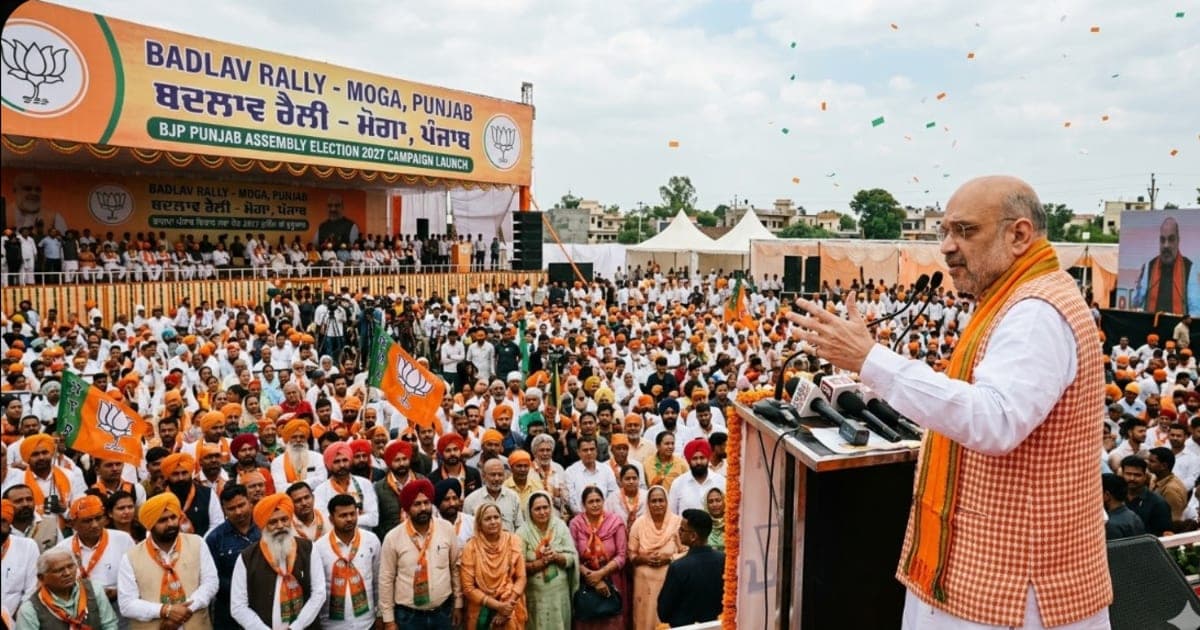
The Home Minister addressed a "Badlav" rally in Moga today — a deliberate choice of venue in the heart of the Malwa region, the agrarian belt that decides Punjab elections more than any other part of the state. If you want to signal that the BJP is no longer a party that wins a handful of urban Hindu seats in Amritsar and calls it a Punjab campaign, you hold your opening rally in Moga in front of farmers. That is what Shah did today.
Why Moga, Why Now
Context first.
BJP won 2 seats in the 2022 Punjab Assembly Elections. AAP won 92. The party fought that election in the aftermath of a bitter split with the Shiromani Akali Dal — its long-term alliance partner — over the farm laws, and went into polling with negligible rural Sikh support, no significant coalition partner, and a candidate base that was not prepared for a solo fight.
Three years later, the BJP has been systematically building an independent cadre in Punjab. It has absorbed former Congress and SAD leaders at both the district and state level. It has reorganised its booth-level structure. And it has made a strategic decision that the 2027 election will be fought as a direct three-way contest — AAP, Congress, and BJP — without looking for an alliance to supplement its own weaknesses.
Today's Moga rally is the public declaration of that intent.
Moga is not a BJP stronghold. It sits in the Malwa belt — rural, Sikh-majority, farmer-community heavy, historically suspicious of Delhi's political priorities. Packing a rally ground in Moga sends a specific message: the party that rural Punjab associated with the farm laws and the Red Fort violence of 2021 is asking for a second hearing. Whether it gets one is the central question of the next thirteen months.
The Three Arguments Shah Made
The speech had a structure. It was not a single rhetorical stream. Shah made three distinct arguments, each aimed at a different voter category.
On security. Punjab shares an international border with Pakistan. Cross-border drone activity — carrying narcotics, weapons, and counterfeit currency — has been a documented and increasing problem throughout the AAP government's tenure. Shah's argument: this requires a state government that works in coordination with the Centre's security apparatus rather than against it. The BSF's expanded jurisdiction along the Punjab border — a decision that triggered significant controversy when announced, with the state government filing legal objections — was referenced as a Centre initiative that a BJP state government would support rather than resist.
"Punjab is the sword-arm of India. But today, that arm is being weakened by those who prioritise populism over protection."
This is aimed at a specific voter: the Jat Sikh farmer who takes genuine pride in Punjab's martial tradition and security role and is genuinely concerned about the drone and drug corridor from Pakistan. It is not aimed at the AAP voter who sees BSF jurisdiction expansion as an encroachment on state rights.
On agriculture. This is the hardest sell for the BJP in Punjab, and Shah knew it. He did not try to re-litigate the farm laws — he did not mention them. Instead he moved forward: a technology-first diversification package to move Punjab away from the water-intensive paddy-wheat cycle that has been depleting the state's groundwater for decades. A "Global Food Processing Hub" in the Malwa belt. Direct benefit transfer to farmers without middlemen. An Agri-Tech push.
The substance of the agricultural argument is not wrong. Punjab's paddy-wheat monoculture is a genuine long-term crisis — the water table in many districts has fallen to alarming levels, and the crop residue burning that follows every paddy harvest is an environmental and public health disaster. A BJP government in Delhi has been trying to push diversification without adequate compensation for the income difference between paddy and alternatives. Whether farmers trust the BJP to deliver differently than it has in the past is a separate question from whether the policy diagnosis is correct.
The PM-Kisan figures Shah cited are real. DBT has genuinely reached farmers' accounts. The question Punjab farmers will ask is whether that is enough — and whether the party that tried to push three farm laws through Parliament without adequate consultation has earned the right to design their agricultural future.
On drugs. This was the most emotionally charged segment of the speech and it was deliberately so. Punjab's drug problem — particularly synthetic opioids and injectable drugs — has destroyed families across the state regardless of religion, class, or party affiliation. It is a genuine crisis that every Punjab government since the 2000s has promised to address and none has solved.
Shah's promise: a specialised NCB regional task force headquartered in Amritsar with district-level presence across the state. A "surgical strike" on drug cartels. A BJP government that would go after supply chains rather than just street-level users.
This pitch is aimed directly at mothers and older family members who have watched the drug crisis consume young men in their communities. It is also aimed at the youth themselves — Shah made a visible effort to connect with the large proportion of young attendees at the rally.
The credibility problem: the BJP has governed at the Centre throughout the period of Punjab's worst drug crisis. Cross-border narcotics trafficking is a Central intelligence and border management issue as much as a state policing issue. The argument that a BJP state government would do what the BJP Centre has not managed to do requires voters to accept a separation of accountability that will be tested in debate.
What "Solo Run" Actually Means
The rhetoric at the rally made one thing unambiguous: the BJP is not currently seeking an alliance with SAD, Congress, or any regional player for 2027.
This is a significant strategic bet. In every Punjab election since 2002, the BJP fought as part of a coalition — primarily with SAD — that gave it access to Sikh rural voters it could not reach independently. The farm law split ended that arrangement. The BJP has spent three years deciding whether to rebuild the SAD alliance or to build its own rural base from scratch.
Moga is the answer: they are building from scratch.
The stage today featured former Congress workers, former SAD district leaders, and several recently-joined local heavyweights. This is the "big tent" approach — absorbing political talent from across the spectrum rather than cultivating a narrow ideological base. It works in the long run if the party can hold these converts together and if they bring their voter networks with them. It is vulnerable to the perception that BJP is a coalition of defectors rather than a genuine political movement in Punjab.
The AAP government will frame it exactly that way. So will Congress.
The AAP Counter-Protests in Ludhiana
While Shah was in Moga, AAP and Congress held counter-protests in nearby Ludhiana, focusing on the rising cost of living — fuel surcharges, the Rupee at 92.3, global oil above $100.
The timing was deliberate. The message: the BJP's "Badlav" campaign is happening while the Centre's economic management — or the consequences of global events on a government that imports 85% of its oil — is making daily life more expensive for ordinary Punjabis.
Shah addressed this indirectly: "Global headwinds require strong-willed leadership that doesn't just offer freebies but builds long-term economic resilience."
This is the BJP's standard counter to the AAP's welfare scheme politics — "freebies" is a word the BJP has used consistently to describe AAP's free electricity, water, and public transport policies. AAP's counter is that these welfare measures have measurably improved quality of life for urban and semi-urban households. The debate is real and it will run through every constituency conversation until polling day.
The economic context of March 2026 — oil crisis, currency pressure, fuel surcharges — does create a genuine political liability for the Centre that the state-level opposition will not let go. Whether voters attribute the Rupee's fall and ATF surcharges to the BJP government or to an external war is partly a function of which narrative they encounter more frequently.
The Three-Way Fight — Positions as of Today
AAP enters the campaign defending a first-term record. The "Punjab Model" — borrowed from the Delhi governance blueprint — has had three years to show results. On electricity: free units have been delivered. On schools: some visible improvements. On drugs: the problem is not solved. On investment and employment: Punjab's economic performance under AAP has not been transformational. Incumbency is both AAP's asset and its liability. Bhagwant Mann is a likeable chief minister with genuine mass appeal, but governing a complex state with a difficult fiscal position is harder than the opposition campaign that brought AAP to power.
SAD is attempting to rebuild on Panthic identity and regional issues after the catastrophic 2022 result where it won just three seats. The Badal family's political brand has been severely damaged. Whether SAD can reconstitute itself as a credible Panthic voice when the BJP is now directly competing for rural Sikh votes is the central question of SAD's 2027 survival.
BJP starts from two seats and needs to multiply that by a factor of fifteen to twenty to be competitive for government. The arithmetic is daunting. The infrastructure is being built. The intent is clear. Moga is the starting gun.
What Happens Next
Shah's Moga appearance will be followed by a BJP organisational calendar in Punjab that runs from now through polling day in early 2027. Expect district-level rallies across Malwa, then the Doaba, then the Majha region. Expect more former Congress and SAD leaders to formally join the party in staged events. Expect the central government to announce Punjab-specific projects and schemes at regular intervals.
The AAP government will respond with its own development announcements and will attempt to frame every BJP project announcement as election-season credit-claiming for schemes that were either state-funded or already in the pipeline.
The Congress will try to find a lane between AAP and BJP, appealing to voters who want neither the incumbents nor the party they previously voted out.
Punjab 2027 is thirteen months away. It started today in Moga.
The road from here to Chandigarh is long and every kilometre of it is going to be contested.