Modi's 30 Million: The Number That Tells You Something About Power in 2026
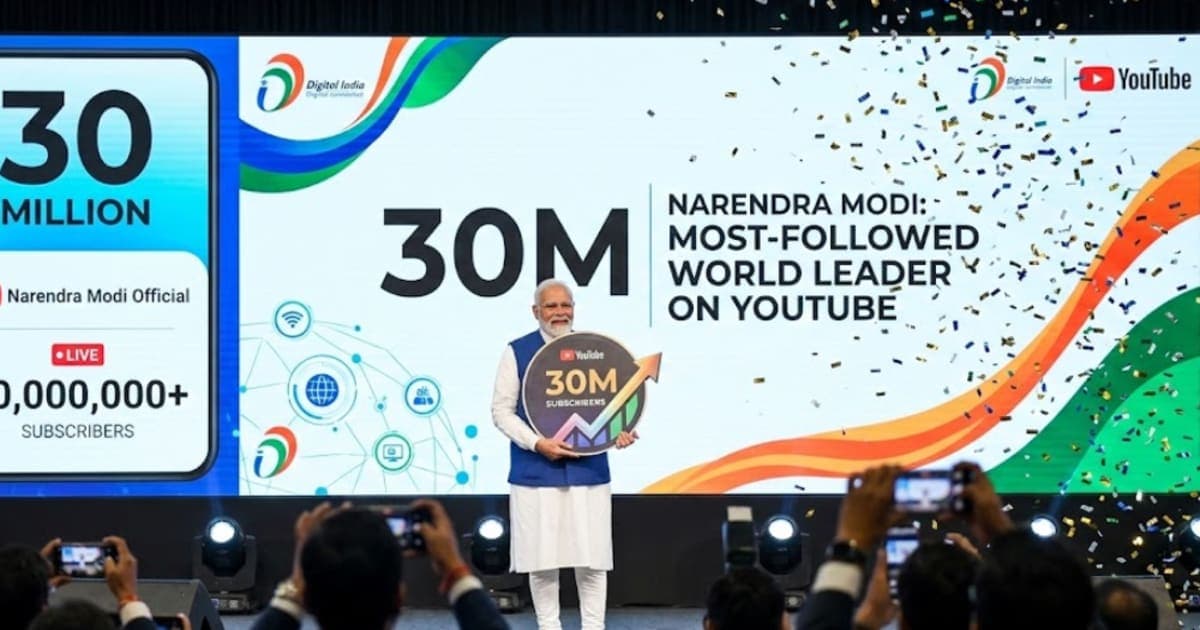
Seven times. That is how many more YouTube subscribers Narendra Modi has than Donald Trump.
Not seven percent more. Seven times. On a platform where Trump built his political revival, where he commands genuine mass attention, Modi's 30 million subscribers make the American president look like a regional creator who hasn't quite broken through yet.
That happened quietly on Tuesday morning, while most of the world's news editors were watching the Gulf.
Nobody Else Is Close
Jair Bolsonaro — who ran one of the most aggressive social media operations in Latin American political history, who arguably pioneered the WhatsApp-to-YouTube pipeline for conservative populism in the developing world — sits at roughly 7 million. He is also no longer in power.
Zelenskyy spent three years as the most globally covered politician alive. Parliamentary addresses, late-night show appearances, the full force of Western media sympathy behind him. His YouTube numbers are not in the same conversation.
This is not a story about Modi being good at social media. It's a story about everyone else being somewhere else entirely while he was building something they didn't take seriously until it was too late to catch up.
What 30 Million Looks Like Inside India
Rahul Gandhi has invested seriously in his digital presence — more seriously than his party would have thought necessary five years ago. He is at 10.2 million. The AAP is at 7.1 million. The Congress party's official channel: 6.8 million.
Modi's individual channel beats the combined institutional presence of the principal opposition.
In an election cycle, that gap is not abstract. It is the difference between needing media intermediaries and not needing them. Between hoping a journalist frames your message fairly and not needing a journalist at all.
February Was Already a Big Month
Before the YouTube number, there was Instagram.
Last month, Modi crossed 100 million followers — first politician anywhere on earth to do it. His feed is a studied mix: high-stakes diplomatic photographs from foreign visits, then a video of him doing yoga at dawn, then photographs from the Ram Mandir ceremony, then something that looks almost like a travel vlog from Lakshadweep. The combination shouldn't work as well as it does. It works extremely well.
On X he has 106 million followers. Still the most-followed active politician on the platform.
Three platforms. Three nine-figure or near-nine-figure numbers. The closest comparable case in global politics doesn't really exist.
The Mechanics of It
Mann Ki Baat is probably the least flashy and most important piece of the operation.
A monthly address, live-streamed and archived. It has run for years. The format creates habit — people know when it is coming, they return for it, and the absence of an interviewer gives it the texture of something unfiltered even when it isn't. That sense of directness is hard to manufacture and harder to sustain. His team has sustained it.
The Shorts strategy is less discussed but probably reaches more people. Thirty-second vertical clips cut from speeches and official appearances, designed for a mobile-first audience that will not watch a forty-minute address but will watch the forty seconds that mattered. India's under-30 electorate lives on that format. Meeting them there rather than expecting them to seek out the full version is a choice that most government communications operations still haven't made.
Behind-the-scenes PMO content does something different again. It makes the machinery of government feel accessible — not the polished press conference version of governance, but something that looks like a person doing a job. Whether or not that impression reflects the reality is a separate question. The impression lands.
What the Number Is Actually For
There is a version of this story where 30 million YouTube subscribers is a vanity metric — something to put in a press release, a point of national pride, ultimately not that consequential.
That reading misses the structural point.
A direct channel into 30 million households that requires no newspaper editor, no television anchor, no algorithm intervention beyond the one his own team manages — that is a communications infrastructure. When a crisis breaks, the channel is already there. Already trusted. Already habitual. The relationship was built in ordinary time, which means it is available in extraordinary time.
Previous generations of political leaders had to negotiate with media gatekeepers for access to that kind of reach. They had to hope the coverage was fair, or manage the coverage if it wasn't, or work around it through advertising. This is a different arrangement entirely.
Whether you find that reassuring or concerning probably depends on how much you trust the person holding the channel.
Subscriber figures reflect data available at time of publication.