Political speeches at summits have a particular grammar. There's the historical context section, the data section, the vision section, and the closing call to action that lands to applause and is largely forgotten by the following week.
Modi's keynote at the News18 Rising Bharat Summit on February 27 followed that structure. But buried inside it were five things worth paying attention to — not as political messaging, but as a statement of where the government actually intends to go in the next decade.
Here's what he said, stripped of the occasion, and what it means.
1. The "Fragile Five" Comparison
Wasn't Just Nostalgia
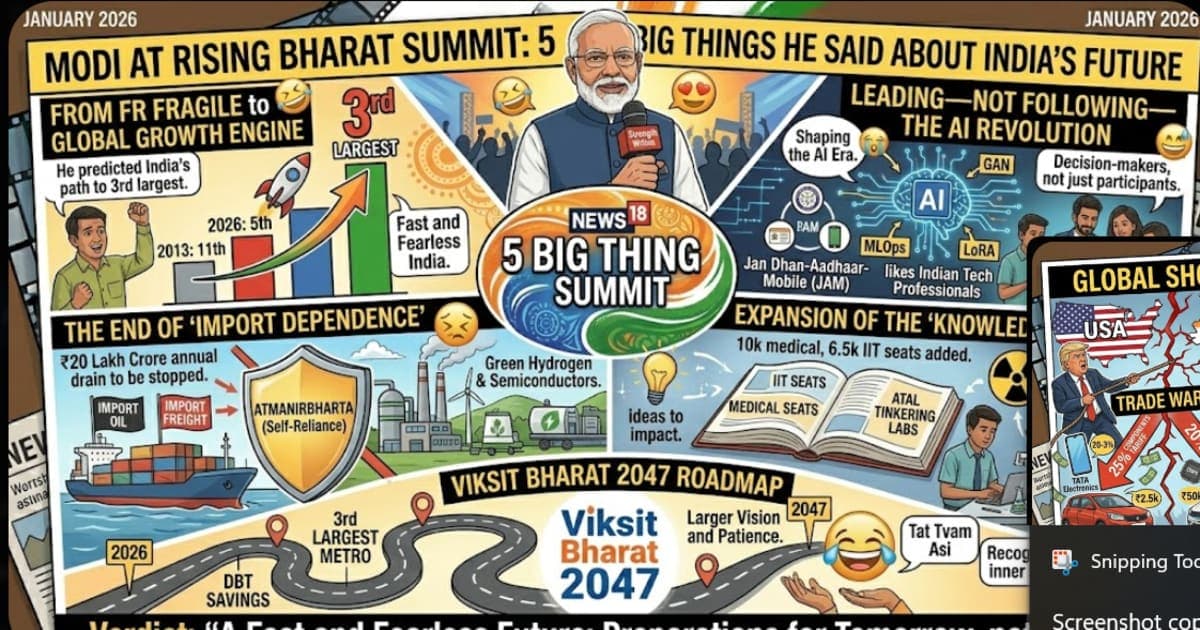
Modi opened with 2013 — a year that his government returns to regularly, and for understandable reasons. In 2013, India was on a shortlist nobody wanted to be on: the "Fragile Five," a Morgan Stanley designation for emerging market economies most vulnerable to capital flight and currency collapse. India was in that list alongside Brazil, Indonesia, South Africa, and Turkey.
The contrast he drew was stark and it's largely accurate: India has moved from the 11th to the 5th largest economy in a decade, doubled its GDP in nominal terms, and is now the country that other nations are lining up to sign trade agreements with rather than the one nervously monitoring its current account deficit.
The forward claim — third largest economy within this term — is the part that gets contested. Japan and Germany are ahead of India in fourth and third place. Both are stagnating. India is growing at roughly 6.5–7% annually. The arithmetic is not unrealistic. Whether the policy environment sustains it is a different and more complex question.
What the comparison actually signals is a government telling the business community: the uncertainty of that era is structurally resolved. Come build here.
2. "We Are the Decision-Makers"
on AI — What That Actually Means
This was the section of the speech that the technology community will parse most carefully.
The claim that India is a "shaper" of the AI era rather than a follower is ambitious — but there's a specific argument underneath it that is worth taking seriously.
India's Digital Public Infrastructure — the JAM trinity of Jan Dhan bank accounts, Aadhaar biometric identity, and mobile penetration — is genuinely unique at the scale it operates. Over a billion people with verified digital identities linked to financial accounts is a dataset and an infrastructure layer that no other country has built at comparable speed.
For AI development, this matters in a specific way. The bottleneck for training useful AI is not compute alone — it's structured, representative data at population scale. India has built the infrastructure for exactly that.
The data center and power infrastructure buildout he referenced is real — several large-scale AI compute investments have been announced in the last eighteen months, including commitments from global cloud providers that India is their next major investment geography.
"Decision-maker" is a strong claim. "Significant participant with structural advantages nobody else has" is the more accurate version. But in political speech, that's what it means.
3. ₹20 Lakh Crore
— The Number That Should
Make You Uncomfortable
This was the most substantively interesting part of the speech and the least dramatic.
Modi revealed that India currently spends over ₹20 lakh crore annually on three import categories: petroleum at ₹11 lakh crore, fertilizers at ₹2.25 lakh crore, and foreign shipping freight at ₹6 lakh crore.
Put that in context. India's entire central government expenditure in the 2026 budget is approximately ₹50 lakh crore. These three import bills alone represent 40% of that number — money leaving the economy every year, denominated in foreign currency, structurally dependent on prices set elsewhere.
The point he was making is not new — import dependence as a strategic vulnerability has been government policy thinking for a decade. But presenting it as a specific number rather than a general principle is different. It's harder to dismiss.
The response he outlined: National Critical Mineral Mission for battery and semiconductor inputs, green hydrogen as a petroleum substitute, ethanol blending to reduce the fuel import bill, and a domestic semiconductor fabrication ecosystem.
These are all long-cycle investments. None of them resolve the ₹20 lakh crore problem in this decade. The honest version of the claim is that this government is planting trees whose shade it will not sit under — which, if true, is actually the more impressive commitment.
4. The Education Numbers
Are Larger Than They Sound
Modi announced specific additions to India's educational infrastructure: 10,000 new medical seats, 6,500 new IIT seats, 50,000 Atal Tinkering Labs in schools, and 10,000 new PM Research Fellowships.
Each of these individually sounds like a policy announcement. Together they describe something more specific — an attempt to solve the bottleneck problem that has limited India's innovation output despite its talent density.
India produces more engineering graduates than almost any country. It has historically not produced proportionate innovation output — not enough patents, not enough deep-tech startups, not enough laboratory-to-market translation. The Tinkering Labs and Research Fellowships are targeting that specific gap — the distance between a young person with a good idea and an institution that helps them do something with it.
The nuclear sector opening to private players is the most significant structural announcement in this section, and it got less attention than it deserved. The space sector's private opening produced ISRO-adjacent startups, commercial launch capabilities, and a new category of Indian deep-tech company within five years. If the nuclear sector follows a similar pattern, it creates an entirely new industrial segment in a country that currently imports most of its energy.
5. Viksit Bharat 2047
Is Not a Slogan Anymore
This is where the speech gets philosophical — and also where it makes its most politically vulnerable claim.
Modi addressed critics of the 2047 target directly. The charge is that "Developed India by 2047" is a horizon so distant that it functions as political cover — a goal that sounds inspiring without requiring accountability in any electoral cycle that currently exists.
His response was essentially: short-term political thinking is the problem, not the solution. That the decisions being made now — the DBT system that has saved ₹24 trillion from leakages since inception, the metro network that is now the third largest in the world, the digital infrastructure — are the foundation for 2047, not the destination.
The Tat Tvam Asi reference at the close — a Vedantic principle roughly translating to "the potential you seek is already within you" — was the rhetorical frame for a specific policy argument: that India's constraints are not external, they are choices, and different choices produce different outcomes.
Whether you find that inspiring or deflecting probably depends on which side of the political conversation you were already on.
What's harder to dismiss is the specific, measurable claims he backed it with. The data on import bills. The specific seat numbers. The infrastructure metrics. These are the kinds of commitments that create a record to be held against.
The Five Points, Summarised
| Theme | What He Said | What It Actually Means |
|---|---|---|
| Economy | 5th largest, heading to 3rd | Japan and Germany are stagnating; the arithmetic is realistic |
| AI | India is shaping, not following | DPI gives India structural data advantages others don't have |
| Imports | ₹20 lakh crore leaving annually | Long-term bets on green hydrogen, semiconductors, minerals |
| Education | 10k medical + 6.5k IIT seats, 50k labs | Targeting the lab-to-market gap, not just graduate numbers |
| 2047 | Viksit Bharat is a data-backed roadmap | Long-cycle investments whose results outlast any single term |
The Summit speech was not a budget announcement or a policy gazette. It was a statement of direction — where this government believes India is going and why.
The five things worth taking seriously from it are not the ones that generated the most applause. They're the ₹20 lakh crore import number, the nuclear sector opening, the DPI-as-AI-infrastructure argument, the specific education commitments, and the willingness to defend a 2047 horizon against short-termism explicitly.
Whether the execution matches the ambition is a question that 2047 will answer. Several smaller questions will be answered considerably sooner.
This article is based on Prime Minister Modi's keynote address at the News18 Rising Bharat Summit on February 27, 2026. Quotes and figures cited are sourced from the official address as reported. Economic projections and policy analysis represent editorial assessment and not official government positions.