Mark Carney Is in New Delhi — and the India-Canada Relationship Is Finally Acting Like Adults
NEW DELHI, March 16, 2026
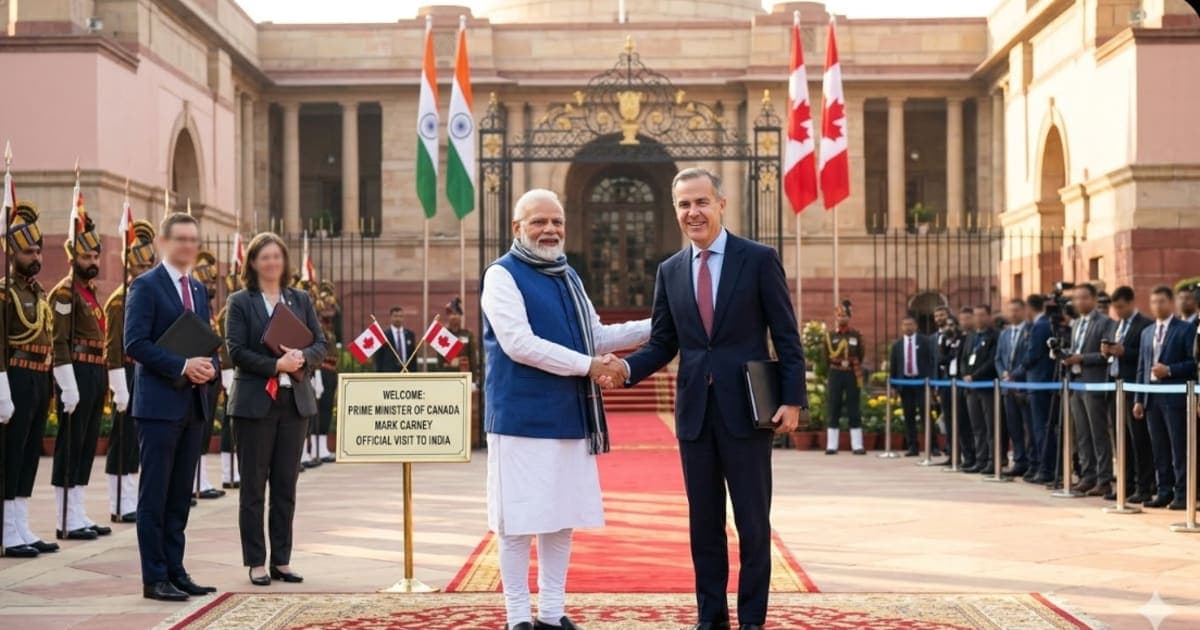
Mark Carney arrived at Hyderabad House this afternoon. The last time an Indian Prime Minister sat across from a Canadian counterpart for a substantive bilateral conversation, the topic was a murder in Surrey. Today's agenda is critical minerals, pension fund investments, and a CEPA that has been stalled for the better part of four years.
The distance between those two conversations is the story of how quickly geopolitics can reorganise relationships that ideology had frozen.
From Frozen to Functional — How It Happened
The India-Canada relationship hit its lowest point in late 2023, when then-PM Justin Trudeau publicly alleged Indian government involvement in the killing of Khalistan separatist Hardeep Singh Nijjar in British Columbia. India expelled Canadian diplomats. Canada recalled its High Commissioner. The bilateral relationship effectively ceased to function at the governmental level for the better part of eighteen months.
Mark Carney became Liberal Party leader and Prime Minister in March 2025 — and from his first week in office, signalled a different approach. The Nijjar case did not disappear from Canadian legal proceedings, but Carney made clear he was not going to allow a single unresolved security case to define the entire bilateral relationship between two G20 economies with deep trade, investment, and diaspora connections.
By mid-2025, back-channel diplomatic contact had resumed. By late 2025, trade officials from both sides were quietly meeting on the margins of multilateral forums. By January 2026, the CEPA technical teams had restarted formal negotiations.
Today's Hyderabad House summit is the public culmination of that quiet reconstruction.
What Carney Is Actually Here For
The two-day Mumbai stop before New Delhi was deliberate and revealing. Carney met with Tata Sons leadership, Reliance Industries executives, HDFC Bank's board, and the CEO of Adani Ports. He attended a business roundtable organised by CII with over 80 Indian corporate representatives.
This is not the itinerary of a Prime Minister on a diplomatic courtesy call. It is the itinerary of a Prime Minister who came to do business and used the business meetings to establish credibility before the political meetings.
The New Delhi agenda has three substantive pillars:
Critical Minerals. Canada holds some of the world's largest reserves of lithium, cobalt, nickel, and rare earth elements — the materials that electric vehicle batteries, defence electronics, and clean energy infrastructure require. India's domestic critical mineral reserves are limited, and its current supply chain for these materials runs uncomfortably through China. A bilateral critical minerals framework — covering extraction investment, processing partnerships, and supply chain commitments — is the headline deliverable both sides want to announce.
Pension Fund Investment. Canada's pension funds — CPPIB, OMERS, Ontario Teachers', CDPQ — collectively manage over CAD $2 trillion in assets and have been among the largest foreign investors in Indian infrastructure over the past decade. Regulatory friction in the approval process for Canadian pension fund investments in Indian infrastructure projects has been a recurring complaint. A bilateral investment facilitation framework that streamlines approvals is on the table.
CEPA Progress. The Comprehensive Economic Partnership Agreement has been in negotiation since 2010 with multiple false starts. The current round of talks, restarted in 2022, stalled when the diplomatic relationship collapsed in 2023. With both sides now motivated — Canada desperately needs trade diversification away from its 75% US dependence following the Trump tariff shock, and India wants preferential access to Canadian markets and resources — the political will for a framework agreement announcement exists in a way it has not before.
The Punjab Signal
Carney did not visit Punjab. This will be read in some quarters as a snub to the large Sikh-Canadian diaspora. It should be read as something more deliberate: a signal to New Delhi that he is not here to engage with the political symbolism that defined the Trudeau era's India relationship.
Trudeau's India policy was shaped, in part, by electoral calculations involving Sikh-Canadian voters in ridings like Brampton and Surrey. Carney's decision to bypass the traditional Punjab visit — physically removing the optics of symbolic solidarity with diaspora politics — is a direct message to Modi: this visit is about state-to-state interests, not Canadian domestic politics.
For India, that signal matters as much as anything on the formal agenda. The Trudeau years created genuine Indian suspicion that Canadian federal politicians would never separate their diaspora electoral calculations from bilateral policy. Carney is demonstrating, through the itinerary itself, that he will.
What Both Sides Need From This
Canada's situation is genuinely urgent. The Trump administration's tariffs have exposed the structural fragility of a trading relationship where 75% of exports go to a single market that has demonstrated its willingness to use trade as a political weapon. CEPA with India is not just economically attractive — it is strategically necessary for Ottawa to demonstrate to its own business community that Canadian trade diversification is real and executable.
India's calculus is less urgent but equally clear. Access to Canadian critical minerals on preferential terms, a streamlined pathway for Canada's enormous pension funds to continue infrastructure investment, and normalisation of a bilateral relationship that was embarrassingly dysfunctional — all of these serve Indian interests without requiring India to make any concessions that compromise its strategic autonomy.
The relationship reset that began when Carney took office in March 2025 has, twelve months later, arrived at Hyderabad House.
The agenda is minerals, money, and a trade deal. The subtext is two countries that need each other more than the last four years suggested — and a Canadian Prime Minister disciplined enough to leave the symbolism at the door.