The Rupee at 92.3 — What the Number Actually Means for How You Live
MUMBAI / NEW DELHI, March 14, 2026
Two ships made it through the Hormuz this morning. That was the good news. Here is everything else.
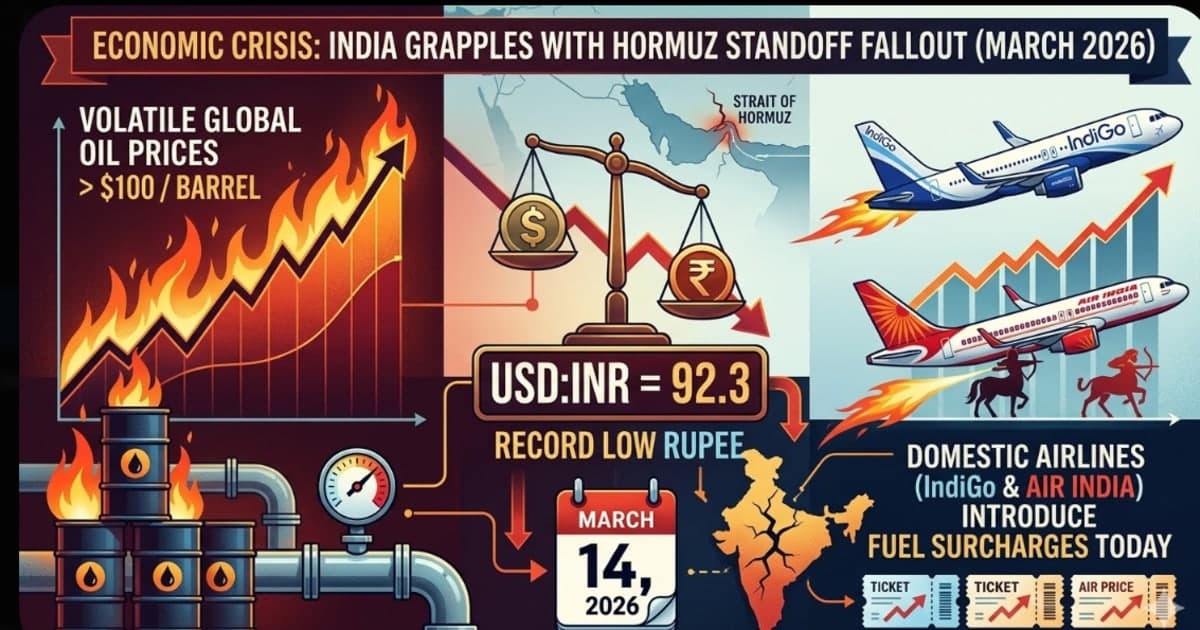
The Indian Rupee hit 92.3 against the U.S. Dollar today. That is a record low. It is not a rounding error or a momentary dip that the Reserve Bank will smooth over by Monday. It is the currency market's verdict on what a 12% devaluation since February 28 looks like when oil is above $100, foreign investors are pulling money out of emerging markets, and the trade deficit is widening faster than any policy response can address.
If you are trying to understand why your flight just got more expensive, why onions cost 12% more than they did 48 hours ago, and why the government called an emergency meeting on a Saturday afternoon — this is the explanation.
Oil at $100+ — What It Costs India Specifically
India imports over 85% of its crude oil. That is not a vulnerability that can be fixed in weeks or months — it is the structural reality of a 1.4 billion person economy that runs on imported energy.
The arithmetic is straightforward and brutal: every $1 increase in the price of a barrel of crude adds approximately $1.1 billion to India's annual import bill. Oil has gone from $71 per barrel to oscillating between $102 and $108 in less than three weeks. That is a $31 to $37 per barrel increase. Run the numbers: between $34 billion and $41 billion in additional annual import costs, if prices stay at current levels.
They may not stay at current levels. The direction of movement — absent a resolution in the Hormuz standoff — is upward rather than down. Iranian threats against Saudi and UAE energy infrastructure remain live. Any strike on Aramco facilities that succeeds would remove additional supply from global markets and push crude past $120 immediately.
The energy analyst framing this accurately is not predicting catastrophe. She is pointing at insurance costs. Even if the Strait of Hormuz reopens tomorrow — which it won't, but hypothetically — the war-risk insurance premium that shipping companies now pay to transit the Gulf has been permanently recalibrated upward. Markets do not forget that the strait was closed and ships were attacked. That risk is now priced into every future voyage for years. Triple-digit oil is not just a war phenomenon. It may be the new baseline for the Gulf premium.
Why the Rupee Is Falling — The Three Mechanisms
The Rupee at 92.3 is not one thing happening. It is three things happening simultaneously.
Foreign Portfolio Investors are leaving. When geopolitical risk spikes globally, institutional investors move money from emerging market assets — Indian equities, Indian bonds — into U.S. Dollar assets and gold. This is not a judgment on India specifically. It is a mechanical flight to safety that happens every time a major crisis raises global uncertainty. The sell pressure on Indian assets creates sell pressure on the Rupee, because selling Indian assets means exchanging Rupees for Dollars.
The trade deficit is widening fast. India was already running a trade deficit — importing more than it exports — before the crisis. Oil is India's largest import. At $105 per barrel versus $71, every tanker that arrives in Mundra or Kandla represents a larger outflow of foreign exchange. More Dollars leaving India to pay for oil means more downward pressure on the Rupee.
Inflation expectations are feeding on themselves. When the market expects fuel prices to rise — and they will — it expects consumer price inflation to follow. Higher inflation historically pressures a central bank to raise interest rates. Higher rates slow growth. A market that is pricing in slower growth and higher inflation simultaneously is not a market that wants to hold the local currency.
The RBI intervened in spot markets today, selling U.S. Dollars from its foreign exchange reserves to put a floor under the Rupee and reduce volatility. This works in the short term — it absorbs some of the selling pressure. India's foreign exchange reserves were approximately $640 billion heading into the crisis, which gives the RBI meaningful room to operate. The constraint is not reserves — it is that intervention buys time, not resolution. If the underlying pressures do not ease, the RBI can slow the decline but cannot reverse it indefinitely.
Flying Is More Expensive Starting Tonight
IndiGo and Air India both announced Aviation Turbine Fuel surcharges today, effective immediately.
ATF now accounts for approximately 48% of Air India's operating expenses, according to their spokesperson's statement. That figure was around 35% before the oil price surge. The Rupee's depreciation compounds this directly — aircraft leases are denominated in U.S. Dollars. An airline paying lease costs in Dollars while earning revenue in Rupees takes a direct hit every time the exchange rate moves against the Rupee. At 92.3, those lease payments are significantly more expensive in Rupee terms than they were at 83, where the currency was trading before the crisis.
The surcharge structure announced today:
| Route | Surcharge |
|---|---|
| Short haul under 500 km | ₹400 |
| Medium haul 500–1,500 km | ₹750 |
| Long haul over 1,500 km | ₹1,200 |
| International intercontinental | ₹5,500–₹8,500 |
The Delhi-Mumbai route — India's busiest air corridor — is medium haul. Add ₹750 to whatever fare you were looking at yesterday. A Delhi-London flight, which was already expensive, just got ₹8,500 more expensive overnight.
For passengers who booked months ago and are travelling on existing tickets, the surcharge may or may not be applied depending on the airline's fare conditions. Check your ticket terms before assuming you're protected.
Food Prices — The Number That Affects Everyone
The aviation surcharge affects people who fly. The food price increases affect everyone.
The All India Motor Transport Congress issued a warning today: if diesel prices are not additionally subsidised, freight rates for trucks will need to rise 15–20% within the week. Nearly everything that moves in India — vegetables, fruit, milk, packaged goods — moves on trucks. A 15–20% increase in freight costs is a direct input into the price of every item that travels more than a few kilometres from where it is produced.
What is already showing up in mandis as of today:
Tomatoes and onions: up 12% in the past 48 hours. These are the two vegetables whose price movements have historically been the most politically sensitive in India. A 12% increase in 48 hours is a rate of change that, if sustained, produces severe public pressure within days.
Edible oil: up 8%. Edible oil supply chains have been disrupted separately — global vegetable oil markets are connected to energy prices through the biofuel link, and supply chain costs from affected regions have pushed prices upward.
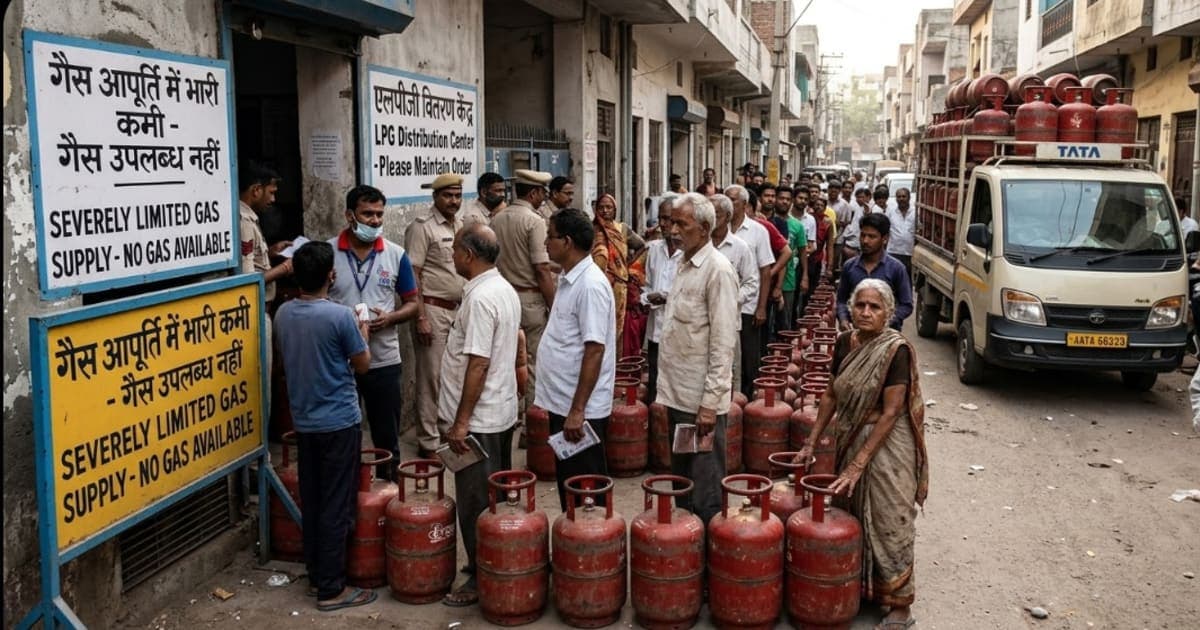
LPG: The Shivalik's cargo will bring relief to cylinder supply. It will not bring relief to the cost of last-mile LPG delivery, which depends on diesel trucks running delivery routes at current fuel prices.
The cold chain — the refrigerated logistics infrastructure that keeps perishables from farm to consumer — is particularly vulnerable to a diesel price shock. It runs continuously, it runs on fuel, and there is no immediate substitute. A cold chain disruption does not show up in today's prices. It shows up in the quality and availability of perishables in urban markets in five to seven days.
What the Government Discussed This Afternoon
Finance Minister Nirmala Sitharaman chaired an emergency meeting today with the RBI Governor and the Petroleum Minister. No formal policy announcement emerged from the meeting. Sources familiar with the discussions indicate three options on the table.
Excise duty cut on petrol and diesel. This is the most direct and fastest-acting option. The central government has cut excise on fuel before — most recently in 2022 during the Russia-Ukraine oil price shock. A cut reduces the retail price at the pump without requiring oil marketing companies to absorb additional losses. The fiscal cost is significant — the central government takes in roughly ₹3-4 lakh crore annually from fuel excise — and that revenue disappears proportionally with any cut. Given the existing fiscal pressures, how deep a cut is fiscally viable is the internal debate.
Rupee-Rial bilateral trade mechanism. India has been working on payment mechanisms that allow it to buy Iranian oil in local currencies rather than U.S. Dollars, avoiding both sanctions exposure and Dollar outflow. If the Hormuz situation resolves and Iranian oil flows resume, having a working Rupee-Rial mechanism in place would reduce the Dollar demand that is currently contributing to Rupee depreciation. This is a medium-term option, not an this-week fix.
Strategic Petroleum Reserve drawdown. India's SPR holds crude oil at underground facilities in Vishakhapatnam, Mangaluru, and Padur — a total capacity of 5.33 million metric tonnes. Drawing down the reserve releases oil into the domestic market, cooling domestic prices and reducing the immediate pressure to import at current prices. The constraint: SPR exists for genuine supply emergencies. If it is drawn down now and the crisis extends for months, India enters a future supply emergency with depleted reserves.
None of these options resolve the underlying problem. They buy time and reduce the severity of the economic shock while diplomatic and military developments determine when — and at what cost — the Strait reopens.
The Number to Watch
92.3 is today's number. It will change on Monday morning when markets open. The direction it moves will depend primarily on three things: whether additional Indian-flagged vessels successfully cross the Hormuz in the next 48 hours, whether any development in the U.S.-Iran conflict suggests movement toward a ceasefire, and whether the RBI's intervention is sustained or pulled back.
If the 22 Indian-flagged vessels still stranded in the Persian Gulf begin moving through in the coming days, the Rupee will recover some ground. If the conflict escalates — another ship attacked, a strike on Gulf energy infrastructure, further Hormuz closure actions by the IRGC — it will fall further.
The structural reality does not change with either outcome. India imports 85% of its crude. The Hormuz handles the majority of that supply. The war-risk premium on Gulf transit has been permanently repriced upward. The trade deficit will be wider in 2026 than it was in 2025 regardless of what happens to the Rupee.
92.3 is not the destination. It is a point on a curve whose direction is still being determined by events happening in a strait 4,000 kilometres from Mumbai.
The ships that make it through matter. The diplomacy that gets them through matters. The military and political developments that determine when normal commercial transit resumes matter most of all.
Everything else — the surcharges, the onion prices, the RBI's Dollar sales — is India managing the consequences of a crisis it did not start and cannot end on its own.