What's Happening Today — Saturday, March 14, 2026
Some Saturdays the news takes a break. This is not one of those Saturdays. Here's everything worth understanding from today's headlines, written straight.
Two Indian Ships Just Crossed the Hormuz. That Matters More Than It Sounds.
Start with the good news, because it's genuinely significant.
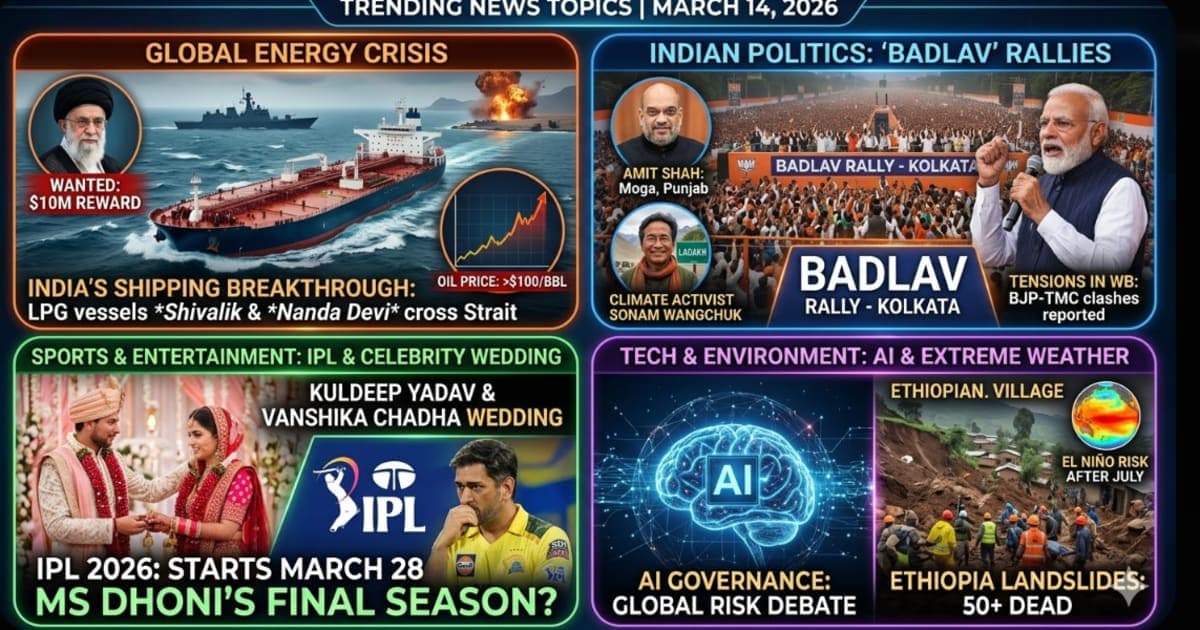
The Shivalik and the Nanda Devi — two Indian-flagged LPG vessels — successfully crossed the Strait of Hormuz today and are currently heading to Gujarat. They made it through. Both ships. No incident.
This is the direct result of the diplomatic clearance that External Affairs Minister Jaishankar reportedly negotiated with Iran over the past week — an agreement allowing Indian-flagged vessels to transit the strait while the IRGC continues to threaten and attack other commercial traffic. Whether you call that a diplomatic win or a humiliating acknowledgment that India had to ask permission to use international waters, the practical effect is the same: LPG is moving toward Indian ports today that wasn't moving three days ago.
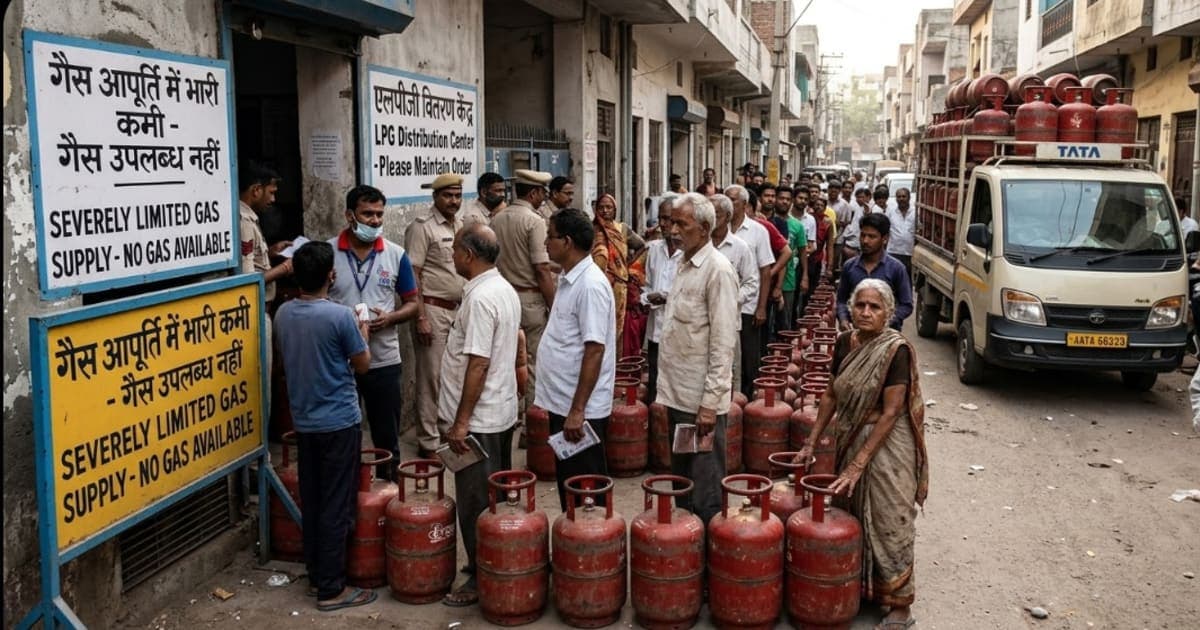
For context on why this matters to daily life: India sources 91% of its LPG from the Gulf. Every day that supply is disrupted is another day of rising prices, black markets, and commercial operators unable to function. The Shivalik and Nanda Devi crossing today doesn't solve the crisis. It's a signal that the back-channel is working, at least partially, at least for now.
The Hormuz Standoff: Mojtaba Khamenei's Position and the $10 Million Bounty
Iran's new Supreme Leader Mojtaba Khamenei — who took over following the assassination of his father Ayatollah Ali Khamenei in the U.S.-Israeli strikes — has issued a formal statement today maintaining that the Strait of Hormuz will remain closed to vessels that do not obtain IRGC clearance.
The U.S. response came in a form that makes the situation feel more like a crime thriller than conventional diplomacy: a $10 million bounty has been placed on Mojtaba Khamenei for information leading to his capture or, implicitly, something more permanent. The announcement landed on international wires this morning and immediately dominated global financial and political news.
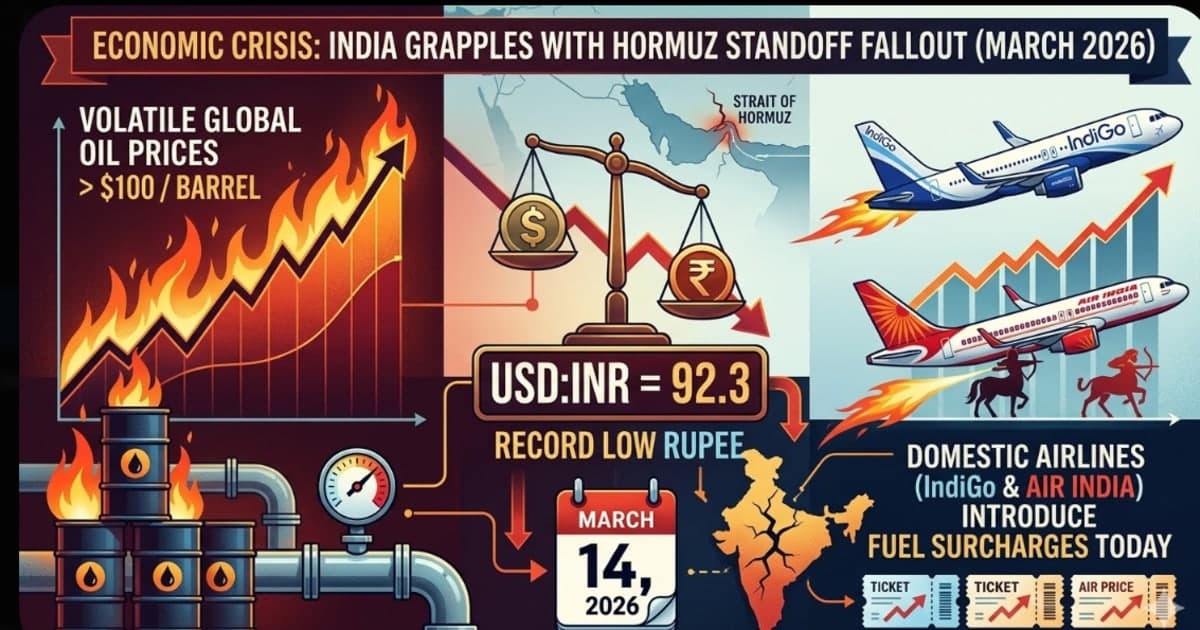
The effect on markets was predictable. Global oil prices remain above $100 per barrel and have been volatile all morning. The rupee hit a record low of 92.3 against the U.S. dollar today — the currency reflecting what the bond and commodity markets are already pricing in: a prolonged disruption to India's energy supply chains with no clear resolution timeline.
IndiGo and Air India both announced fuel surcharges today, effective immediately. Airlines pass jet fuel cost increases to passengers within days, sometimes hours. You will pay more for a domestic flight booked in the next month than you would have paid for the same seat two weeks ago. That's the war landing in your travel budget.
PM Modi's "Badlav" Rallies — Kolkata and Silchar
On the domestic political front, Prime Minister Modi addressed major rallies today in Kolkata and Silchar under the BJP's "Badlav" (Change) campaign.
The Kolkata rally was the larger and more politically charged of the two. Modi dedicated projects worth ₹23,550 crore to West Bengal and directed his messaging squarely at the Mamata Banerjee-led TMC government. The "Badlav" framing positions BJP as the agent of change against what it characterises as a decade of TMC misgovernance in the state. West Bengal goes to elections in 2026, making today's rally the formal opening of what will be a long and almost certainly ugly campaign season.
The violence was also there. Clashes between BJP and TMC workers were reported near the rally site. This is not new in West Bengal politics — the state has a documented history of political violence around election cycles — but the proximity to a sitting Prime Minister's event will generate significant coverage and political recrimination over the weekend.
In Silchar, the messaging was similar: central investment, infrastructure projects, accountability for state-level governance. Silchar is in Assam, where the BJP is on stronger ground, and the rally served a different purpose — consolidating existing support rather than contesting new territory.
Amit Shah in Punjab — The 2027 Election Campaign Starts Now
Home Minister Amit Shah was at the "Badlav" rally in Moga, Punjab, today, effectively launching the BJP's campaign for the 2027 Punjab Assembly elections.
Punjab is currently governed by the Aam Aadmi Party under Chief Minister Bhagwant Mann. BJP's 2022 performance in Punjab was poor — they won a handful of seats in a house of 117. The 2027 campaign is going to require a fundamentally different approach, and today's Moga rally is the opening statement of whatever that approach turns out to be.
The "Badlav" branding is doing identical work in Punjab as it is in West Bengal: framing the BJP as the challenger against incumbent state governments rather than the national ruling party defending its record. It's an interesting rhetorical choice that acknowledges BJP's state-level weakness in both territories.
Sonam Wangchuk Released From Jodhpur Jail
Climate activist and Ladakh advocate Sonam Wangchuk was released from Jodhpur Central Jail today after the Centre revoked his detention under the National Security Act.
Wangchuk had been detained under the NSA — a preventive detention law that allows detention without trial — in connection with his campaigns for Ladakh's statehood and Sixth Schedule constitutional protections for the region. His detention had generated significant criticism from civil liberties groups and opposition parties. The NSA is a tool that sees relatively limited use and attracts scrutiny whenever it is applied to a figure with Wangchuk's public profile.
The timing of the revocation — on a Saturday when the news cycle is crowded with the Hormuz standoff and the political rallies — is the kind of administrative decision-making that happens when governments want something done without it becoming the dominant story. Wangchuk's release is significant for the Ladakh movement. How he uses the political moment he now has will determine whether his detention ends up strengthening or weakening his advocacy.
IPL 2026 Confirmed for March 28 — And the Dhoni Question
The BCCI confirmed today that the IPL will proceed as scheduled, starting March 28 in Bengaluru. Given that a significant portion of India's cricket-watching public has been following the T20 World Cup through March, the league starting six days later is going to hit an audience that is already cricket-saturated and will be happy to remain so.
The question consuming IPL discourse right now has nothing to do with the schedule. It's about whether this is MS Dhoni's last season.
Dhoni is 44. He played a limited role for CSK last season. He has given no public indication either way. The speculation that every season might be his last has been running since 2019 — but in 2026, with the T20 World Cup just concluded and India having won it with a younger generation of players fully established, the conversation has a different weight than it has had before. If this is the last time Dhoni walks out at Chepauk in yellow, a significant portion of the Indian cricket fanbase will want to see it in person rather than on a screen.
Tickets for CSK home games have been sold out since January.
Kuldeep Yadav Gets Married Today
Indian spinner Kuldeep Yadav married Vanshika Chadha today, and the photos from the wedding festivities have been everywhere on social media since morning.
Yuzvendra Chahal and several other teammates attended. The Kuldeep-Chahal combination — one of the more beloved partnerships in Indian cricket over the past decade — generated predictably warm social media content from the event. The India cricket team is in a good collective mood right now, coming off a World Cup win, and a teammate's wedding on a sunny Saturday in March is the kind of human story that cuts through the heavier news cycle.
Shubman Gill is expected to be named Cricketer of the Year at the upcoming BCCI annual awards. The T20 World Cup run would make a strong case for multiple players in that conversation, but Gill's consistency across formats throughout 2025-26 puts him at the front of it.
Ethiopia Landslides — 50 Dead
Landslides in Ethiopia have killed at least 50 people. The death toll is still being confirmed as rescue teams work through affected areas.
Landslides in East Africa during seasonal rainfall are not rare, but the scale of this event — and the likelihood that infrastructure and relief access in the affected region will slow rescue operations — makes this a significant humanitarian story. International agencies are assessing what response is needed.
The event is also part of a broader pattern that weather scientists have been tracking: international weather models are now indicating that an El Niño pattern may emerge after July 2026. El Niño years bring specific consequences to different regions — drought in parts of Africa, South Asia, and Australia; flooding in parts of South America and East Africa. The India Meteorological Department will be watching the July projection closely for its implications on the 2026 monsoon, which is already a concern given the agricultural pressure created by the gas crisis and fertilizer supply disruptions.
AI Governance — The Debate That Won't Wait
The global conversation about AI risk management and governance is intensifying today across policy forums, tech publications, and social media.
The specific pressure point: with the EU AI Act's high-risk obligations coming into full enforcement in August 2026, and with no comparable framework in place in the U.S., India, or most of Asia, the question of who governs AI systems — and by what standards — is one that different governments are answering differently and incompatibly.
The debate today is focused on a specific dimension: what role ordinary citizens and civil society organisations should play in AI risk assessment, as opposed to leaving governance entirely to governments and the technology companies themselves. It's a question with no consensus answer and significant stakes, and it's going to be running through the policy conversation for the rest of the year.
The Week Ahead
The Hormuz standoff has no resolution date. Oil will stay above $100 until it doesn't. The rupee will stay under pressure. IndiGo and Air India surcharges are in effect.
IPL starts in two weeks. Dhoni's status will be the dominant cricket conversation until the first CSK match resolves it one way or another.
The "Badlav" rallies will continue. West Bengal and Punjab will become progressively louder as election timelines tighten.
And two Indian ships are heading to Gujarat with LPG on board. Small mercies, documented clearly, on a complicated Saturday.