India's Gas Crisis in March 2026 — A Narrow Strait Is Deciding Whether Your Dhaba Opens Tomorrow
Let's start with a number. One-fifth.
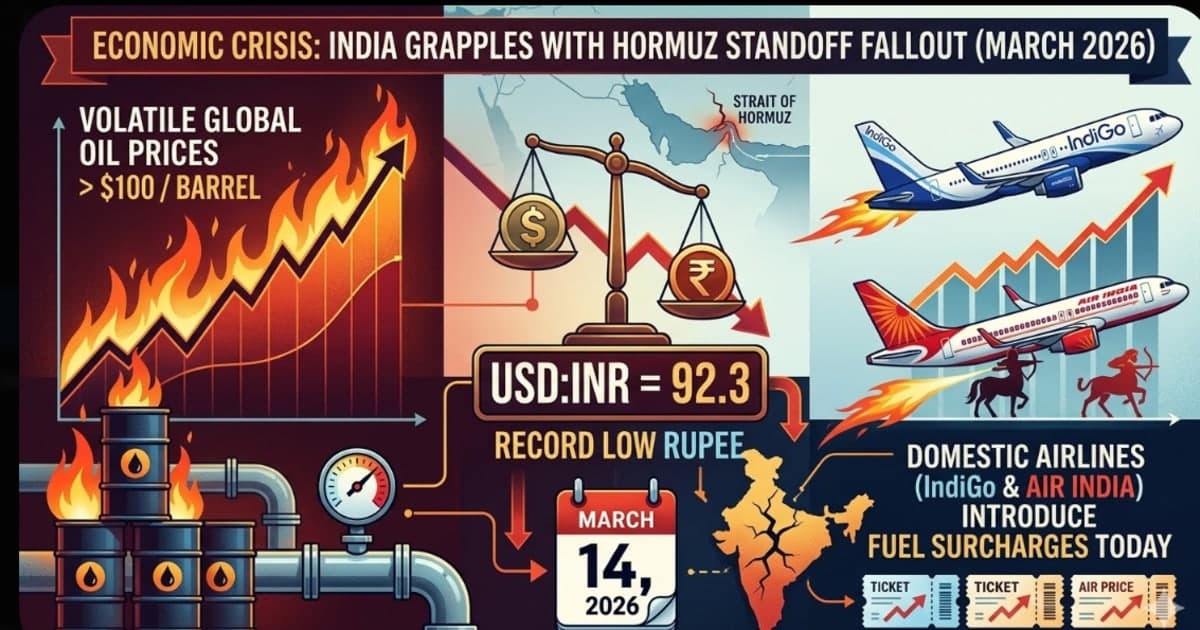
One-fifth of the world's oil and gas travels through a 33-kilometre-wide channel between Iran and Oman. That's the Strait of Hormuz. And right now, in March 2026, that channel is effectively closed for business.
India found out what that means the hard way.
It Started With Qatar
On March 3rd, Iranian drone strikes hit QatarEnergy's facilities at Ras Laffan — the single largest LNG production site on the planet. QatarEnergy declared force majeure. Production halted. Contracted deliveries stopped.
Qatar is India's largest LNG supplier. Not one of the largest — the largest. In 2024–25, India imported 27 million tonnes of LNG. A significant majority came from the Gulf region, with Qatar at the top.
Within 48 hours of the strikes, Indian gas importers started getting calls. Petronet LNG notified GAIL and other buyers: expect cuts of 10 to 30 percent. GAIL passed those cuts downstream. Gujarat Gas declared its own force majeure and stopped deliveries to industrial clients. Adani Total Gas told industrial users prices were going up, supply was going down, and there was nothing to negotiate.
ONGC's Dahej gas cracker facility dropped to reduced capacity almost immediately.
One-third of India's LNG imports hit at once. And India holds zero strategic reserves for natural gas. None. The strategic petroleum reserve covers about eight to nine days of oil demand. For gas, the number is zero.
The Government Moved Fast
On the night of March 10th, the Ministry of Petroleum and Natural Gas notified the Natural Gas (Supply Regulation) Order, 2026 — invoking the Essential Commodities Act of 1955.
That order did something significant. It overrode every existing commercial gas sale agreement in the country. Every one. It handed the central government direct authority over how every available cubic meter of gas gets allocated — to whom, at what price, under what conditions.
The PPAC set pooled pricing. Buyers in priority sectors must accept those prices. If they don't like it, their option is to waive litigation rights and accept anyway.
This is not a small thing. India does not invoke the Essential Commodities Act lightly. The last time something comparable happened in energy was during acute fuel shortages in the 1970s. The fact that it was used here tells you how seriously the government assessed the situation.
The Priority Framework — Who Gets Gas and Who Doesn't
The order created four tiers. Here's who gets what.
Full allocation: Domestic PNG for household kitchens. CNG for buses, autos, cabs, private vehicles. LPG production for household cylinders. These get 100% of their six-month average consumption. Non-negotiable.
80%: General manufacturing, commercial city gas consumers, tea industries. Running, but reduced.
70%: Fertilizer plants. The Kharif sowing season is approaching. The government says urea reserves are adequate. IFFCO and Kribhco have quietly told a different story — both have reported production reduction already. That gap between the official statement and the ground reality is worth watching.
65%: Refineries, power plants, petrochemical facilities. The deepest cuts. This is where gas was freed up to protect the household tier above.
Who's Actually Suffering
The government's communication has been consistent: households are protected. PM Modi, Minister Puri, Minister Goyal — all saying the same thing. Don't panic buy. India First policies are working. No absolute crisis for citizens.
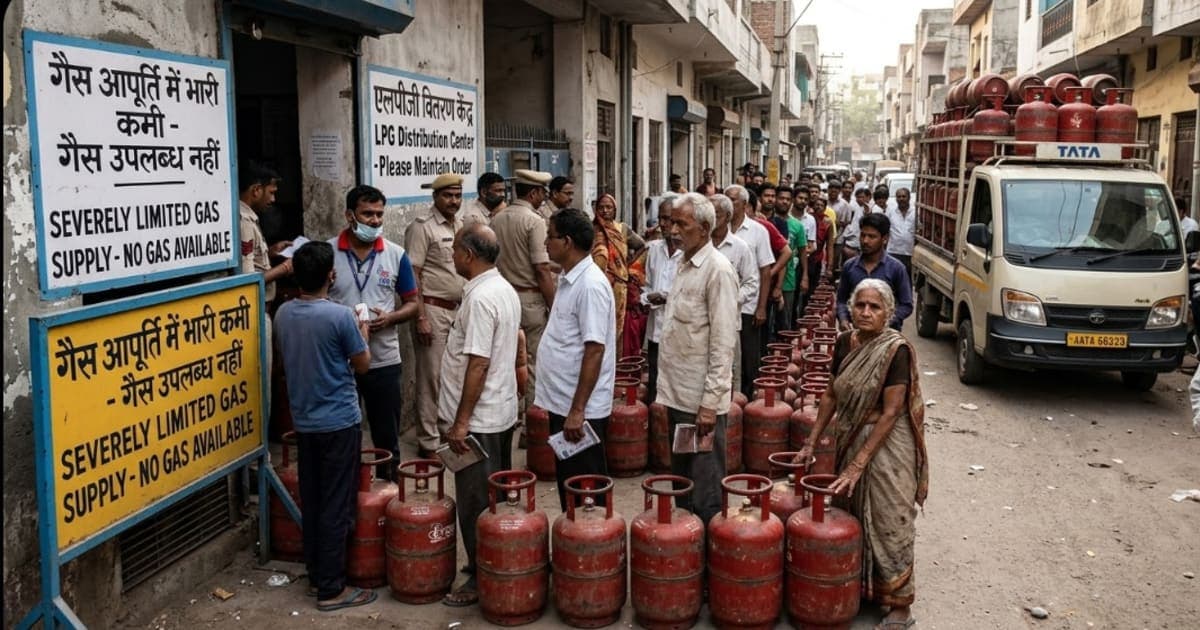
That's broadly true for domestic PNG and LPG users. Household cylinder booking waiting periods went from 21 days to 25 days — that's the main visible change for most families.
But here's what's not making it into the official press releases.
Restaurants across Mumbai, Delhi, Bengaluru, and Kolkata are in crisis. Commercial LPG supplies have been cut. Kitchens can't run at full capacity. Restaurant associations have been warning of closures. Smaller places — the ones running on thin margins to begin with — are already shutting.
Now think about who eats at those smaller places. Not the office crowd that can pivot to Swiggy or a cloud kitchen. Daily wage workers. Construction labourers. Migrant workers who rely on a ₹40 plate of dal-chawal from a roadside dhaba as their primary meal. That supply chain just broke, quietly, without much official acknowledgment.
Civil society groups are pushing for affordable food service establishments to be reclassified as food security infrastructure and moved to a protected allocation tier. That reclassification has not happened.
What the Government Is Actually Doing About Supply
Domestic refineries have been directed to maximize LPG output. Government sources report a 10–25% increase in domestic LPG production over the past week, with refineries at maximum capacity.
India is also sourcing alternative LNG from North America and Australia — bypassing the Hormuz blockage entirely by rerouting. It works. It's just more expensive. Longer routes, higher freight, and war-risk insurance premiums that have gone through the roof since the strikes began. Oil marketing companies running under regulated retail fuel prices can't pass those costs to consumers. Their margins compress. HPCL, BPCL, IOC — Kotak Securities has already flagged caution on all three.
High-level grievance committees at oil marketing companies are handling emergency requests from hospitals, schools, and essential commercial users. That process exists. How fast it moves in practice is a different question.
The Structural Problem This Exposed
48.7% of India's crude oil imports. 68.4% of its LNG imports. More than 91% of its LPG imports.
All from the Middle East. All vulnerable to the same chokepoint.
That's not a new problem. Analysts, energy economists, and multiple government committees have flagged India's Gulf dependence for years. The Strait of Hormuz has always been the single point of failure in India's energy supply chain. What 2026 did was demonstrate, with real consequences, exactly what happens when that point fails.
The renewable transition helps — in electricity generation. India's installed power capacity crossed 520 GW in January 2026, with roughly 40 GW of new capacity added this financial year alone, most of it renewable. That reduces how much a future Hormuz disruption affects the grid.
It does nothing for LPG in a kitchen. It does nothing for CNG in a truck. It does nothing for the fertilizer plant running at 70% capacity before sowing season.
India has no strategic gas reserve. That's the gap this crisis made undeniable.
Where Things Stand Right Now
The government has stabilized the household tier. That's real and it matters.
Everything below that tier is absorbing the shock. Industry running at reduced capacity. Restaurants closing or cutting menus. Fertilizer production reduced ahead of an agricultural season. Urban food systems strained in ways that hit the most economically vulnerable the hardest.
The crisis will resolve. Either the conflict de-escalates, or alternative supply chains normalize, or both. Qatar will resume LNG production at some point.
What won't resolve on its own is the structural exposure. India's energy safety net — specifically for gas — is thin in a way that this crisis made impossible to ignore. Whether the government uses this moment to build strategic gas reserves and accelerate domestic gas production, or waits for the next disruption, is the policy question that will define India's energy security for the next decade.
The strait will not become less important. The question is whether India decides to depend on it less.