The Ground Gave Way in Ethiopia — and a Warming Pacific is Sending the Next Warning
ADDIS ABABA / GENEVA, March 14, 2026
The landslides in southern Ethiopia's Gamo Zone began on the night of March 9 and continued through the early morning of March 11. By Thursday, the death toll stood at 70. [web:156] By Friday, Addis Standard was reporting it had risen to 107. [web:152] Three days of national mourning have been declared. [web:144]
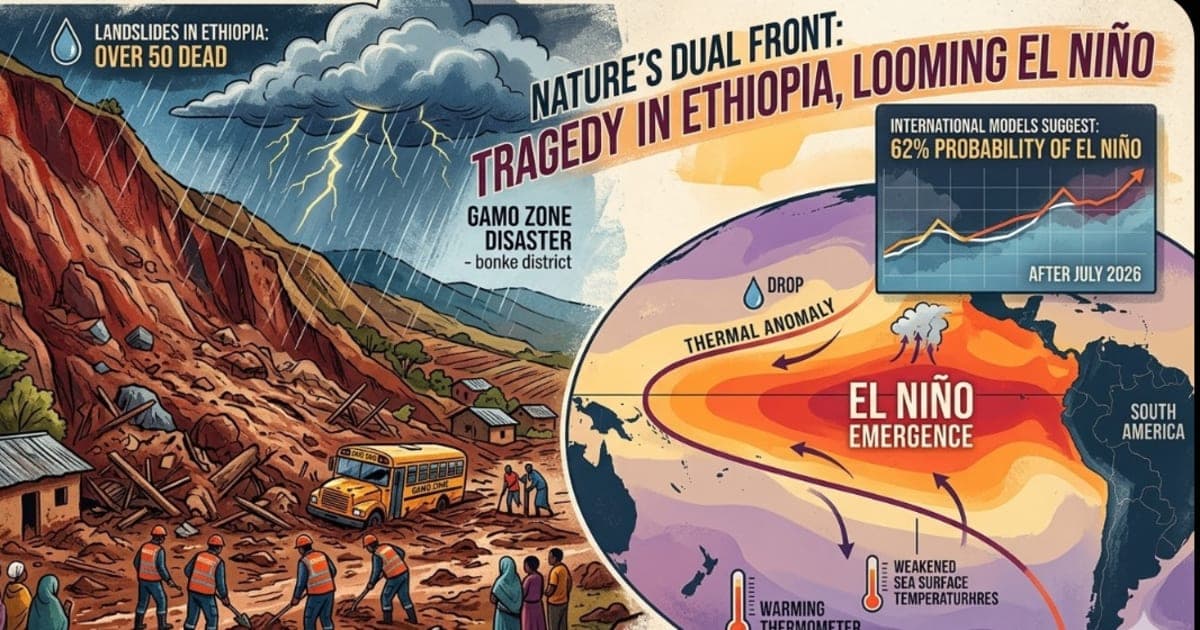
The numbers are still moving. Emergency teams are still working through the mud of three districts — Gacho Baba, Kamba, and Bonke — where unseasonal rains waterlogged the highland slopes and entire sections of hillside collapsed onto homes and roads. [web:145] One person was pulled alive from the debris in Gacho Baba. [web:143] At least 128 remain missing. [web:143] Over 3,400 people have been displaced. [web:144]
While Ethiopia counts its dead, weather scientists in Geneva are watching the equatorial Pacific and sending a different kind of warning. El Niño — the periodic warming of Pacific ocean surface temperatures that reshapes rainfall patterns globally — is coming back. The question is how strong it arrives, and whether the world that is already managing an energy crisis, a currency shock, and multiple active conflicts has the administrative capacity to prepare for it.
What Happened in the Gamo Zone
The disaster struck between the night of March 9 and the early morning of March 11, following continuous unseasonal rainfall across the highland areas of the South Ethiopia Regional State. [web:150]
Three woredas were hit: Gacho Baba, Kamba, and Bonke. In Bonke's Yela Kebele, a mother and her two children were killed instantly when a landslide struck their home. The father survived with serious injuries and was taken to the Bonke Gazeso Health Center. [web:150] In Gacho Baba's Mazo Doysa Kebele, six people were killed in a separate slide. In Kamba's Balta town, two more died in sudden flooding. [web:150] These are the documented individual incidents. The broader destruction — homes buried, transport routes blocked, bridges flooded — has made reaching the remoter villages slow and has complicated the rescue count. [web:150]
The town of Arba Minch and its surroundings received two days of continuous rainfall that caused significant destruction to homes, infrastructure, and agricultural land. [web:142] Major roads are blocked by debris. Several bridges are underwater. Emergency response teams are working but operating in restricted conditions because the infrastructure required to reach the worst-affected areas is the same infrastructure that the landslides destroyed. [web:142]
Gamo Zone's disaster response director Mesfin Manuqa confirmed 64 bodies recovered and 128 missing as of Thursday. [web:143] By Thursday evening, CGTN was reporting the toll at 70. [web:148] Addis Standard's Friday update placed it at 107. [web:152] Sky News confirmed 80 as of Saturday with three days of mourning declared. [web:144] The discrepancy between these numbers reflects the same problem as the rescue operation: remote areas being reached at different times, not coordinated counting from a central source.
Al Jazeera reported on March 12: "The death toll from landslides and flooding in the Gamo Zone of southern Ethiopia has risen to at least 64, with dozens more people missing, according to local law enforcement." [web:143] As of the time of writing, the confirmed minimum is 80, with the actual toll almost certainly higher as remote villages are accessed.
Why This Keeps Happening Here
The July 2024 landslides in Gofa Zone — the neighboring district — killed over 250 people. [web:144] Southern Ethiopia's highlands are now experiencing catastrophic landslides on roughly an annual cycle.
This is not coincidence and it is not simply bad weather. The combination that makes these slopes lethal is well documented: deforestation has removed the root systems that bind the soil in place. Agricultural expansion onto steeper terrain has replaced the forest cover that once managed water runoff. The clay-heavy red soils of the Ethiopian highlands become heavy, unstable, and mobile when saturated. Population growth has pushed communities into areas that were once understood as too risky for permanent settlement.
Climate change is accelerating the rainfall intensity. The Belg rains — Ethiopia's spring rainy season — are becoming more volatile. Meteorologists studying East Africa have noted that storm intensity in the region is increasing, partly attributed to warming. [web:142] Kenya has also seen multiple casualties from flooding this week in the same regional weather system. [web:142]
The result is a predictable cycle that is not being interrupted by the responses available to it. Emergency response teams dig people out. National mourning is declared. Displaced families are registered. The root causes — deforestation, land degradation, inadequate early warning systems reaching rural communities, insufficient managed resettlement from high-risk slopes — remain structurally unaddressed because they require investment, institutional capacity, and political will at a scale that the South Ethiopia Regional State does not currently have access to.
Regional president Tilahun Kebede urged residents in at-risk highland areas to evacuate. [web:142] The problem with that instruction, as any resident of these areas can explain, is that the livelihood — the farm, the home, the community — is on the highland. The evacuation order asks people to abandon the only economic basis they have without offering a credible alternative.
The El Niño Signal — What the WMO Actually Said
The WMO published its latest ENSO update on March 3, 2026. [web:153] This is the primary verified source for the El Niño forecast, and it requires careful reading because the headline numbers are frequently misrepresented in coverage.
The current state: the weak La Niña that characterised late 2025 and early 2026 is fading. [web:151] As of mid-February, sea surface temperatures in the tropical Pacific showed La Niña conditions weakening and moving toward ENSO-neutral. [web:151]
The forecast:
- March–May 2026: 60% probability of ENSO-neutral conditions. [web:153]
- April–June 2026: 70% probability of ENSO-neutral. The chances of El Niño developing are around 30%. [web:153]
- May–July 2026: 60% probability neutral, El Niño chances rise to around 40%. [web:153]
The critical caveat in the WMO's own document: "Forecast uncertainty increases at longer lead times. Predictions issued at this time of year are typically less reliable due to the so-called boreal spring predictability barrier, a well-known limitation affecting ENSO outlook skill." [web:153]
What does this mean practically? The spring predictability barrier is a documented phenomenon: ENSO forecasts issued between February and June are systematically less reliable than forecasts issued at other times of year. The Pacific's atmospheric and oceanic dynamics shift in ways that make the forward projection uncertain. A 40% El Niño probability by May–July is significant enough to prepare for. It is not a certainty.
WMO Secretary-General Celeste Saulo's statement was measured: "The WMO community will be carefully monitoring conditions in the coming months to inform decision-making." [web:155] This is not alarmism. It is an instruction to pay attention.
What El Niño Does — The Regional Specifics
El Niño's effects are not uniform. They play out differently in different regions, and the timing of the event's peak matters as much as its intensity for determining which regions bear the heaviest impact.
India and the monsoon. The Southwest Monsoon typically runs June through September. A La Niña or neutral ENSO is generally associated with normal to above-normal monsoon rainfall. El Niño has historically been associated with deficient monsoon years in India — the relationship is not deterministic, but it is statistically significant. The 1997–98 El Niño coincided with a deficient monsoon. The 2002 El Niño year was one of India's worst monsoon failures in decades.
A post-July 2026 El Niño development would catch the tail end of the monsoon season at best. The primary monsoon impact in India would be felt in 2027 rather than 2026. But a moderate-to-strong El Niño developing by late 2026 would already be influencing the atmospheric conditions that shape the 2027 monsoon outlook. For a country already managing a currency at 92.3, an energy crisis, and disrupted supply chains, a below-normal monsoon in 2027 would arrive into a system with reduced resilience.
Australia. El Niño years are associated with increased bushfire risk and suppressed winter and spring rainfall. Australia experienced devastating bushfires in the 2019–20 El Niño period. A return to El Niño conditions in late 2026 puts the 2026–27 Australian summer fire season on watch.
South America. Peru and Ecuador receive abnormally heavy rainfall during El Niño, with flooding and coastal destruction. Brazil's Amazon and agricultural regions in the south tend to experience drought. The 1997–98 El Niño caused $33 billion in damage globally; a moderate-to-strong 2026–27 event in an already economically stressed world would produce comparable or greater disruption.
The Horn of Africa. El Niño's effect on East Africa is the reversal of what it does to South Asia: it tends to bring above-normal short rains to the Horn, including Ethiopia, Kenya, and Somalia, in the October–December period. That sounds beneficial, but for communities whose highland slopes are already degraded and whose drainage infrastructure is minimal, above-normal rainfall in late 2026 means more of exactly what caused this week's disaster.
Southern Ethiopia was hit by floods in this week's Belg rains. If the El Niño forecast materialises and brings heavier-than-normal short rains to the region in October–December 2026, the humanitarian situation in the Gamo Zone and surrounding areas could deteriorate significantly within the same calendar year.
The Compound Crisis Framework
What makes 2026 different from previous years of El Niño concern is not the El Niño itself. The Pacific has oscillated between El Niño and La Niña for longer than there have been meteorologists to document it. What is different is the context into which the next El Niño is arriving.
Global temperatures have been running above historical norms since 2023. The 2024–25 period included record-high ocean temperatures. The WMO has noted that even "neutral" ENSO conditions are now operating within a warmer baseline, which means that the cooling effect of La Niña is smaller than it was in previous cycles, and the warming amplification of El Niño is larger. [web:147]
The global food system is already under pressure from the Hormuz disruption. Fertilizer supply from the Middle East — the region handles roughly 30% of global fertilizer exports — has been disrupted since the end of February. A failed monsoon year in India in 2027, arriving after an already strained 2026 agricultural season, would compound the food security implications of supply chain disruption with reduced production from one of the world's largest agricultural economies.
This is the compound crisis structure that makes El Niño forecasting in 2026 a matter of urgent relevance rather than academic interest. No single factor — the Hormuz closure, the currency pressure, the fertilizer disruption, the El Niño probability — is a catastrophe in isolation. Their interaction across a twelve-to-eighteen month window is what requires attention.
What Early Warning Actually Means
The WMO's March 3 statement serves a specific purpose beyond scientific documentation. It gives governments, agricultural planners, humanitarian organisations, and infrastructure managers a four-to-six month window to act before conditions arrive.
In practice: India's India Meteorological Department will be issuing updated monsoon outlooks through March, April, and May as new ENSO data comes in. The June 1 monsoon onset forecast will be the most significant climate event for Indian agricultural planning in the year. Water storage decisions, crop selection, and state-level drought preparedness frameworks are all influenced by whether the June forecast says "normal," "deficient," or "below normal."
For Ethiopia, the window is being used — or should be — to pre-position emergency food and shelter supplies in the Gamo Zone before the October short rains begin, to accelerate the resettlement of families from the most vulnerable slopes, and to clear the debris-blocked roads while conditions allow.
For the global humanitarian system, the El Niño watch is the instruction to begin fundraising for the responses that will be needed in 2027, because raising money after a crisis is slower and more expensive than raising it before.
The families of the 128 people missing in the Gamo Zone mud did not have four months of warning. The rain came and the earth moved. The El Niño forecast gives the rest of the world something those families did not have: time.
Whether that time is used is a different question from whether the warning was issued.
The WMO issued the warning. The rest is political will, institutional capacity, and resource allocation — none of which the weather forecast controls.