This March 20, two things happen at the same moment.
The Earth's subsolar point crosses the Equator. Day and night balance. The Northern Hemisphere tilts back toward the sun for the first time since September.
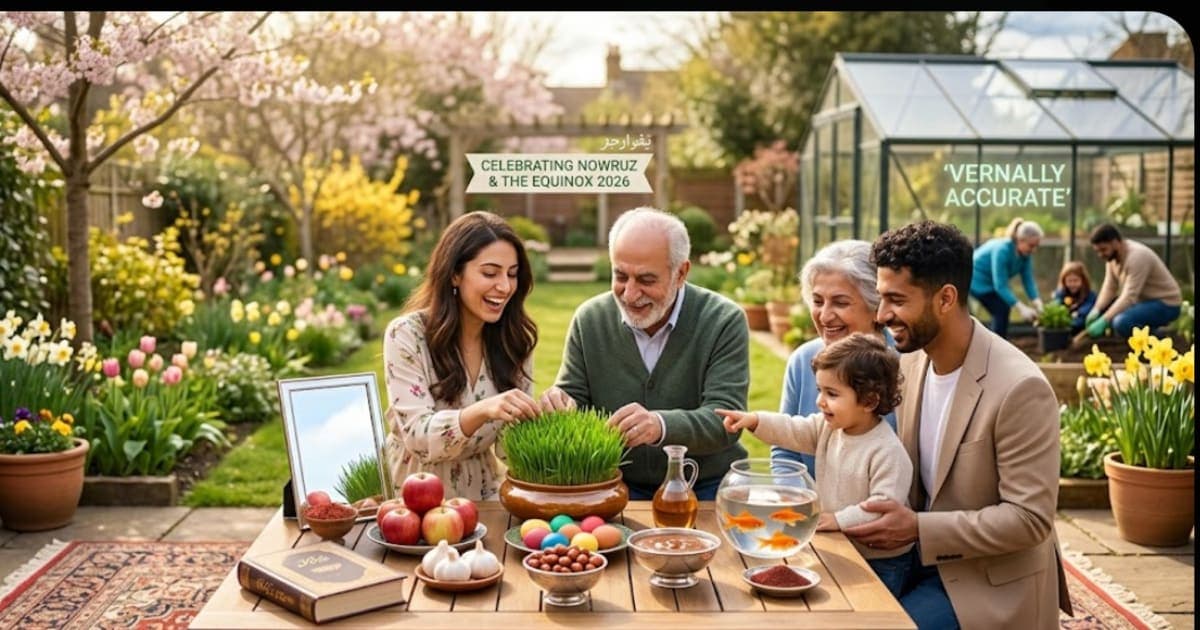
And somewhere in Iran, in Afghanistan, in Tajikistan, in the diaspora living rooms of Toronto and London and New York, a family gathers around a table set with seven symbolic items and waits — literally waits — for that exact astronomical moment to mark the beginning of a new year.
Nowruz and the Vernal Equinox don't just share a date this year. They share a logic. They always have. This March, more people than usual seem to be noticing.
What the Equinox Actually Does
The science is precise and worth stating clearly.
The Vernal Equinox is not a metaphor. It is a specific astronomical moment — the instant the Earth's tilt neutralizes relative to the Sun, when day and night are nearly equal everywhere on the planet, when the Northern Hemisphere begins its six-month lean back toward light.
What follows that moment is biological, not poetic. Lengthening daylight triggers hormonal shifts in plants that have been dormant for months. Sap moves. Buds form. The ecosystem doesn't gradually decide to wake up — it activates, because the signal arrived.
Humans are part of that ecosystem. Circadian rhythms, seasonal mood shifts, the very specific restlessness that arrives in late March that makes people want to open windows and move furniture — these are biological responses to the same lengthening light that wakes the trees.
The impulse toward renewal in spring isn't a lifestyle trend. It's a species response. The lifestyle trends are just what happens when that impulse meets Instagram.
Three Thousand Years of Doing This Right
Nowruz has been celebrating the equinox for over three millennia.
That number is worth sitting with. Three thousand years of the same ritual, across civilizations that rose and fell, across the Zoroastrian roots it grew from, across Central Asia, the Middle East, the Balkans, and every diaspora community that carried it into new geographies.
What makes Nowruz different from most New Year celebrations is that it doesn't pick an arbitrary date. January 1 is a calendar convention. Nowruz is a celestial one. The new year begins at the exact moment the Sun crosses the celestial equator — not at midnight, not on a Monday, but at the precise instant the planet resets.
That specificity is the whole point.
The weeks leading up to it involve Khouneh Takouni — literally "shaking the house." Every rug beaten. Every curtain washed. Every corner scrubbed. Not because Persian households are particularly dusty but because the ritual is about clearing the physical space of winter's residue. Making room. Literally, materially, making room.
On the eve of the last Wednesday before Nowruz, there is Chaharshanbe Suri — bonfires in the street, people jumping over the flames, chanting to give the fire their pallor and take back its warmth and redness. It is a purification ritual that has survived three thousand years because it works — not magically, but psychologically. There is something about jumping over fire with your neighbors that genuinely cleanses something.
The Table That Explains Everything
The Haft-Sin table is where Nowruz becomes visible.
Seven items, each beginning with the Persian letter "Seen," arranged as an altar for the new year. Each one carries specific meaning:
Sabzeh — wheat or lentil sprouts, grown at home in the weeks before the equinox. Rebirth. Something that was a seed and is now living.
Seeb — apple. Beauty and health.
Seer — garlic. Medicine. The acknowledgment that health is intentional.
Senjed — oleaster fruit. Love.
Samanu — wheat germ pudding, slow-cooked for hours. Affluence and patience.
Serkeh — vinegar. Age. The wisdom that accumulates over time.
Sumac — for the color of sunrise. The literal color of the new morning.
Colored eggs for fertility. A mirror for reflection. Goldfish swimming in a bowl for life in motion.
This table is assembled with intention. Every item is chosen for what it represents, not just for how it looks. It is, in the language that lifestyle media uses now, a mindfulness practice — an annual act of placing meaning into physical objects and gathering the family around them.
The fact that this practice is 3,000 years old and currently trending on home decor accounts simultaneously is not a contradiction. It is, if anything, proof that the instinct it represents never went anywhere.
Why This Is Landing Differently in 2026
Nowruz has always existed. The equinox has always happened. What's different this year is the audience paying attention.
There is a specific cultural hunger right now for ritual that didn't get invented by a brand. For traditions with geological roots rather than marketing budgets. For the "ancient" in a media environment that is otherwise obsessed with the new.
Nowruz satisfies that hunger completely. It is simultaneously the most scientifically grounded New Year celebration on earth — tied to an astronomical event, not a calendar convention — and one of the most symbolically rich. The Haft-Sin table is beautiful and it means something specific. The spring cleaning is practical and it is also a ritual of release. Chaharshanbe Suri is a fire festival that predates most living religions and feels, if you've ever been near those bonfires, completely necessary.
Lifestyle and wellness communities are connecting with it because it does what the best rituals do: it takes an internal feeling — the spring restlessness, the desire for a clean start, the need to mark that something is ending and something else beginning — and gives it a physical form.
You can't jump over a bonfire and feel nothing. You can't grow lentil sprouts on your windowsill for three weeks and not feel something when they're there on the table.
The Wider Tapestry
Nowruz is the most explicitly equinox-tied of this season's celebrations, but it isn't alone.
Easter and Passover — both lunar festivals, both built around themes of liberation and rebirth — arrive within weeks of the equinox. Holi has already happened, painting the spring with color and the symbolic defeat of winter's darkness. In Japan, Hanami — the cultural practice of gathering under cherry blossoms to mark their brief, impermanent bloom — turns an entire nation toward the same act of paying attention to renewal.
Different traditions. Different symbols. Different centuries of origin.
The same planet, tilting back toward the sun. The same biological signal, received by every culture that ever paid close enough attention to notice it.
What This March Actually Is
The convergence of the 2026 equinox and Nowruz is not a novelty. It happens every year — the equinox is always in mid-to-late March, and Nowruz is always tied to it.
What shifts is whether people notice.
This year, more are noticing. The Haft-Sin aesthetic is in home decor feeds. The spring cleaning ritual is in wellness newsletters under new names. The bonfire is a metaphor in a hundred essays about letting go.
That's not appropriation. That's recognition — the slow realization that a 3,000-year-old tradition understood something about the human relationship with seasonal change that we're still figuring out how to articulate.
The equinox happens whether we mark it or not. The question is whether we show up for it.
This March, it seems like more of us are.
Nowruz 2026 begins at the exact moment of the Vernal Equinox on March 20, 2026. It is recognized as an Intangible Cultural Heritage of Humanity by UNESCO and is observed as a public holiday across more than a dozen countries.