Supreme Court vs. NCERT: The "Judicial Corruption"
Chapter That Triggered an Unprecedented Legal Firestorm
Somewhere in India right now, a school principal is personally overseeing the physical collection of Class 8 Social Science textbooks from classrooms and storage rooms.
That's not a metaphor. That's a direct order from the Supreme Court of India, issued this week, making school principals personally responsible for ensuring that a specific chapter never gets taught to their students.
The chapter in question discussed corruption in the judiciary.
What followed after that chapter went to print — the suo motu cognisance, the courtroom confrontations, the unconditional government apology, the author blacklistings, the seizure of an estimated 2.38 lakh textbooks — is one of the most extraordinary institutional collisions in recent Indian legal and educational history.
What the Textbook Actually Said
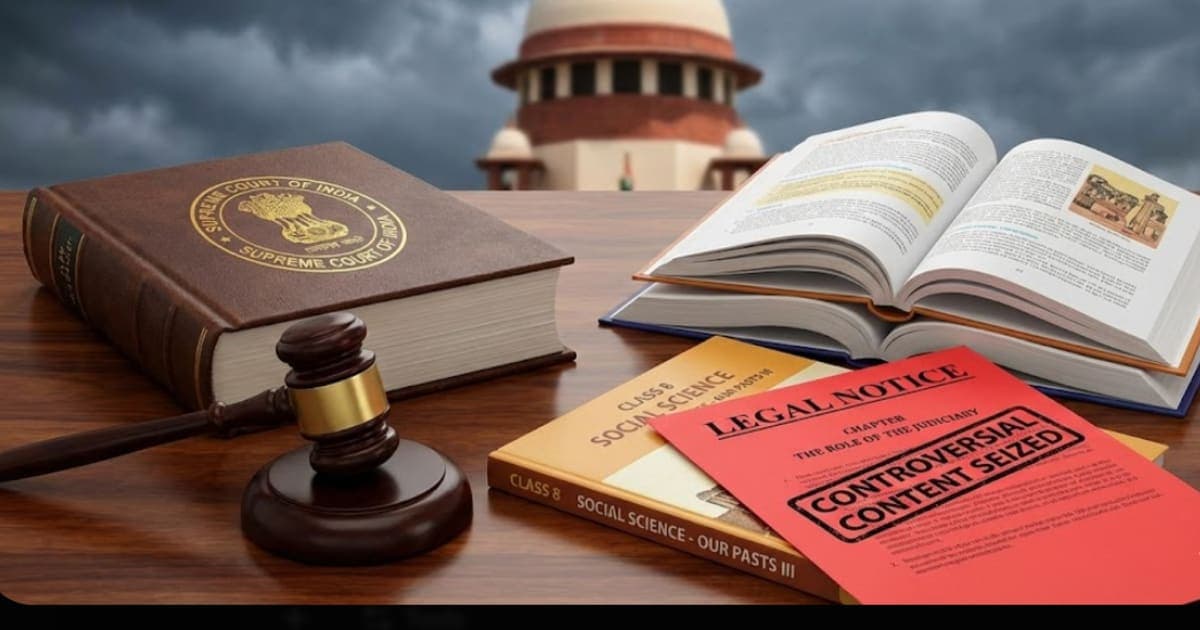
The NCERT Class 8 Social Science textbook Part 2, revised for 2026, included a chapter titled 'The Role of the Judiciary in Our Society.'
Previous editions of this textbook were straightforward — court hierarchy, constitutional provisions, how citizens access justice. The 2026 revision tried to do more. It attempted to address the real, documented problems paralyzing the Indian legal system.
Three were identified: massive case backlogs, an inadequate number of judges, and judicial corruption.
On the corruption point, the text stated: "People do experience corruption at various levels of the judiciary. For the poor and the disadvantaged, this can worsen the issue of access to justice."
It cited data: roughly 81,000 cases pending in the Supreme Court, 6.2 million in High Courts, 47 million in district and subordinate courts. It quoted former CJI B.R. Gavai from a July 2025 speech, noting that instances of misconduct negatively impact public confidence.
All of those numbers are real. The pendency data is parliamentary record. The Gavai quote is from a public speech. The corruption complaints mechanism — CPGRAMS — is a functioning government system.
None of that made the chapter acceptable to the Supreme Court when it landed on their radar.
The Courtroom
The matter came before a three-judge bench on February 25 — CJI Surya Kant, Justice Joymalya Bagchi, and Justice Vipul M. Pancholi — when senior advocates Kapil Sibal and Abhishek Manu Singhvi urgently mentioned it.
Their argument was specific and worth understanding precisely. They weren't saying corruption doesn't exist in the judiciary. They were saying: why only the judiciary?
"They have left out bureaucracy, politics, etc. Not a word on other sectors. They are teaching as if it only exists in this institution."
It's a selectivity argument. If the textbook's stated purpose was to give Class 8 students an honest picture of systemic corruption in Indian institutions, the chapter's narrow focus on the judiciary — while leaving politicians, ministers, and investigative agencies entirely untouched — raises a legitimate question about intent.
CJI Surya Kant made clear he had already been tracking the textbook. The court had taken suo motu cognisance before the advocates even arrived — triggered by hundreds of calls from Bar members and High Court judges across the country.
His language was not measured.
He described the chapter as a "tentatively calculated, deep-rooted attempt" and a "conspiracy to defame the judiciary." He said the court was "bleeding today" from the reputational damage. He said: "I will not allow anyone on earth to defame the institution or taint its integrity. Whosoever and however high it may be, I know how to deal with it."
Justice Bagchi added that teaching children this material undermines the constitutional principle of separation of powers and the basic structure doctrine.
The Government's Response
Solicitor General Tushar Mehta appeared on February 26 with an "unconditional and unqualified apology" from the Ministry of Education and the Centre.
And then he went further.
The people who wrote the chapter, Mehta told the court, would not be associated with any preparation of any chapter or any work in any ministry going forward.
That's a blacklisting. Not a reprimand, not a demotion — a permanent ban from all future government educational and consultative roles for the subject experts and authors who drafted the text.
Government sources indicated that while the data used in the chapter is technically public record, the drafters failed to consult the Union Law Ministry for context. The use of the Gavai quote was also deemed to have stripped his remarks of their broader meaning.
Whether that framing holds up to scrutiny — whether "we should have consulted more ministries" is an adequate explanation for why accurate public data ended up being treated as institutional defamation — is a question that educators and transparency advocates are now asking.
Five Orders, 2.38 Lakh Books
The court didn't stop at the apology.
Five directives came down, each one more striking than the last.
Complete halt on reprinting, distribution, and digital dissemination of the textbook. Immediate physical seizure of all copies — estimated at 2.38 lakh books — from storage, retail outlets, and educational institutions. Personal responsibility for that seizure placed on NCERT Director Dr. Dinesh Prasad Saklani and on the principals of every school where the book had already reached. A strict ban on any instruction being imparted from the controversial chapter. And show-cause notices to the Secretary of the Department of School Education and the NCERT Director, asking them to explain why criminal contempt proceedings should not be initiated against them.
"If you teach the entire teaching community and the students that the judiciary is corrupt — what message will go?" CJI Kant asked from the bench.
It's a fair question. It also sits uncomfortably next to another fair question: what message goes when accurate, publicly available data about an institution is ordered removed from a school curriculum and the people who included it are permanently barred from government work?
The Debate This Has Opened
The legal fraternity is divided, quietly, on what this week actually means.
On one side: the judiciary's need to protect its institutional credibility is not trivial. In a country where courts are often the last line of defense for ordinary citizens against state overreach, public faith in the system carries real weight. A Class 8 textbook that teaches children the judiciary is corrupt — without the same scrutiny applied to every other institution — does risk doing disproportionate reputational damage.
On the other side: the pendency data is real. The corruption complaints are real. Former Chief Justices have acknowledged these problems from the bench and at public events. If Parliament can discuss judicial accountability and former CJIs can cite misconduct concerns in public speeches, the argument that 14-year-old students should be shielded from the same information requires careful unpacking.
What does censoring accurate civic information from educational material actually produce? Respect for institutions, or students who graduate with an incomplete understanding of the system they'll spend their lives navigating?
That's not a comfortable question. It doesn't have a clean answer.
What Happens Next
The court has given two weeks for compliance reports on the textbook seizure. The AAIB — wait, wrong story. The NCERT is expected to submit a revised version of the chapter for court review before any new edition goes to print.
The authors are blacklisted. The books are being collected. The chapter won't be taught this academic year.
What lingers is the chilling effect. Every textbook author, every subject expert, every NCERT committee member working on curriculum revision right now is aware of what happened to the people who wrote that chapter. The administrative consequence of including accurate but institutionally sensitive material in a school textbook is now, as of February 2026, a permanent career ban.
What gets written — and more importantly, what gets left out — in the next revision cycle will tell you everything about what that lesson taught.
This article is a legal and educational commentary piece based on publicly available Supreme Court proceedings, official government statements, and reported NCERT textbook content as of February 26, 2026. All court quotes are reproduced as reported in publicly accessible legal and news sources.