LPG Price Hike March 2026: How Much More Will You Pay?
NEW DELHI, March 7, 2026 — Saturday morning brought an unwelcome surprise for millions of Indian households. State-owned oil marketing companies quietly pushed up LPG cylinder prices overnight, and for many families, the timing couldn't be worse.
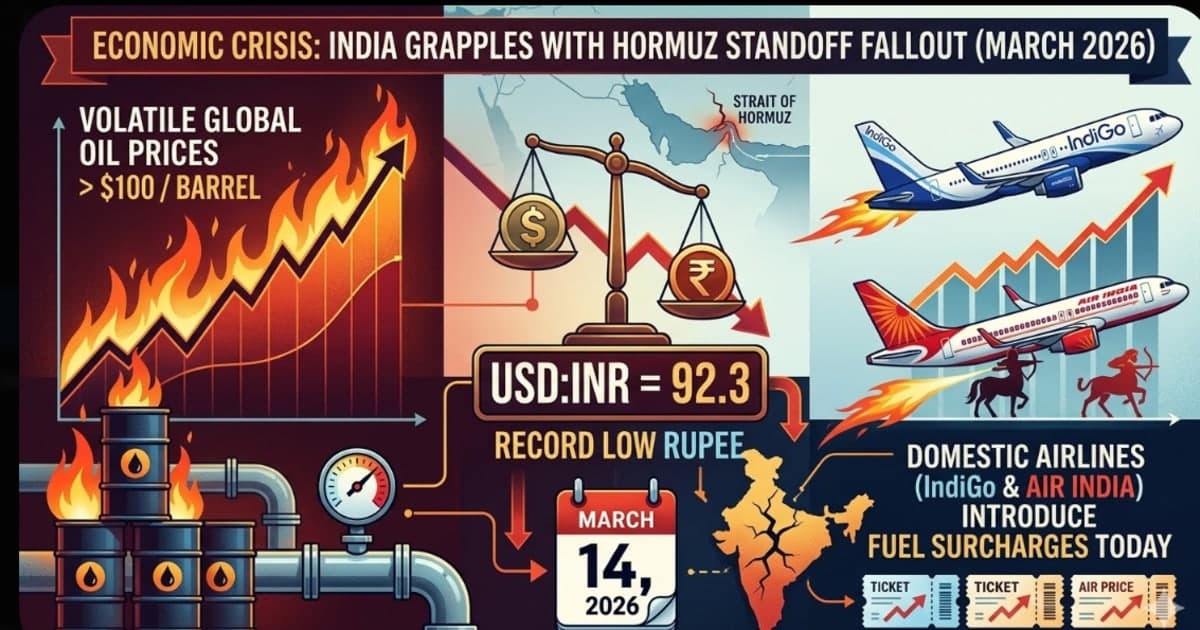
The hike — the first significant revision since April last year — isn't happening in isolation. It's a direct consequence of what's unfolding 3,000 kilometers away in the Persian Gulf, where a widening military conflict has effectively choked off tanker traffic through the Strait of Hormuz. India's kitchen fuel is now caught in the crossfire of a geopolitical crisis it has no control over.
What You'll Pay Now: City-by-City Numbers
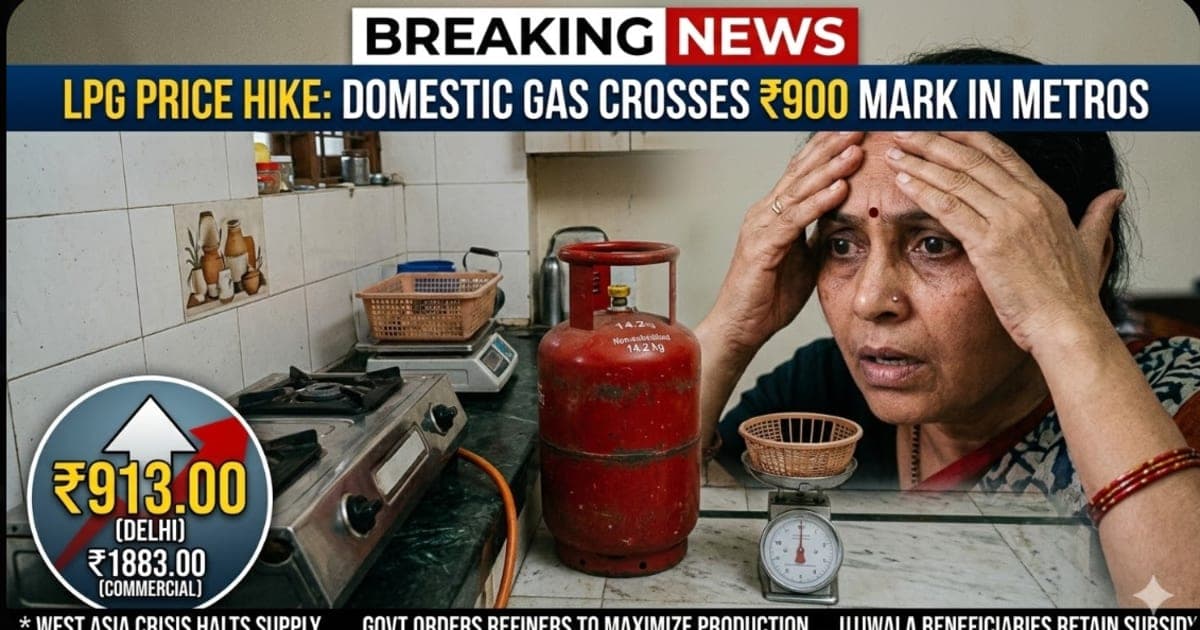
The revision is two-tiered. The standard 14.2-kg domestic cylinder has gone up by ₹60, while the 19-kg commercial cylinder — the lifeline of hotels, dhabas, and catering businesses — jumped by roughly ₹115. In most major cities, the domestic cylinder has now crossed the ₹900 mark.
Domestic (14.2 kg) — New Prices:
- New Delhi: ₹853 → ₹913
- Mumbai: ₹852.50 → ₹912.50
- Kolkata: ₹879 → ₹939
- Chennai: ₹868.50 → ₹928.50
Commercial (19 kg) — New Prices:
- New Delhi: ₹1,768.50 → ₹1,883
- Kolkata: ₹1,875.50 → ₹1,990
Note: Doorstep prices may vary slightly depending on your municipality or rural district, due to local VAT rates and transport costs.
Why a Strait 3,000 KM Away Is Hitting Your Gas Bill
The Strait of Hormuz is just 21 miles wide at its narrowest point, but it carries more than a fifth of the world's seaborne oil and gas. For India, it's not just important — it's almost irreplaceable.
India imports around 60% of its annual LPG requirement. Of that, 85–90% comes from Middle Eastern suppliers — Saudi Arabia, Qatar, the UAE, and Kuwait — and nearly 95% of that supply moves through Hormuz. When that corridor gets disrupted, India feels it almost immediately.
Right now, insurers are pulling coverage for tankers attempting the route. Alternative paths around the Arabian Peninsula exist, but they're slower and dramatically more expensive. Every extra day at sea, every additional risk premium on freight, eventually shows up in what you pay at the cylinder.
"India's LPG import price is directly linked to the Saudi Contract Price," a senior energy analyst explained. "When global benchmarks spike because of supply disruption or even just the threat of it, those costs flow straight down to OMCs — and eventually to consumers."
Government's Emergency Move: Divert, Don't Export
The Ministry of Petroleum and Natural Gas didn't wait for the situation to worsen. On Friday, it invoked emergency powers under Section 3 of the Essential Commodities Act, 1955 — a rarely used but powerful tool.
Every oil refiner operating in India, public or private, has now been ordered to channel all propane and butane streams generated during crude refining exclusively into LPG production. These feedstocks, which refiners normally divert into higher-margin petrochemicals like polypropylene, can no longer be used that way. Violations will be treated as breaches of the Petroleum Products Order, 1999.
It's a blunt instrument, and private petrochemical exporters will feel the pinch. But officials are unapologetic about the priority call.
"Household energy security comes first during a national emergency," a senior government official said, speaking anonymously. "Squeezing incremental supply out of domestic refining buys us time while our seaborne import lines are paralyzed."
Who Gets Hit the Hardest — and Who's Protected
The ₹60 hike lands differently depending on where you sit in the economy.
- Middle-class households using non-subsidized cylinders will feel it most directly — ₹60 per refill adds up fast when food inflation is already squeezing budgets
- Small restaurant owners and dhaba operators are staring at a ₹115 jump on commercial cylinders, with little choice but to raise menu prices and pass the pain to customers
- PMUY beneficiaries — over 10 crore families enrolled under the Pradhan Mantri Ujjwala Yojana — are insulated for now, continuing to receive a ₹300 per cylinder subsidy
That last point matters. The government has, at least for now, protected its most vulnerable consumers from the full shock.
The Bigger Picture: India's Hormuz Problem Isn't Going Away
This crisis has exposed something India's energy planners have known for years but struggled to act on fast enough — the country is dangerously dependent on a single chokepoint for a fuel that goes into hundreds of millions of kitchens every day.
The diversification push is underway. Since early 2026, public sector companies have been receiving initial shipments under new long-term LPG contracts with suppliers on the US Gulf Coast. It's a start, but US imports currently account for only about 10% of total LPG imports. That's not nearly enough to act as a meaningful buffer when Hormuz goes dark.
Until that balance shifts — and until domestic production from natural gas streams scales up meaningfully — Indian households will keep waking up to mornings like this one, where a conflict halfway across the world determines what it costs to cook breakfast.