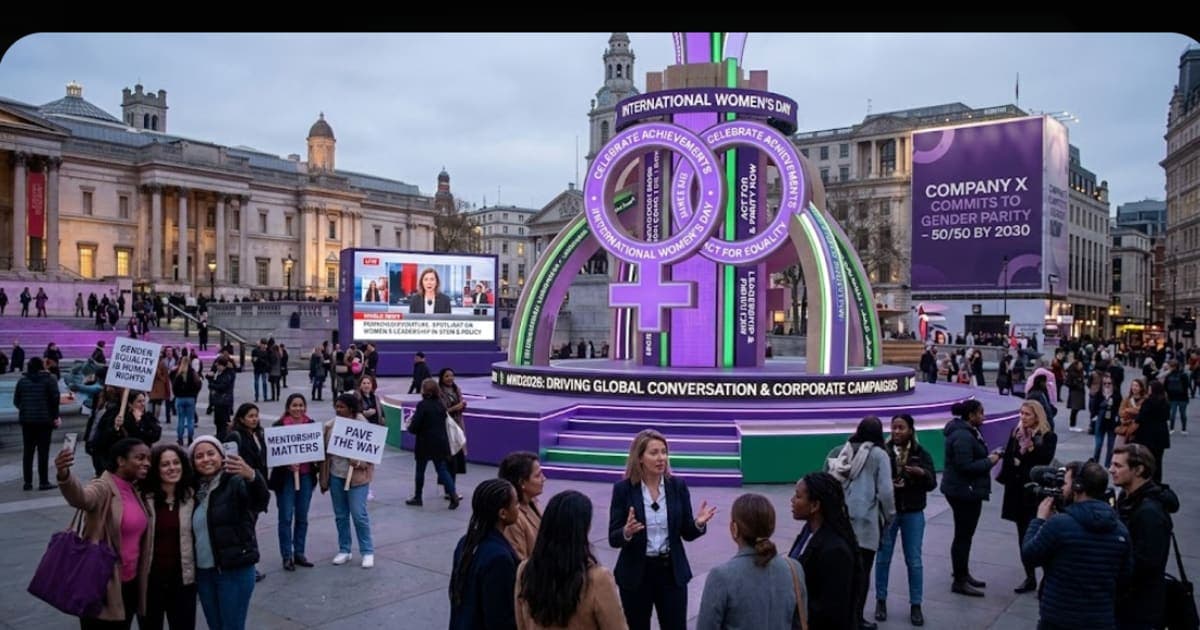
Every year around the first week of March, something shifts in the news cycle.
The purple starts appearing. The panel invitations go out. The corporate email arrives — the one with the bold header and the photograph of a woman looking confidently at something just off-camera. LinkedIn becomes briefly unrecognizable.
Some of this is meaningful. Some of it is performance. The interesting thing about International Women's Day in 2026 is that more people than ever can tell the difference — and they're saying so out loud.
March 8 is no longer a date that passes with polite acknowledgment. It is one of the most contested, most discussed, and — in the right hands — most genuinely useful dates on the annual calendar.
Where This Actually Came From
The history of IWD matters because it keeps getting flattened.
It was not created by a UN resolution (though the UN formally adopted it in 1977). It was not the result of a branding exercise or a global summit. It came out of the labor movements of the early twentieth century — women in North America and Europe who were demanding shorter working hours, equal pay, and the right to vote, and who had very little patience for being told to wait.
The specific radical energy of that origin is what gives IWD its structural tension, the quality that keeps it from becoming purely ceremonial. Every March, the observance holds a mirror up to the present moment and asks the same question it was built to ask: How far have we come, and how much further must we go?
That question has no comfortable answer. Which is precisely why it needs to be asked every year.
What March Actually Does Well
For one month, the media spotlight corrects itself.
The contributions of women that exist in the background of news coverage for the other eleven months of the year — female heads of state navigating geopolitical crises, women leading AI research and renewable energy transitions, women building businesses in markets that weren't designed to support them — get floodlit.
This matters more than it sounds like it should.
Representation in media coverage is not just a fairness issue; it is a behavioral one. When the next generation sees women consistently shown in positions of complexity, authority, and expertise, it changes the internal map of what is possible. It does the quiet, structural work of dismantling the assumption that leadership has a default gender.
IWD amplification isn't feel-good content. It is normalization at scale — which is the only level at which cultural change actually operates.
The Corporate Problem
Has a Very Simple Test
Here is what purple-washing looks like: a logo turns violet on March 8, a campaign launches featuring women looking empowered in well-lit photography, an internal "women in leadership" breakfast is held, and on March 9 everything returns to the way it was on March 7.
Consumers and employees have become very good at recognizing it. The discourse around IWD corporate campaigns in 2026 is not "did you participate?" — it is "what did you actually do?"
The test is simple and the questions are not subtle: What is your gender pay gap and have you published it? What percentage of your executive leadership is female? What concrete policy — parental leave, mentorship infrastructure, pay transparency — are you launching today that will still be running in October?
The companies that answer those questions specifically and publicly build something. The ones that don't have learned, over several cycles of increasingly vocal consumer response, that a purple logo without data is now a liability, not an asset.
IWD has quietly become one of the most effective annual corporate accountability audits that no regulator had to mandate.
The Numbers That Don't Move Fast Enough
The statistics are not improving at the rate the narrative around IWD suggests they should be.
UN Women data puts the timeline for full gender equality — at the current rate of progress — at approximately 300 years. That number is not a projection designed to be dramatic. It is the output of measuring how quickly things are actually changing and doing the arithmetic.
The global pay gap remains stubbornly real. Women earn, on average, roughly 80 cents for every dollar earned by men in equivalent roles — and that gap widens significantly for women of color, indigenous women, and women in the informal economy. The pandemic accelerated the withdrawal of women from formal labor markets, not because women chose to leave, but because the unpaid care infrastructure of most societies collapsed and someone had to absorb it.
Violence against women remains what global health organizations have taken to calling a shadow pandemic — ongoing, systemic, and persistently underfunded in terms of both research and prevention.
March is when activists leverage peak media attention to push these numbers into policy conversations. The discussions are not abstract. They are demands — for pay transparency legislation, for affordable childcare infrastructure, for reproductive rights protections, for legal frameworks that actually function for survivors of harassment and violence.
These demands existed before March 8. They will exist after March 9. IWD is the moment when the audience is large enough to matter.
The Honest Question About March 9
The criticism of IWD that has the most merit isn't the one about purple-washing or corporate performativity.
It's the quieter one: what happens the day after?
The energy generated in March — the panels, the pledges, the trending hashtags, the front-page features — has a half-life. Unless it is deliberately converted into sustained institutional commitment, it dissipates. And the structural problems it was meant to address do not dissipate with it.
Gender equality is not a topic for one month of the year. It is an economic and human rights imperative that affects half the global population, with consequences that extend to the other half. The research on what happens to GDP, to community health indicators, to intergenerational poverty when women have full economic and social participation is not ambiguous. It improves everything.
The test of whether IWD 2026 means anything is not what happens on March 8. It is whether the commitments made on March 8 are still visible in September.
What March 8, 2026 Is For
The day will be loud. It will be well-attended. The coverage will be extensive. The hashtags will trend in every major market.
That is not the problem. That is the infrastructure.
The point is what gets built on top of it. The panel that leads to a hiring policy change. The corporate pledge that comes with an eighteen-month accountability review. The keynote that reaches the person in the room who needed to hear that what she's building is possible.
IWD has always been a catalyst, not a conclusion. Its roots were in protest because protest is the beginning of change, not the change itself.
The march to parity is not a metaphor. It is a description of what is required — consistent forward movement, every month, in every organization, by everyone who benefits from the world that full gender equality would build.
March 8 is the start line. What you do on March 9 is the race.
International Women's Day is observed annually on March 8. The 2026 theme, as designated by the United Nations, centers on accelerating action toward gender equality. It has been observed globally since the early 20th century and formally recognized by the United Nations since 1977.