Somewhere in the world tonight, someone is watching the sky.
Not casually. Deliberately. With a kind of focused patience that thirty days of fasting builds in a person. They are looking for the crescent — the thin sliver of the Shawwal moon that ends Ramadan and begins everything else.
When it's confirmed, the shift is immediate. The quietness of the preceding month — the predawn meals, the long afternoons, the deliberate self-restraint — doesn't fade gradually. It breaks, suddenly, into something that sounds like joy amplified by two billion people exhaling at once.
That is Eid al-Fitr. And in March 2026, it arrives at a moment when the world could genuinely use what it offers.
The Morning That Starts Everything
Eid morning has a specific quality that doesn't translate well in photographs, though millions will try.
It begins before sunrise. Families in new clothes — often bought weeks in advance, the best thing in the wardrobe reserved specifically for this morning — move through streets that are simultaneously quiet and humming. Everyone is going in the same direction.
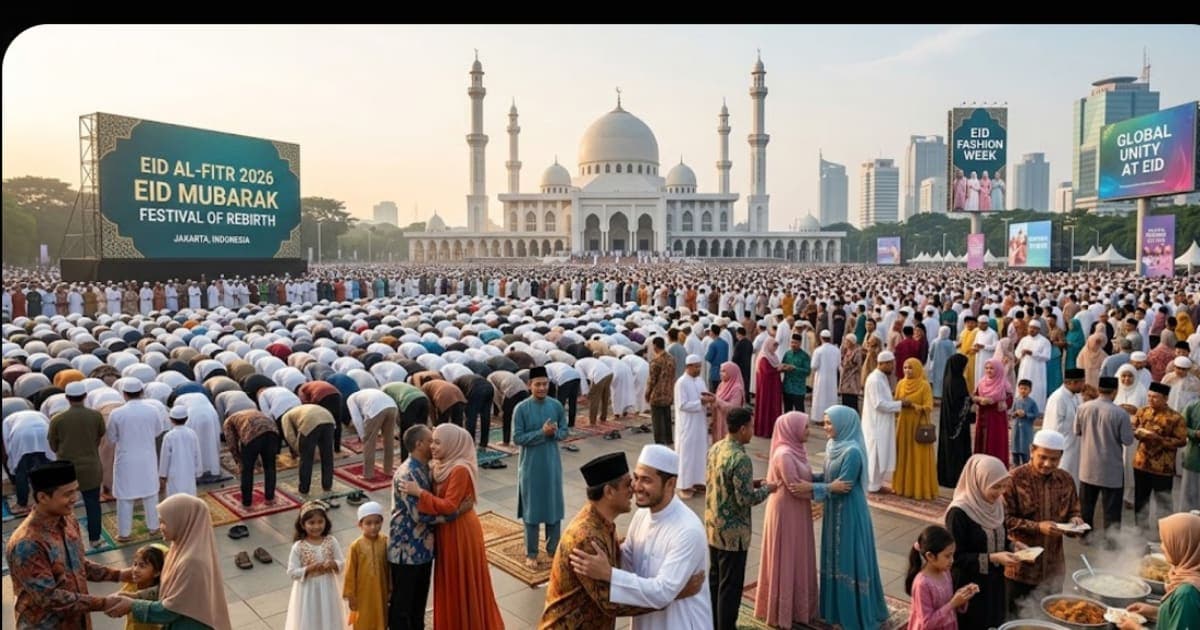
The Salat al-Eid, the Eid prayer, is where the scale becomes undeniable. Standard mosques don't hold the numbers. Convention centers, sports stadiums, public parks, and open squares fill with rows of worshippers that stretch further than the eye can follow. In Jakarta alone, the congregations number in the millions. In Istanbul, Cairo, Karachi, London, New York — the same scene, adapted to local geography.
The chant of Allahu Akbar moves through the crowd in waves. After the sermon ends, what follows is harder to describe but easier to feel if you've ever been near it: strangers embracing with the specific three-fold hug that signals something more than greeting. Grievances set aside. Old arguments, if not resolved, at least paused. The Ummah — the global Muslim community — becoming briefly, physically, undeniably visible.
World news outlets will run aerial footage of these congregations because there is no other way to show what "billions of people celebrating the same thing at the same time" actually looks like from above.
What People Wear and Why It Matters
The Eid outfit is not a trivial thing.
It is not just dressing up. It is a deliberate, symbolic act — presenting yourself renewed, wearing something that marks the occasion as different from every other day. For many families, children receive new clothes as one of their Eid gifts, and the anticipation around that is its own kind of joy.
In 2026, the global modest fashion market is hitting peaks that would have seemed unlikely ten years ago. What used to be a niche space is now a full design industry — luxury brands releasing Eid collections, Dubai-based designers going international, Indonesian fashion houses with global distribution deals.
The visual diversity is the story. The flowing Abayas of the Gulf. The embroidered Shalwar Kameez of South Asia in colors that rival any spring palette. The bold, patterned Boubous of West Africa. The Turkish and Central Asian interpretations that carry centuries of textile tradition into thoroughly contemporary silhouettes.
Lifestyle editors will cover this the way they cover any major fashion moment — trend reports, designer profiles, shopping guides. The difference is that every garment in the frame carries a cultural weight that most fashion moments don't.
The Feast Is the Point
After prayer, the day belongs to food.
Not just eating — the specific, generational weight of recipes that exist only at this moment of the year. Dishes that grandmothers make and whose recipes live in their hands rather than in any written document.
In the Middle East, Ma'amoul — shortbread filled with dates or pistachios or walnuts, pressed into carved wooden molds — appears on every table. They are made in batches over multiple days before Eid. The kitchen smells of rose water and cardamom for a week.
In South Asia, Sheer Khurma is non-negotiable. Vermicelli cooked in whole milk, thickened with cream, sweetened with dates and dried fruits, finished with fried nuts. It is served in the morning, before anything else, as the literal breaking of the fast.
In Southeast Asia, Ketupat — rice packed into woven palm leaf pouches and boiled — arrives alongside Rendang, the slow-cooked coconut beef that takes hours to build and tastes like it.
Culinary media will run its usual "Best Eid Recipes" coverage, and the fusion angle will be there — traditional Baklava reimagined, Sheer Khurma in a modern format. That's fine. But the real food story of Eid is the unremarkable, irreplaceable act of a family eating something that tastes exactly the way it tasted when they were children.
The Charity That Comes First
Before the feast. Before the gifts. Before any of the celebration.
Zakat al-Fitr — the obligatory charity of Eid — must be given before the morning prayer begins. The logic is specific and deliberate: no one should sit at the Eid table unable to feast because they couldn't afford to. The community ensures that the celebration is genuinely communal before it celebrates anything.
In the final days of Ramadan 2026, that obligation will generate massive, coordinated fundraising efforts — food distribution to refugee camps, direct assistance to marginalized communities, emergency relief in disaster-affected areas. The logistics involved are significant. The intent behind them is simple.
This is the element of Eid that rarely makes it onto the trending hashtags but arguably matters most. The festival's first act, before the prayer and the feast and the new clothes, is ensuring that someone who has less can also eat today.
That's a news story worth telling every year. It mostly gets one paragraph.
The Economy That Moves Around It
For the world news desks, Eid is also a significant economic event — and in 2026 that story is bigger than it has been before.
The "Eid economy" is retail, food production, travel, and hospitality all moving simultaneously. In Muslim-majority nations, the holiday means multi-day shutdowns — schools, offices, markets, all closed as families gather.
Eid 2026 falls in March, which in much of the world overlaps with spring break. The result is a surge in travel bookings that airlines and hotels have been preparing for since the calendar confirmed it. Families separated by migration are flying home. Others are taking the combined holiday window for travel they've been planning for months.
Tourism boards across the Gulf, Southeast Asia, and Turkey have structured "Eid Holiday" campaigns around this exact window. They understand that the overlap of religious celebration and school holiday creates a travel moment that markets itself.
What Eid 2026 Actually Represents
The sun sets on the first day of Eid, and the celebrations continue. Relatives visited. Gifts exchanged. Fireworks over city skylines in a dozen time zones running consecutively east to west.
Eid al-Fitr trends globally every year for the same reason anything genuinely human trends: it connects to something people recognize, regardless of whether they share the tradition.
The discipline of Ramadan followed by the release of Eid. The charity given before the feast. The specific weight of generational recipes and the clothes saved for one morning. The strangers embracing in open squares before sunrise.
These are not obscure religious details. They are recognizable human experiences in a specific cultural form — the kind of form that, when you encounter it honestly, makes the world feel less fragmented than it usually does.
In March 2026, that is not a small thing to offer.
Eid Mubarak.
Eid al-Fitr 2026 begins upon the confirmed sighting of the Shawwal crescent moon, expected around March 30–31, 2026, depending on geographic location and local moon-sighting methodology. Celebrations vary by region and continue across multiple days.