Grounded: The DGCA's Sweeping Aviation Crackdown
on VSR Ventures Following the Baramati Tragedy
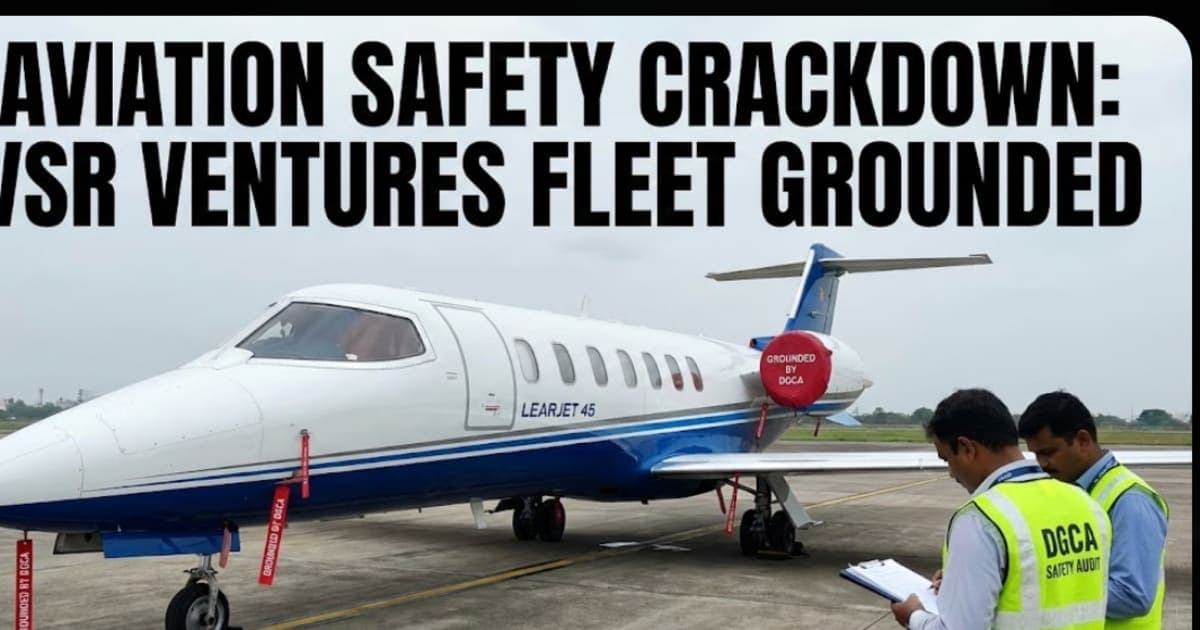
Four Learjets are sitting on a tarmac somewhere in India right now, going nowhere.
The DGCA grounded them this week — VT-VRA, VT-VRS, VT-VRV, and VT-TRI, all operated by New Delhi-based charter company VSR Ventures Pvt Ltd — following a special safety audit that found serious gaps in airworthiness, maintenance procedures, and flight operations. The planes stay grounded until VSR can demonstrate, conclusively, that those gaps have been fixed.
That's the regulatory action. The story behind it is considerably heavier.
January 28, Baramati
The crash that triggered everything happened five weeks ago at Baramati airport in Maharashtra.
A 15-year-old Learjet 45 — registration VT-SSK, owned and operated by VSR Ventures — was making a second landing attempt in poor visibility conditions at the uncontrolled airport. It didn't make it.
All five people on board were killed. Former Maharashtra Deputy Chief Minister Ajit Pawar. Pilot Capt. Sumit Kapur. Co-pilot Capt. Shambhavi Pathak. Personal security officer Vidip Jadhav. Flight attendant Pinky Mali.
The loss of a senior political figure guaranteed that this crash would not be quietly absorbed into the routine statistics of aviation incidents. Questions about the aircraft, the operator, the maintenance history, and the regulatory oversight that had allowed this specific jet to keep flying — those questions arrived fast and they arrived loudly.
The Ministry of Civil Aviation told the DGCA to find answers.
What the Audit Found
The special audit ran from February 4 to February 16. The team examined VSR Ventures' compliance records, maintenance practices, crew training standards, and safety management systems across the company's entire operational infrastructure.
The findings were not reassuring.
The DGCA's official statement described "several non-compliances of approved procedures in the organisation in the area of airworthiness, air safety, and flight operations." Four aircraft were grounded immediately. The company was issued deficiency reporting forms and ordered to submit a root-cause analysis of every identified lapse before any of those jets are permitted back in the air.
What that language means in practice: the regulator found enough wrong that it wasn't comfortable letting those planes fly.
This Was Not the First Warning
For anyone who had been watching VSR Ventures closely, the Baramati crash was not a bolt from a clear sky.
The company had been here before. In September 2023 — less than three years ago — another VSR Ventures Learjet 45 (VT-DBL) crash-landed at Mumbai airport. That incident triggered its own investigation, its own questions, its own paper trail.
What happened next is the part that demands attention. Following the 2023 Mumbai crash, the European Union Aviation Safety Agency — EASA — requested information from VSR Ventures as part of their investigation process. The company reportedly did not respond adequately. In December 2024, EASA suspended VSR Ventures' Third Country Operator authorization — the certification that allows non-EU carriers to operate in European airspace.
An international aviation authority revoked a safety certification because a company failed to cooperate with a crash investigation.
VSR Ventures' fleet of 17 aircraft continued operating domestic routes in India.
Then came January 28.
The Political Pressure
Rohit Pawar, NCP (SP) MLA and nephew of the late Ajit Pawar, has made VSR Ventures the central focus of his public statements since the crash. He has not been quiet about it.
His response to this week's grounding order was not relief. It was escalation.
"This is merely the tip of the iceberg," he said outside the Vidhan Bhavan in Mumbai. He called the action a "sham," accused the DGCA of having initially attempted to issue VSR Ventures a clean chit hours after the crash — pointing to a January report that claimed no Level-I findings in a previous 2025 audit — and raised the question that has been circulating in Maharashtra political circles since the accident: who is protecting this company?
"If VSR is at fault, then the DGCA is also at fault. Who issued the airworthiness certificates? Who looks into aircraft maintenance?"
His demands are specific: ground all VSR aircraft, not just four. Lodge a criminal FIR. Hand the investigation to an independent international body — he has named the US NTSB and the UK's Air Accidents Investigation Branch specifically — rather than leaving it with domestic regulators who may have a conflict of interest in their own oversight record.
Whether those demands result in action is a political question as much as a regulatory one.
What Changes Now
The DGCA, to its credit, appears to understand that the Baramati crash has created a moment that requires more than a targeted response to one operator.
A phase-wise audit of all non-scheduled operators across India is now underway. Following a high-level meeting with charter operators, the regulator has announced two changes that represent a meaningful shift in how private aviation safety information reaches the public.
First: a safety ranking system for charter companies, published directly on the DGCA website. Publicly accessible, operator by operator.
Second: mandatory disclosure of aircraft age, maintenance records, and pilot experience levels to clients at the point of booking.
Both of those things should have existed already. The fact that they're being introduced now, in the aftermath of five deaths, says something about how reactive the regulatory framework has been.
What's Still Unknown
The Aircraft Accident Investigation Bureau has recovered data from the Digital Flight Data Recorder. The Cockpit Voice Recorder was thermally damaged in the crash and international assistance has been sought to retrieve what's recoverable.
The AAIB's preliminary report is expected on or before February 28.
That report will be the first evidence-based account of the actual sequence of events on the morning of January 28 — what the aircraft was doing, what the crew was saying, what warnings the systems were giving, and what, precisely, went wrong on the second approach into Baramati.
Until that report lands, the full picture remains incomplete. The maintenance failures identified in the audit tell part of the story. The CVR and DFDR data will tell the rest.
Five people got on a 15-year-old jet operated by a company that an international aviation authority had already flagged. They didn't come home.
The grounded Learjets on the tarmac are a regulatory response to that fact. Whether they're an adequate one is a question India's aviation sector is going to be arguing about for a long time.
This article is based on publicly available DGCA statements, reported EASA regulatory actions, official Maharashtra political statements, and publicly reported details of the January 28, 2026 Baramati crash investigation as of February 26, 2026.