Bal Vivah Mukt Bharat: What the Campaign Actually Did in 100 Days and Where India Stands Now
Child marriage is not a new problem in India. What's new is the government treating it like one that can actually be solved — not by passing another law, but by going door to door, temple to temple, gram panchayat to gram panchayat, and refusing to let the conversation stay quiet.
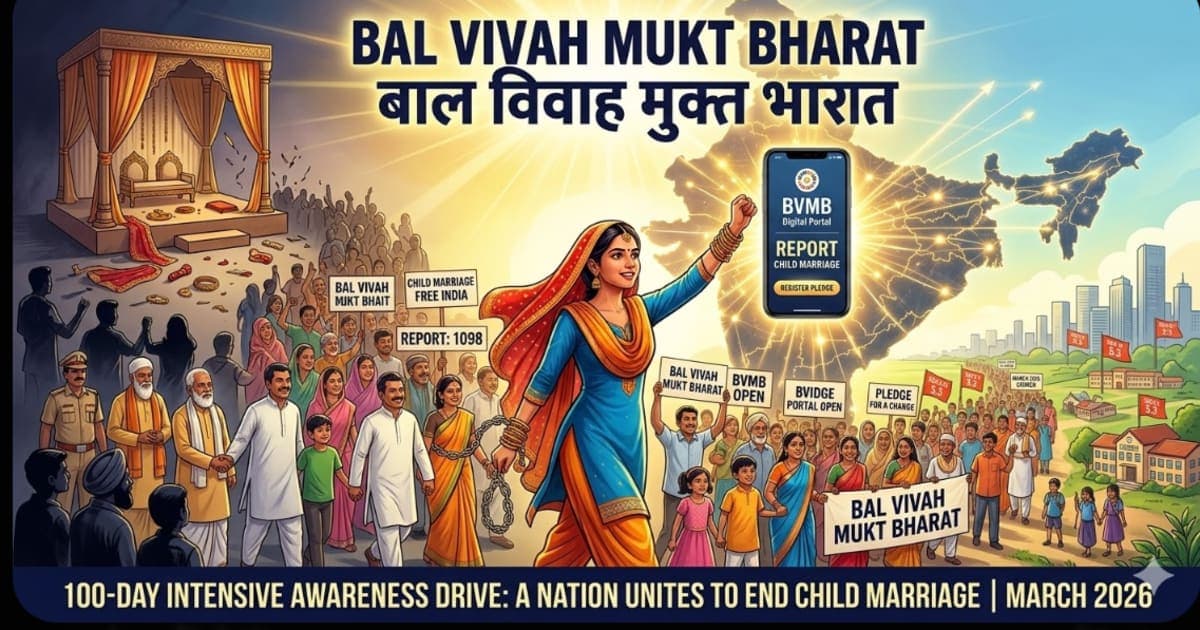
The Bal Vivah Mukt Bharat campaign wrapped up a 100-day intensive drive on March 8, 2026. The numbers from that drive are what's driving the current search surge — and they're worth understanding properly.
What the 100-Day Drive Actually Accomplished
The drive ran from November 27, 2025 to March 8, 2026 — the one-year anniversary of the campaign's initial launch by the Ministry of Women and Child Development.
By the time it ended:
Over 6 crore citizens were directly reached through awareness programs across the country. That's not social media impressions — that's physical outreach: schools, colleges, panchayats, religious institutions, community halls.
More than 28 lakh pledges against child marriage were registered on the government's official portal.
In Telangana alone, authorities and local workers prevented over 1,000 child marriages during the 100-day window. One state. One hundred days. One thousand children who didn't get married before they were ready.
The most significant result came from Chhattisgarh — Balod district became India's first fully child-marriage-free district, maintaining zero incidence across all 436 of its Gram Panchayats. That's not a government claim. That's a verified on-the-ground record.
The Legal Side — What the Law Actually Says
A lot of people searching this topic are trying to understand what's legal, what isn't, and what happens to people who violate it. Here's the clear version.
The Prohibition of Child Marriage Act, 2006 sets the baseline: marriage is prohibited for girls under 18 and boys under 21. Violating this is a cognizable, non-bailable offence. That means police don't need a warrant to arrest someone, and bail isn't automatic.
The punishment for an adult male who marries a child: up to two years of rigorous imprisonment and a fine up to ₹1 lakh. But it doesn't stop there. Anyone who solemnises, promotes, or even attends a child marriage — including parents, the priest, the caterer, the tent house owner — can be prosecuted under the same law.
What's changed under the new criminal codes is the connection to sexual offences. Under the Bharatiya Nyaya Sanhita, 2023, sexual relations with a wife below 18 years of age constitute rape. The Supreme Court has further clarified that penetrative sexual assault by a husband on a child bride falls under aggravated penetrative sexual assault under the POCSO Act, 2012 — which carries significantly harsher sentencing.
This legal alignment is important because for years, the "she's my wife" defence created ambiguity in prosecutions. That ambiguity has been deliberately closed.
Child Marriage Prohibition Officers (CMPOs) are now active at district and sub-district levels. They can gather evidence, approach courts for injunctions to stop marriages before they happen, and initiate prosecutions. Their details are publicly available on the government portal.
How the Campaign Was Built — The Three-Phase Approach
The 100-day drive wasn't a single announcement. It was a deliberate three-phase strategy that targeted different parts of the problem.
Phase 1 (November–December 2025): Going to the students
Schools, colleges, and universities hosted debates, essay competitions, and pledge ceremonies. The aim was to reach young people directly — not through their parents or teachers telling them what to do, but by giving them information about their own rights and the documented health and economic consequences of early marriage. Girls who understand what child marriage costs them are more likely to refuse it and more likely to report it when they see it happening to someone else.
Phase 2 (January 2026): Going after the enablers
This is the phase that doesn't get enough attention. A child marriage requires more than a family's consent — it requires a venue, a priest, food, a tent, music. The campaign specifically targeted religious institutions and marriage service providers. Temples, mosques, churches, caterers, tent houses, DJs, and priests were asked to formally pledge not to provide their services for any marriage involving an underage bride or groom.
The logic is straightforward: if the infrastructure of a wedding refuses to show up, the wedding is significantly harder to hold.
Phase 3 (February–March 2026): Local governance
Gram Panchayats and Municipal Wards were mobilised to pass formal resolutions declaring their jurisdictions "Child Marriage-Free Zones." This matters because it creates local accountability. A panchayat that has passed such a resolution and then allows a child marriage to happen in its jurisdiction has a documented contradiction to answer for.
The Portal and the Helplines — What You Can Actually Do
If you become aware of an impending child marriage — in your village, your neighbourhood, anywhere — here's what exists:
stopchildmarriage.wcd.gov.in is the dedicated BVMB portal. You can report an incident anonymously, find your local CMPO's contact information, and see district-level data on cases reported and prevented.
Childline: 1098 — 24/7, connects to child protection services and law enforcement
Women Helpline: 181 — specifically for women and girls in distress
Both helplines are now integrated with ERSS-112 — the emergency response system — so a call doesn't stay with a helpline operator. It triggers a coordinated response from law enforcement.
Anonymity is protected. You can report what you know without having to put your name to it.
Where the Hard Work Still Is
The campaign is honest about where the problem is worst. West Bengal, Bihar, and Rajasthan continue to have the highest rates of child marriage in the country. In these states, the issue is layered — it's not just cultural acceptance of the practice, it's economic. Families in poverty sometimes see a daughter's marriage as a financial decision: one less mouth to feed, a smaller household, a bride price received.
No awareness drive fixes poverty in 100 days. The campaign acknowledges this. The longer-term strategy involves connecting families to existing government welfare schemes — direct benefit transfers, girl child education schemes, self-help group programmes — so that the economic calculation that leads to child marriage changes. It's slower work than a court injunction, but it's the work that actually changes the baseline.
Patriarchal norms in deeply rural areas don't shift from a government poster. They shift when enough people in a community speak against something publicly and loudly enough that silence stops being the easier option. That's what the panchayat resolution strategy is trying to create — not just legal accountability, but social accountability at the hyperlocal level.
The Bigger Frame
India committed to SDG 5.3 — eliminating child marriage by 2030. That's four years away. The current prevalence rate, despite significant improvement over the past decade, still means millions of girls are at risk.
The Bal Vivah Mukt Bharat campaign is the most coordinated attempt India has made to hit that deadline. Whether it succeeds depends on whether the momentum from the 100-day drive gets sustained into the quieter months that follow — when the search volume drops, the pledges get filed away, and the panchayat resolutions sit in a folder somewhere.
Balod district, Chhattisgarh proved it's possible. 436 panchayats. Zero cases. That result came from sustained local accountability, not from a single campaign drive.
The question isn't whether the goal is achievable. Balod answered that. The question is whether every other district in India is willing to do the same work.