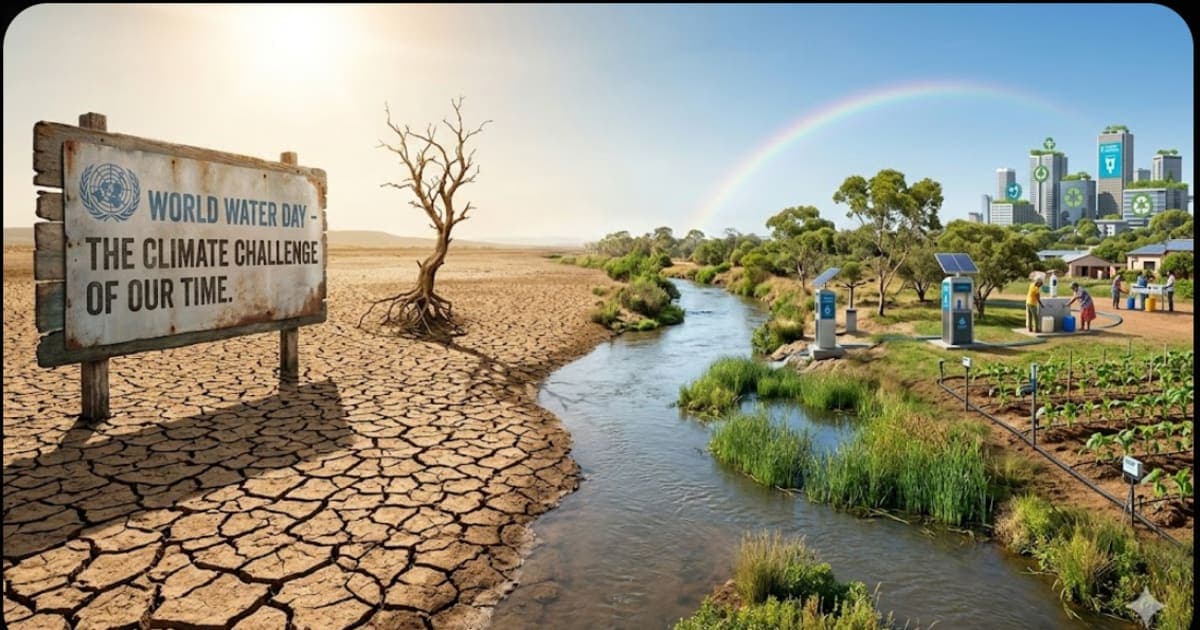
Every March 22, the United Nations marks World Water Day.
For most of its history, that date functioned as a reminder — a scheduled moment to talk about something important that the rest of the calendar tends to crowd out. In 2026, it functions as something else. Less a reminder, more an alarm that's been going off for a while and is getting harder to sleep through.
The global water crisis is no longer a future projection. It is a present-tense emergency with a body count, an economic cost, and a geographic footprint that touches every continent on the planet.
The Loop Nobody Wanted to Be In
Climate change and water don't have a one-directional relationship. They operate in a feedback loop — each one accelerating the other, neither one solvable without addressing both.
Climate change manifests primarily through water. Rising sea levels. Catastrophic floods. Prolonged droughts. Glaciers that are shrinking faster than the models predicted.
As global temperatures rise, the water cycle breaks down in two directions simultaneously. Arid regions get drier — evaporation increases, reservoirs drop, droughts extend from seasons into years. And at the same time, a warmer atmosphere holds more moisture, which means when it does rain, it rains harder and faster than infrastructure was designed to handle.
So some communities are watching their water supply turn to dust. Others are drowning in it. Often, the same community experiences both in the same decade.
The glaciers are the long-term problem that doesn't get enough attention. These are the freshwater reserves that billions of people in Asia, South America, and Europe depend on — not abstractly, but directly, through rivers that are fed by seasonal melt. When the glaciers are gone, those rivers don't just run low. They change permanently. Agriculture built around them for centuries becomes nonviable. Hydroelectric infrastructure fails. Cities that assumed a water supply find they no longer have one.
This is not a projection. It is happening. The timeline is the debate, not the outcome.
What the Crisis Actually Costs
The human toll is the obvious starting point. Billions of people still lack access to safely managed drinking water. Billions more lack basic sanitation. In 2026. On a planet that has the technology and the resources to solve both of those problems. The gap is political, not technical.
But the economic argument reaches audiences that the humanitarian one sometimes doesn't.
Agriculture uses roughly 70% of global freshwater withdrawals. When droughts intensify and river flows drop, crop yields fall and food prices rise — not in one country but across the supply chains that connect every grocery store on earth to fields in water-stressed regions.
The semiconductor industry runs on water. The textile industry runs on water. Data centers — the physical infrastructure behind the digital economy — run on water for cooling. When rivers run dry or water rights become contested, supply chains stop. The connection between water security and economic stability is direct, and the global economy is starting to price that risk in ways it wasn't doing five years ago.
The other cost that rarely makes it into economic forecasts: conflict. Water scarcity is already driving forced migration at scale. "Climate refugee" and "water refugee" have become effectively the same term. Families leaving land that can no longer support them — not because of war or political persecution, but because the water is gone.
Where Policy Is Failing and Why
The United Nations' Sustainable Development Goal 6 — clean water and sanitation for all by 2030 — is off track. Not slightly off track. Significantly, measurably off track.
The reasons are structural and they're fixable, which makes it more frustrating than if they weren't.
Water is systematically underpriced. In most markets, the price of water reflects the cost of delivering it, not the cost of extracting it or the cost of eventually running out. This makes waste rational and conservation financially irrational for the people doing the most damage.
Shared rivers are governed by treaties written before anyone was calculating reduced flows from climate change. The Nile, the Mekong, the Colorado — all of them are subject to international or interstate agreements that were negotiated around water volumes that no longer exist. Updating those agreements requires diplomacy in an era where cooperation on anything is difficult, and water is worth fighting over.
And then there's the infrastructure problem that is almost too mundane to make news and too costly to ignore. Trillions of gallons of treated, cleaned, processed water are lost every year through aging pipes before they reach anyone. The investment required to fix this is enormous. The political will to prioritize it over more visible spending is rarely there.
What's Actually Working
The crisis has produced real innovation, and it's worth naming it specifically rather than gesturing at "technology."
Desalination is no longer the expensive, ecologically damaging option it was twenty years ago. Advances in membrane technology combined with renewable energy integration are making it viable for coastal cities that previously had no realistic alternative to shrinking groundwater supplies.
Wastewater reclamation is the rebranding story of the decade. Singapore's NEWater program — highly purified reclaimed water that now covers a significant portion of the city-state's demand — has demonstrated that circular water economies are not theoretical. They work, they scale, and they change the math on water security for dense urban populations.
In agriculture, precision farming is doing the most direct work on the biggest problem. Soil sensors, AI-driven weather forecasting, and targeted drip irrigation are reducing agricultural water use significantly — not by asking farmers to use less water, but by giving them tools that make efficient use the default outcome of how they farm.
These are not solutions to the crisis. They are tools that make solving it possible. The distinction matters.
What Individuals Can Do
That Actually Matters
The individual action conversation in climate and environment coverage has a credibility problem. It has been used, sometimes cynically, to shift responsibility from corporate and government actors onto people whose individual choices represent a fraction of the total impact.
That critique is valid. And it doesn't mean individual action is worthless.
Fixing household leaks, water-efficient fixtures, drought-tolerant landscaping — these things collectively add up to meaningful volumes across a population. More importantly, they build the cultural relationship with water scarcity that makes political action possible.
The most powerful individual lever is the political one. Supporting companies with transparent, audited water sustainability practices. Voting for officials who treat water infrastructure as the critical national security issue it is, rather than the boring municipal budget line it's usually treated as.
Policy change at the scale this problem requires needs political cover. Political cover requires an electorate that treats water as a priority. That starts with individuals deciding it's one.
March 22
World Water Day this year is not a ceremonial occasion.
It is a checkpoint on a problem that is moving faster than the policy responses chasing it. It is a moment to be honest about how far off track the 2030 goals are, what the actual costs of inaction look like, and where the real solutions are being built.
Water is not a background condition of civilization. It is the condition. Everything else — food, energy, industry, health, political stability — runs on it.
The alarm has been going for a while. The question March 22 asks, every year, with increasing urgency, is simple:
Is anyone actually awake yet?
This article is an environmental policy analysis piece for World Water Day 2026, based on UN Sustainable Development Goal reporting, publicly available climate and hydrology research, and documented water technology case studies.