By the time most of the world wakes up on the morning of March 4, someone in Mathura has already been covered in pink for an hour.
That's how Holi works. It doesn't build slowly. It arrives all at once — color in the air, color on every surface, color on the faces of people who will spend the rest of the day laughing at each other's appearance. By afternoon, social media will look like someone spilled the entire visible spectrum across every platform simultaneously.
But before any of that happens, there is the fire.
The Night Before Everything
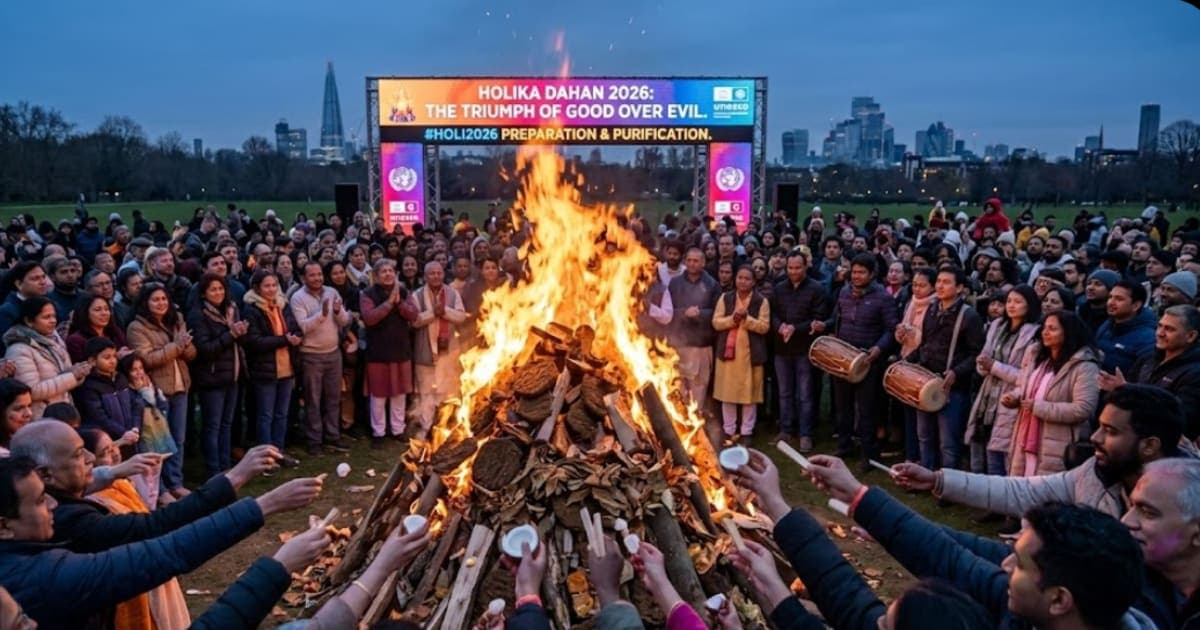
On the evening of March 3, the bonfires go up.
Holika Dahan — Chhoti Holi — is the part of the festival that doesn't make it into the color-run marketing materials or the influencer content packages. It is quieter and older and, in many ways, more important.
The story behind it is the kind that survives millennia because it contains something true. Prahlad — a young prince devoted to Lord Vishnu in defiance of his father's orders — is tricked by his aunt Holika into sitting on a funeral pyre. Holika has a cloak that supposedly makes her immune to fire. She doesn't survive. Prahlad does.
The bonfire lit every year on the eve of Holi is the retelling of that story — the physical, communal act of choosing to believe that devotion and goodness are stronger than power and cruelty.
What makes it resonate outside of its mythological frame is what people bring to it. Twigs. Dry leaves. In some traditions, written notes. The symbolic burning of whatever from the previous year they want to leave in the fire — resentments, regrets, the specific weight of something that didn't go the way it should have.
It is, stripped of all ceremony, a very human ritual. Make a fire. Let something go. Show up tomorrow lighter.
What the Colors Are Actually For
Holi falls in the Hindu lunar month of Phalguna — the hinge point between winter and spring, when the landscape is doing exactly what the festival does: breaking open in color after months of being closed down.
The connection is not metaphorical. It is agricultural. Holi grew from communities that organized their entire calendar around the growing season, for whom the arrival of spring was not an aesthetic event but a survival one. The festival is the cultural memory of that relief — the season that means the crops will grow again, the cold is over, the earth is coming back.
The colors are the blooming flora made participatory. You don't just observe the spring; you wear it. You throw it at your neighbor. You become temporarily indistinguishable from the rest of the world in its seasonal return to brightness.
That's the thing about Holi that gets lost in the slow-motion gulal footage: it isn't just beautiful. It means something specific about what time of year it is and what that has always meant to the people who built the tradition.
Why the Whole World Shows Up for It
Holi has done something that very few religious and cultural festivals have managed: it has traveled completely intact.
It hasn't been flattened into a generic "color festival." It hasn't lost its name or its story. It arrived in London and New York and Sydney and Cape Town as itself — and people who had no prior connection to South Asian culture showed up anyway, because the invitation is the most legible one any festival has ever issued.
Come outside. Throw color at someone. Let someone throw it back. Go home covered in evidence of something joyful.
There is no dress code. No prior knowledge required. No in-group to belong to first. When everyone is unrecognizable under the same layers of red and blue, the social architecture that normally organizes how people relate to strangers temporarily stops functioning.
That is not an accident. It is the design. Holi has always been explicitly a festival of social dissolution — the one day when caste and class are meant to be irrelevant, when the color reaches everyone equally, when the person who threw the pink on your white shirt gets blue in return regardless of who either of you is the other 364 days.
The global adoption of Holi is the world recognizing an invitation it needed.
The Sustainability Conversation
That's Actually Winning
The trending story around Holi in 2026 is not just the spectacle. It is what the colors are made of.
The synthetic dyes that dominated Holi celebrations for decades — cheap, vivid, and laden with industrial chemicals that cause skin reactions and environmental damage — are losing ground fast.
The organic color movement has been building for several years and has reached the point where it is no longer a niche choice. Turmeric yellow. Beetroot red. Marigold orange. Indigo blue from the plant that has been producing it for centuries.
This is the sustainability story that actually makes sense — not a compromise, not a lesser version, but a return to what Holi colors were made from before industrialization made synthetic dyes cheaper. The traditional ingredients are better for skin, better for the water table that catches the runoff, and better for the soil that the festival, at its roots, was always meant to celebrate.
The brands making organic gulal at scale in 2026 are selling out weeks in advance. The conversation has moved from "should you use organic colors" to "where do I get them."
The Food That Belongs to This Day
No serious account of Holi leaves out the kitchen.
Gujiya is the centerpiece — a deep-fried pastry shell filled with khoya and dried fruits, shaped into a half-moon, made in large batches in the days before the festival and distributed to everyone who passes through the door. The making of Gujiya is as much the ritual as the eating of it — the gathering in someone's kitchen, the assembly line of folding and pressing, the particular smell of something frying at scale.
Thandai is the drink of the day — cold milk blended with saffron, almonds, cardamom, and rose petals, served in clay cups because the clay changes the taste in a way that matters. On a warm March afternoon, after hours in the sun with color in your hair and someone else's laughter still in your ears, a cup of Thandai is one of the most specific sensory pleasures the calendar offers.
Food media will publish its Holi recipe guides, and most of them will be good. But the recipes don't fully capture what the food is for — it is the substance of hospitality, the thing you make in quantity because the point is that there is enough for everyone who arrives at your door today.
What March 4 Actually Is
Social media will do what social media does with Holi — generate billions of impressions, trend every relevant hashtag, surface the best photographs of color suspended in midair over crowds of people who are genuinely, visibly, unconditionally happy.
That coverage is not the problem. It is, in its way, the modern version of the same thing — the spreading of the image, the broadcast of the invitation, the proof of concept that joy at this scale is possible.
What the photographs can't show is the weight of the night before — the fire and the thing you chose to leave in it. Or the specific intimacy of cooking Gujiya with someone you've been cooking it with for twenty years. Or the moment when the color lands and the person who threw it becomes, for one second, completely, unconditionally your friend.
That part doesn't trend. It just happens.
And on March 4, 2026, it will happen in more places on earth than it ever has before.
Holi 2026 falls on Tuesday, March 4. Holika Dahan (Chhoti Holi) is observed on the evening of Monday, March 3. The festival marks the end of winter and the arrival of spring in the Hindu lunar calendar and is observed across India, Nepal, and by South Asian communities and Holi enthusiasts worldwide.