India's Power Grid Is Cracking.
This Delhi Summit Might Be the Fix.
Switch on your AC at 7 PM in Chennai this April.
Odds are decent it flickers.
Not because the sun stopped shining —
India added 18 GW of solar last year alone.
But because the sun did stop shining.
At exactly 6:30 PM. When everyone got home.
Plugged in. Cranked up.
And the grid had nothing left to give.
That gap — that terrifying 90-minute window
between solar switching off and demand screaming —
is the central crisis of Indian electricity in 2026.
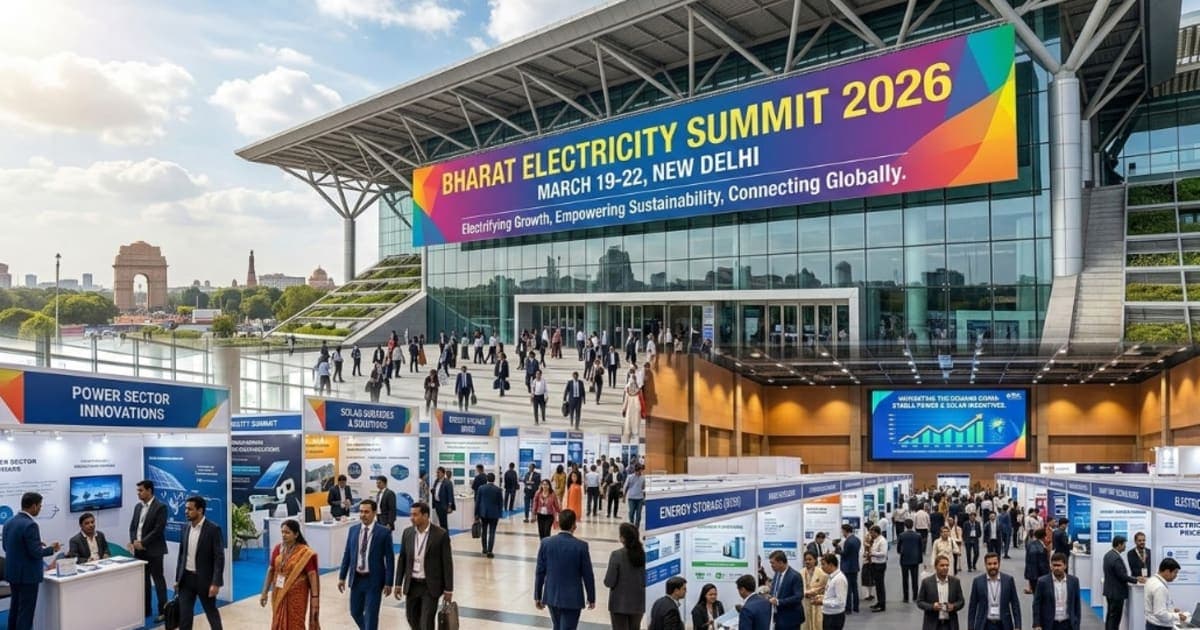
And the 500 exhibitors, 25,000 delegates,
power ministry officials, and battery startups
descending on Yashobhoomi, New Delhi
from March 19th to 22nd
are all there for one reason:
Fix the gap. Before it gets worse.
The Storm That's Already Here
People talk about India's energy transition
like it's a future problem.
It isn't. It's a right-now problem.
Early 2026 brought heatwaves in February —
February — that had UP and Rajasthan
pulling emergency power from neighbouring states.
Data centres in Hyderabad and Noida,
running 24 hours a day for global clients,
added a new layer of "always-on" demand
the old grid was never designed to absorb.
Manufacturing corridors in Gujarat and Tamil Nadu
are humming three shifts because export orders are full.
Everyone needs power. All at once. All the time.
Meanwhile, India's transmission infrastructure —
despite a decade of upgrades and investment —
is running at 97% capacity on peak evenings.
That's not headroom. That's a tightrope.
The Bharat Electricity Summit 2026
isn't a celebration of how far India has come.
It's a war room for what comes next.
The Price Question Nobody Wants to Answer
Here's the conversation happening quietly
in every state electricity board office right now.
What is power actually going to cost?
January 2026 brought Market Coupling —
a mechanism that creates a single unified spot price
across India's three main power exchanges
(IEX, PXIL, and HPX).
On paper, brilliant. More efficient. More transparent.
Real-time pricing signals that push
industrial users to shift load off peak hours.
In practice? It means your factory
now feels every price spike immediately.
No buffer. No averaging. Just the market.
And the market has a problem called regulatory assets.
Here's the backstory most people skip:
India's DISCOMs — the distribution companies
that bring power to your home —
have been quietly carrying
nearly ₹3 trillion in deferred costs on their books.
Costs they weren't allowed to charge consumers
because state governments didn't want to raise tariffs
before elections. So they kept them off the balance sheet.
Year after year.
The Supreme Court finally said: stop.
Pass the costs through. Fix the books.
Tamil Nadu. Uttar Pradesh. Rajasthan. Maharashtra.
All beginning that process now.
What does it mean for you?
High single-digit retail tariff increases
in those states over the next two years.
Not a sudden spike. A slow grind upward.
₹1.50 to ₹2.50 per unit more
by the time the cycle completes.
The summit's pricing sessions
are going to be standing room only.
The Budget Did Something Quietly Massive
While everyone was watching defence allocations
and infrastructure spending in the Union Budget 2026,
the energy ministry buried a few numbers
that are genuinely transformational.
PM Surya Ghar: ₹22,000 Crore for Your Rooftop
The government's flagship rooftop solar scheme
got a budget hike that made solar installers
across the country sit up very straight.
₹22,000 crore. 1 crore homes. 300 free units per month.
The subsidy structure makes the math hard to ignore:
| System Size | Subsidy Amount | Your Cost (Approx) |
|---|---|---|
| 1-2 kW | ₹30,000 | ₹25,000-40,000 |
| 2-3 kW | ₹60,000 | ₹30,000-50,000 |
| Above 3 kW | ₹78,000 | ₹40,000-70,000 |
For a middle-class household in Pune or Jaipur
with a monthly bill of ₹2,500-4,000,
the payback period just dropped to 3-4 years.
After that? Essentially free power for 20 years.
That's not a subsidy. That's an investment
that makes obvious financial sense.
The bottleneck isn't interest anymore.
It's installation capacity.
Which is exactly why the expo floor at Yashobhoomi
will have 40-plus rooftop solar vendors
fighting for installer partnerships this week.
PM-KUSUM 2.0: Farmers Get the Solar Treatment
₹5,000 crore to solarise agricultural pump sets.
This one's underrated in mainstream coverage.
India's farm sector consumes roughly 22% of electricity.
Most of it heavily subsidised.
Most of it consumed during the day
when solar generation is at peak.
Perfect match.
Farmer gets reliable daytime irrigation power.
Grid gets rid of a massive subsidised load.
Government reduces its subsidy bill.
Everyone wins — including the duck curve.
The Customs Duty Cut Nobody Noticed
Sodium Antimonate. Not a household name.
But it's a critical input in solar glass manufacturing.
The budget slashed its import duty significantly.
What this does: makes domestically produced solar panels
meaningfully cheaper to manufacture.
Indian panels — which have been struggling
to compete on price with Chinese imports —
just got a quiet cost advantage.
The "Make in India" solar story
just became slightly more real.
The Technology That Could Save the Grid
Walk into Hall 7 at Yashobhoomi this March.
Battery Energy Storage Systems.
BESS, in the jargon.
The most important pavilion in the building.
The 2026 budget delivered a nine-fold jump
in Viability Gap Funding for BESS —
from roughly ₹110 crore to ₹1,000 crore.
That's not incremental. That's a policy statement.
The logic is straightforward.
Solar generates massively between 10 AM and 4 PM.
Demand peaks between 6 PM and 10 PM.
Without storage, you waste the surplus
and scramble for the peak.
With large-scale battery farms?
You bank the afternoon sun and spend it at dinner time.
The duck curve — India's most expensive headache —
becomes manageable.
What to watch for at the summit:
Two technologies are getting serious attention
from developers and state utilities alike.
Solid-State Batteries: No liquid electrolyte.
Less fire risk. Higher energy density.
Still expensive, but falling fast.
Two Indian startups are reportedly
ready to announce pilot projects at the expo.
Sodium-Ion Batteries: The China-proven alternative
to lithium-ion that uses salt chemistry instead.
Cheaper raw materials. Better thermal stability
in India's 45°C summers.
No cobalt dependency.
Three global majors have confirmed
they're showing sodium-ion storage systems
at Yashobhoomi.
If even one of these technologies gets
a serious commercial commitment this week,
the evening peak crisis gets a credible solution
on a five-year timeline.
Smart Meters: The Silent Revolution
100 million smart meters installed.
150 million more in the pipeline.
This is the piece of infrastructure
that makes everything else actually work.
Right now India prices power like it's 1995.
Flat rate. Use whenever. Pay the same.
Which means everyone runs
their washing machine, dishwasher,
and EV charger at 8 PM
and the grid nearly dies.
Smart meters enable Time-of-Day pricing.
Run your washing machine at 11 AM —
solar surplus, cheap rate.
Charge your EV at 2 AM — dead of night, cheap rate.
Blast the AC at 7 PM? Full price.
Your choice. Your bill.
Behavioural shift + price signal =
grid load spreading out naturally.
No blackouts. No emergency procurement.
Just market logic doing what market logic does.
The summit's smart grid sessions
will show how far real-world deployment
has diverged from the pilot programme promises.
That gap is where the most honest
conversations happen.
The Prosumer: India's New Energy Player
Here's a word that wasn't in India's energy vocabulary
five years ago: Prosumer.
Someone who produces energy and consumes it.
Rooftop solar on your house.
Surplus exported to the grid.
Credit on your bill.
EV charged at home, V2G discharge during peak.
India is building the regulatory framework
for millions of prosumers right now.
The net metering rules, the feed-in tariffs,
the EV charging standards —
all of it landing in a rush.
The Bharat Electricity Summit
has an entire track dedicated
to prosumer policy and technology.
Because in five years, the grid doesn't just serve consumers.
It negotiates with them.
The Green Hydrogen Thread
It's early. Nobody's claiming commercial viability tomorrow.
But the conversations at this summit
about green hydrogen's role in baseload power
will set the direction for 2028-2030 policy.
India's 500 GW renewable target by 2030
creates a surplus problem on good solar days.
Green hydrogen is the most logical way
to store that surplus at scale —
not in batteries, but in molecules.
Industrial fuel. Grid firming. Export commodity.
The sessions here won't produce announcements.
But they'll produce the working groups
that produce the policies
that produce the projects.
That's how this industry actually moves.
What Happens After March 22nd
The summit ends. Delegates fly home.
Business cards exchanged. MOUs signed.
The real work starts.
If this summit does what it should,
India exits March with:
- Faster BESS procurement as state utilities
finally understand what they're buying - Rooftop solar installation capacity doubled
as the PM Surya Ghar money actually flows - Clearer DISCOM tariff timelines
so industries can plan their power costs
for the next three years - Sodium-ion storage pilot commitments
that give the duck curve a credible fix
by 2028-29
And if it doesn't?
If the sessions produce only presentations
and the MOUs produce only press releases?
Then next February's heatwave hits
the same grid running the same margins
with the same evening peak nobody solved.
And a billion-plus people find out
what happens when you delay
the hardest infrastructure problems
long enough.
That's the real stakes at Yashobhoomi.
Not the keynotes. Not the product launches.
Not even the subsidy announcements.
It's whether India uses this window —
the policy momentum, the budget allocation,
the technology readiness, the regulatory pressure —
to actually fix the grid.
Or just talks about it for another year.
March 19th. Yashobhoomi. New Delhi.
The lights had better stay on.
Bharat Electricity Summit 2026 runs March 19-22
at Yashobhoomi Convention Centre, Dwarka, New Delhi.
Registration and exhibitor details at bharatelectricitysummit.in