Remember when a phone that folded was enough to make people stop and stare at someone in a coffee shop?
That was maybe three years ago. Now the person unfolding a Z Flip gets the same reaction as someone pulling out a regular phone — which is to say, none.
Foldable fatigue is real, it arrived faster than anyone predicted, and the industry's response to it has been genuinely interesting. Not "let's make a better hinge." More like: "what if the hinge was never the point?"
In early 2026, three things are happening simultaneously in the foldable space that together signal something more significant than an incremental upgrade cycle. A $2,499 device that unfolds into a 10-inch tablet. A phone with a mechanized arm that deploys a cinema camera. And a display that folds without leaving a crease — the thing users have been asking for since 2019 and everyone said was probably impossible.
None of these are for everyone. That's exactly the point.
The Galaxy Z TriFold:
When "Bigger" Finally Means Something
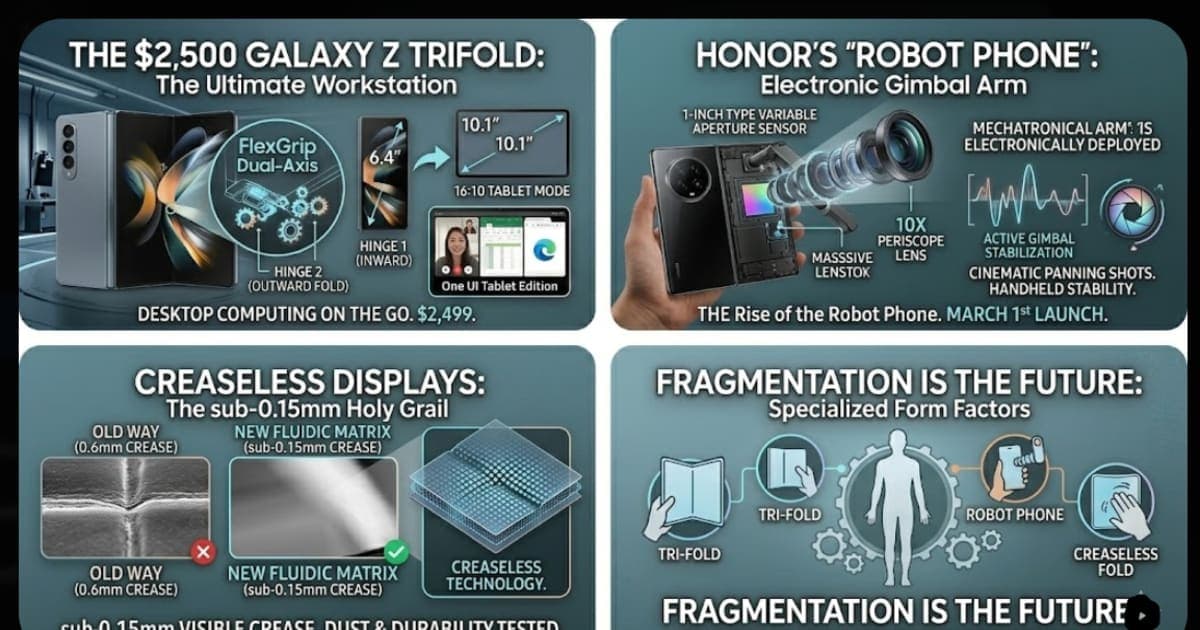
The Z TriFold launched at Unpacked in February 2026 for $2,499, and the price tag is the thing most coverage led with — which is understandable but slightly misses what's interesting about it.
The interesting thing isn't the price. It's what you actually get.
This isn't a phone that unfolds into a bigger phone. It's a phone that unfolds into a genuine 10.1-inch, 16:10 tablet — the kind of screen real estate that makes running three apps side by side feel natural rather than like a software trick running on insufficient hardware.
The Hinge That Makes It Possible
Standard book-style foldables have one hinge. The Z TriFold has two, and they fold in opposite directions.
Hinge one folds inward, the way every Fold has worked since the original. Hinge two folds outward — which is what allows the third panel to wrap around and become the 6.4-inch cover display when the device is closed.
The result, when fully folded, is a device that's 11.4mm thick. Thicker than the S26 Ultra, yes — but not by as much as you'd expect from something that contains two hinges and a 10-inch display folded into thirds.
The engineering here is the kind that doesn't get fully appreciated until you hold one. The device doesn't feel like a compromise. It feels like a decision.
The Software Has to Match the Hardware
Samsung learned from the early Fold generations that impressive hardware running unoptimized software is just an expensive disappointment.
When the Z TriFold opens to 10.1 inches, One UI Tablet Edition activates — a separate software mode with an optimized taskbar and a Multi-Window system that genuinely supports three full-sized apps simultaneously.
Zoom call. Spreadsheet. Browser. All three, visible, usable, on the same screen at the same time.
The 16:10 aspect ratio also means 8K video editing natively — not scaled up or letterboxed, but properly fitted. For anyone who currently carries both a phone and an iPad Pro, the Z TriFold is the first device that makes a credible argument for replacing both.
Is it worth $2,499? For most people, no — and that's fine. It's not designed for most people. It's designed for the specific person who needs maximum capability in a single device and has both the budget and the use case to justify it.
That person exists. There are more of them than you'd think.
The Honor Magic Robot:
A Camera That Also Happens to Be a Phone
This one launched March 1st, 2026, and the name alone generated more confused headlines than any phone announcement in recent memory.
"Robot Phone" sounds like something a product team named in a brainstorm and forgot to change before launch. But spend five minutes with the actual feature and the name starts to make sense — because it genuinely does something that no other phone does, and the mechanism that enables it does look, somewhat unmistakably, like a small robotic arm.
The Arm
Honor's diagnosis of foldable fatigue was more specific than most: photographers were the most disillusioned demographic, because foldable phones fundamentally can't have great cameras. The hinge takes up the space and structural integrity that a serious camera system needs.
Their solution was to abandon the hinge entirely and give the camera its own mechanized appendage.
In Cinema Mode, an electronically controlled mechatronic arm deploys from the phone's main body. Mounted on it: a 1-inch Type sensor with a variable aperture from f/1.6 to f/4.0 and a motorized 10x periscope lens.
Because this camera isn't sharing structural space with a folding screen, Honor could use a lens stack that genuinely rivals dedicated professional hardware. And because the arm is mechanical, it can actively compensate for shake — not with software, but with physical movement, the way a real gimbal does.
Who This Is For
The Honor Magic Robot is the narrowest product brief of anything launched in 2026: a smartphone designed entirely for cinematic videographers who want to leave their gimbal hardware at home.
It's a niche within a niche. Honor knows this. The device isn't trying to be anyone's daily driver in the traditional sense — it's trying to be the thing that cinematographers pack instead of a camera bag.
Whether that market is large enough to justify the product is a business question. As a piece of engineering, it's one of the most specific and committed answers to a user problem the industry has produced in years.
The Creaseless Display:
The One Problem Everyone Forgot
to Stop Complaining About
The crease has been the foldable's original sin since the first Galaxy Fold shipped in 2019.
That tactile ridge down the center of the screen — visible under light, noticeable under your fingertip, impossible to ignore once you've been shown it — has been the #1 complaint from every foldable user in every survey for six consecutive years.
Samsung's previous best was a crease of roughly 0.6mm. Not invisible, but liveable. The kind of thing you stopped noticing after a week and then noticed again every time a friend pointed it out.
In 2026, they reduced it below 0.15mm — a 75% reduction, achieved not by improving the hinge but by changing what the screen itself is made of.
The Fluidic Matrix
The new Fluidic Matrix AMOLED 3X panel uses a flexible substrate that allows individual pixels to shift position slightly within the panel as it folds. Microscopic tensioners pull the screen tight across the hinge area when the device opens.
The result — and this is the part that sounds like marketing until you read the blind test results — is a display that users could not identify the crease location on with their eyes closed.
Not "hard to feel." Not "much better than before." Literally could not find it without looking.
The upcoming Galaxy Z Fold 8, launching later this month, will ship with this display. Tech reviewers have already organized what's being called "The Crease Durability Challenge" — competitive testing across 400,000 fold cycles and a week of sand and dust exposure.
Early results suggest the Fluidic Matrix is significantly more durable than the ultra-thin glass it replaced. Which matters, because a creaseless display that solves the visibility problem but introduces a new fragility problem would be a lateral move rather than a solution.
So far, it doesn't look like that.
The Actual Story Here
Foldable fatigue was real because foldables stopped surprising people. A phone that folded was still just a phone that folded — same cameras constrained by the hinge, same crease, same trade-offs, just with a slightly bigger screen when you opened it.
What 2026 has done is fragment the category into products that each make a specific, committed bet on what "useful" means for a particular user.
A portable workstation that fits in a jacket pocket: Z TriFold.
A cinema camera that also sends your emails: Honor Magic Robot.
A foldable that finally, actually, genuinely doesn't feel like a foldable when you run your thumb across it: Z Fold 8.
The fatigue isn't gone because someone built a better hinge. It's gone because the industry stopped asking "how do we make foldables better" and started asking "what should a foldable actually be for?"
Those are different questions. The answers, it turns out, are a lot more interesting.
Galaxy Z TriFold: Available now, $2,499. Honor Magic Robot: Available March 1, 2026. Galaxy Z Fold 8 with Fluidic Matrix creaseless display: launching later March 2026. Pricing for Fold 8 unconfirmed at time of publication.