AI Governance in 2026 — The Shift From Principles to Enforcement Is Actually Happening
For the better part of a decade, the global conversation about governing artificial intelligence produced documents. Principles. Ethical frameworks. Voluntary commitments. White papers that described what responsible AI should look like without any mechanism for ensuring it looked that way.
That era is ending. Not because governments suddenly became more decisive, but because the technology accelerated to a point where the absence of enforceable rules became politically untenable. Three developments in early 2026 — New Delhi, Geneva, and Brussels — have moved the conversation from what should happen to what is now legally required, scientifically assessed, and diplomatically committed.
The enforcement era is here. Here is what it actually looks like.
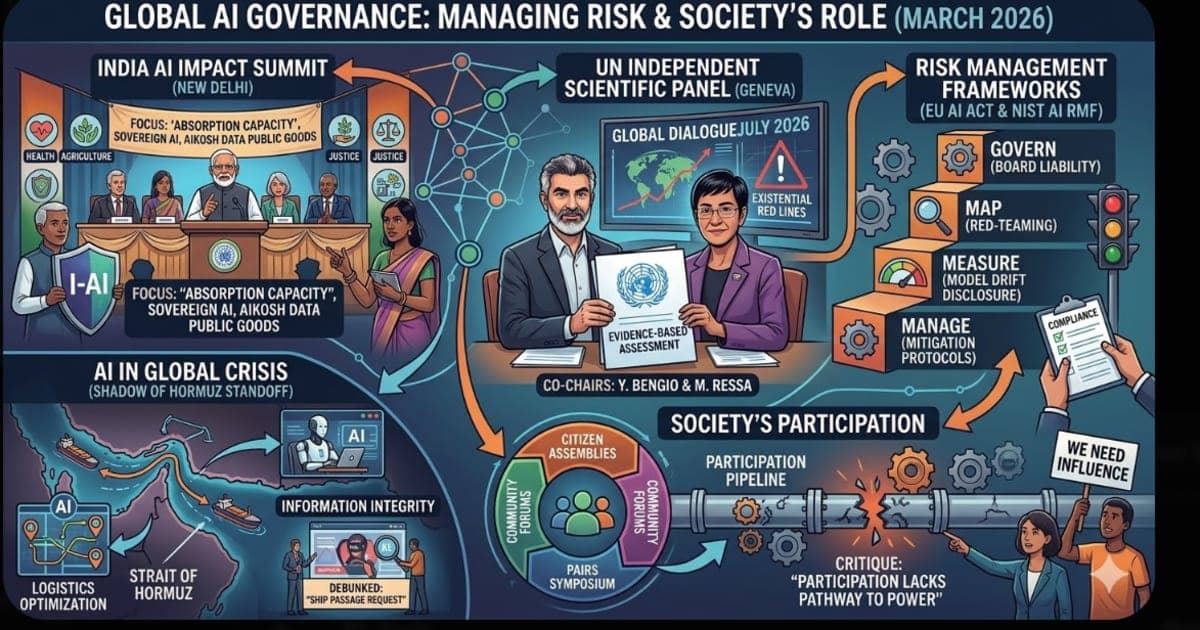
New Delhi, February 2026 — What the AI Impact Summit Actually Produced
The India AI Impact Summit ran from February 16-20, 2026 in New Delhi, with an associated expo bringing together over 300 exhibitors from more than 30 countries. [web:127] The headline output was the New Delhi Declaration on AI Impact — adopted by 88 countries and international organisations, including both the United States and China. [web:128]
That last detail matters. Getting the U.S. and China to endorse the same AI governance document, even a non-binding one, is not a trivial diplomatic achievement. It means the declaration represents a floor that the two countries most capable of shaping AI development have publicly committed to standing on, however loosely.
The declaration is built around five principles: moral and ethical systems, accountable governance, national sovereignty over data, accessible and inclusive technology, and valid and legitimate legal systems. [web:131] These are not operational requirements — they are the framework within which operational requirements are being developed. The value of the New Delhi Declaration is not in what it requires today but in what it makes harder to argue against tomorrow.
The more concrete outputs from the summit:
$200 billion in investment commitments. Electronics Minister Ashwini Vaishnaw announced that over $200 billion in AI and deep-tech investment is expected in India over the next two years, generated through the summit's business programming. [web:128] TCS announced that OpenAI will be the first anchor tenant for its Hypervault data center, with 100MW of capacity powering what is being called "OpenAI for India." [web:131]
The New Delhi Frontier AI Impact Commitments. Two specific voluntary agreements signed by participating frontier AI companies: first, to publish anonymised, aggregated data on how their AI systems are actually being used — giving policymakers evidence about real-world AI impact on jobs, skills, and productivity. Second, to improve testing and evaluation of AI systems across underrepresented languages and cultural contexts, specifically in the Global South. [web:128] English-centric AI is a structural bias that disadvantages the majority of the world's population. Getting the major labs to formally commit to addressing it is at least a documented starting point.
AIKosh and the "Bharat" model push. India's National Dataset Platform launched with over 7,500 datasets and 270 AI models as public goods. [web:134] BharatGen released Param 2 — a 17 billion parameter model supporting all 22 scheduled Indian languages. Sarvam AI revealed a 105 billion parameter model that claims to outperform GPT-4 in regional linguistic nuance. [web:131] The theme here is "AI sovereignty" — the argument that nations should not be entirely dependent on models built by American companies, trained on English-language data, and optimised for Western contexts. India is making that argument not just verbally but by building the alternative.
Fortune described PM Modi's framing as the concept of "Absorption Capacity" — the idea that a nation's strength in the AI era is measured not just by its ability to build frontier models, but by its institutional capacity to safely integrate AI into health, agriculture, justice, and public services. [web:128] That reframing positions developing economies as legitimate participants in AI governance rather than passive recipients of technology built elsewhere.
Geneva, March 2026 — The UN Panel That Will Set the Scientific Baseline
On March 3, the UN General Assembly formally launched the Independent International Scientific Panel on AI. [web:141] The panel elected its co-chairs at its inaugural meeting: Turing Award winner Yoshua Bengio and 2021 Nobel Peace Prize laureate Maria Ressa. [web:132]
Bengio is arguably the most credible voice in academic AI research on the specific question of existential risk — he has been publicly warning about advanced AI dangers since well before it became a mainstream concern. Ressa brings the journalism and human rights perspective: she has documented what algorithmic amplification of disinformation does to democracies, from personal experience, in the Philippines. [web:135]
The 40-member panel's mandate is to do for AI what the IPCC does for climate change — provide independent, evidence-based scientific assessments that inform government decisions. [web:135] UN Secretary-General António Guterres described its goal as "human control of AI" and asked for "less hype, less fear" — a calibration request that suggests the panel is designed to produce measured evidence rather than alarm. [web:138]
The panel's first scientific assessments are due before the UN Global Dialogue on AI Governance in July 2026 in Geneva. [web:138] That July dialogue is the next major international checkpoint — the point at which the scientific baseline produced by the Bengio-Ressa panel gets translated into the diplomatic conversations that may eventually produce binding agreements.
What the panel is specifically assessing: the actual capabilities and risks of current AI systems, including the "existential red lines" concept — predefined capability thresholds that, if reached, would require mandatory international responses. The specific examples being discussed include autonomous bio-weapon design capability and large-scale kinetic warfare coordination. These are not hypothetical scenarios for the panel — they are the specific capabilities being tracked and evaluated as the frontier of AI development advances.
Guterres's framing is the clearest official statement of what international AI governance is trying to achieve: "Human control of AI." Not human coexistence with AI. Not human partnership with AI. Human control. That is a specific and demanding standard that the current trajectory of AI development makes increasingly difficult to guarantee.
Brussels, August 2026 — The EU AI Act's High-Risk Deadline Is Coming Fast
The EU AI Act is the only comprehensive, legally binding AI governance framework that currently exists anywhere in the world. Its full enforcement timeline is the most concrete operational reality in the global AI governance landscape. [web:133]
The critical date is August 2, 2026 — five months away. That is when obligations for high-risk AI systems take full effect across all EU member states. [web:133]
What "high-risk" means under the Act: AI systems in biometrics, critical infrastructure management, education and vocational training, employment and HR management, access to essential services, law enforcement, migration and border control, and administration of justice. [web:139] These are not niche applications. They are the core categories of AI that governments and large organisations are most actively deploying.
The compliance requirements for high-risk AI providers are comprehensive: [web:136]
- Documented risk management system covering the entire lifecycle of the AI system
- Data governance measures ensuring training data quality, representativeness, and bias controls
- Technical documentation retained for a minimum of ten years
- Automatic logging and traceability of system activities
- Human oversight design requirements — the system must be built to allow meaningful human intervention
- Accuracy, robustness, and cybersecurity performance standards
- Conformity assessment before market placement
- CE marking and EU database registration
The penalties for non-compliance reach up to 7% of worldwide annual turnover for the most serious violations. For companies like Google, Microsoft, and Amazon, 7% of worldwide annual turnover is a number that focuses attention.
American and Asian companies with EU-facing AI systems are in a compliance sprint right now. The August 2 deadline is not being treated as a suggestion. A specialist compliance guide published in March noted the recommended sequence: between now and August 2, classify all AI systems, complete conformity assessments, finalise technical documentation, affix CE marking, and complete EU database registration. After August 2, continuous monitoring, incident reporting, and regulatory cooperation. [web:136]
Europe is not the world. But European regulation has historically set standards that other jurisdictions follow, particularly when the alternative is fragmented, incompatible rules across major markets. The EU AI Act is the template that other governments are watching as they consider their own frameworks.
The Participation Problem — Who Actually Has a Voice
The governance architecture being built in 2026 — New Delhi declarations, UN panels, EU enforcement — is sophisticated and largely legitimate. It has a structural problem that the people building it acknowledge but have not solved.
Public participation in AI governance is increasing. Citizens' assemblies, community workshops, public consultations, and online comment processes are more widespread than they were two years ago. The critique emerging from researchers and civil society at events like PAIRS 2026 (the Participation and AI Risk Symposium held this week) is precise: participation has been decoupled from decision-making power. [web:128]
Most public engagement in AI governance happens after the foundational decisions — what problems should AI solve, what data should be used to build it, what deployment contexts are acceptable — have already been made by governments and companies. Citizens are being consulted on implementation details for systems that are already designed and deployed. The "earlier decisions" — the ones that actually determine what values are embedded in AI systems — are made by small technical teams and executive leadership without meaningful external input.
The phrase being used to describe this is a "broken pipeline" — the pathway from community input to actual procurement and deployment rules has breaks in it that prevent citizen preferences from reaching the decisions where they would matter. [web:128]
The honest assessment: this is not a uniquely AI problem. It is the standard democratic deficit in technical policymaking, replicated in AI governance because AI governance is being built by the same institutions that have always excluded meaningful public participation from technical decisions. The UN panel, the EU Act, and the New Delhi Declaration are all produced by experts and governments. None of them have a formal mechanism for the 8 billion people whose lives will be shaped by AI to influence the decisions being made in their name.
Whether that changes before AI systems become too embedded to meaningfully redirect is the political question that the governance frameworks being built in 2026 are not yet answering.
AI in the Middle of the Hormuz Crisis — the Use Case Nobody Planned For
The governance debate is happening while an active war is generating real-time AI applications at scale that nobody was specifically regulating for.
Logistics optimisation systems are currently being used to reroute global shipping around the Strait of Hormuz, calculating fuel-to-risk ratios in real time for hundreds of vessels that would otherwise transit through a war zone. These are AI systems making recommendations that affect billions of dollars of cargo and the energy supply of multiple countries. They are not subject to EU AI Act high-risk classification in their current deployment context. They are operating without the documentation, conformity assessment, or human oversight requirements that would apply to an AI system making employment decisions.
AI-assisted fact-checking units are working at scale to combat the deepfake and disinformation environment created by the conflict — everything from fabricated video of ship attacks to false attribution of statements to officials. The information integrity challenge in a high-stakes geopolitical conflict, where both sides have incentive to shape the narrative, is exactly the context where AI-assisted detection matters most and where the risks of AI-generated fabrication are highest.
Both applications demonstrate the same underlying tension: AI governance frameworks are designed around anticipated use cases in stable environments. Crises create use cases that nobody anticipated, at speeds that outpace regulatory coverage. The Hormuz logistics AI and the conflict disinformation detection systems are operating in a governance gap — valuable, necessary, and essentially unregulated.
The governance frameworks being built this year will not solve that problem. They may make the next crisis slightly better governed than this one.
July 2026 — What Geneva Needs to Produce
The UN Global Dialogue on AI Governance in July is the next major international checkpoint. It will receive the Bengio-Ressa panel's first scientific assessments. It will take place after the EU AI Act's August deadline has created real-world enforcement precedents. It will occur in a world where the Hormuz crisis has demonstrated what unregulated crisis AI looks like.
What July needs to produce, according to the architecture being built:
A shared scientific understanding of current AI capabilities and the specific capability thresholds that would require mandatory international response. The panel's work is the input. The Dialogue is where it becomes the basis for diplomatic commitments.
A Trusted Global Data Framework — the mechanism for sharing data across national boundaries while respecting data sovereignty — that allows the "Red Lines" monitoring infrastructure to function internationally rather than just within jurisdictions that have comprehensive domestic frameworks.
Progress on making participation meaningful rather than cosmetic — incorporating the critique from PAIRS 2026 into the actual structure of how citizen input reaches AI governance decisions.
None of these outcomes are guaranteed. International diplomatic processes on AI have historically produced declarations rather than binding agreements. The difference in July 2026 is that the EU enforcement deadline, the UN panel's scientific authority, and the New Delhi Declaration's diplomatic breadth create a convergence that makes meaningful agreements more likely than they have been at any previous point.
"Less hype, less fear." That was Guterres's instruction to the panel. It is also the appropriate standard for assessing what AI governance in 2026 is actually achieving versus what it is promising.
What it is actually achieving: the first comprehensive legal enforcement framework in Europe, a credible UN scientific panel with legitimate co-chairs, a New Delhi Declaration with 88 signatories including the U.S. and China, and $200 billion in AI investment flowing into a country committed to sovereign, inclusive AI development.
What it is promising: human control of the most powerful technology humanity has built.
The gap between those two things is where the work of the rest of 2026 happens.