Ghibli AI Art and Photo Restoration — Why These Two Trends Just Won't Die
Every few months a new AI image model drops and everyone loses their mind for a week. The hype cycle runs its course, the next thing arrives, and people move on.
But two categories of AI image searches have been consistently popular for years now — and they're still at the top in 2026. Ghibli-style image generation and AI photo restoration. They don't spike and drop like trend cycles. They just stay.
That's worth understanding. Because when something stays popular in AI for this long, it's usually telling you something real about what people actually want.
The Ghibli Thing — Why It's Still Everywhere
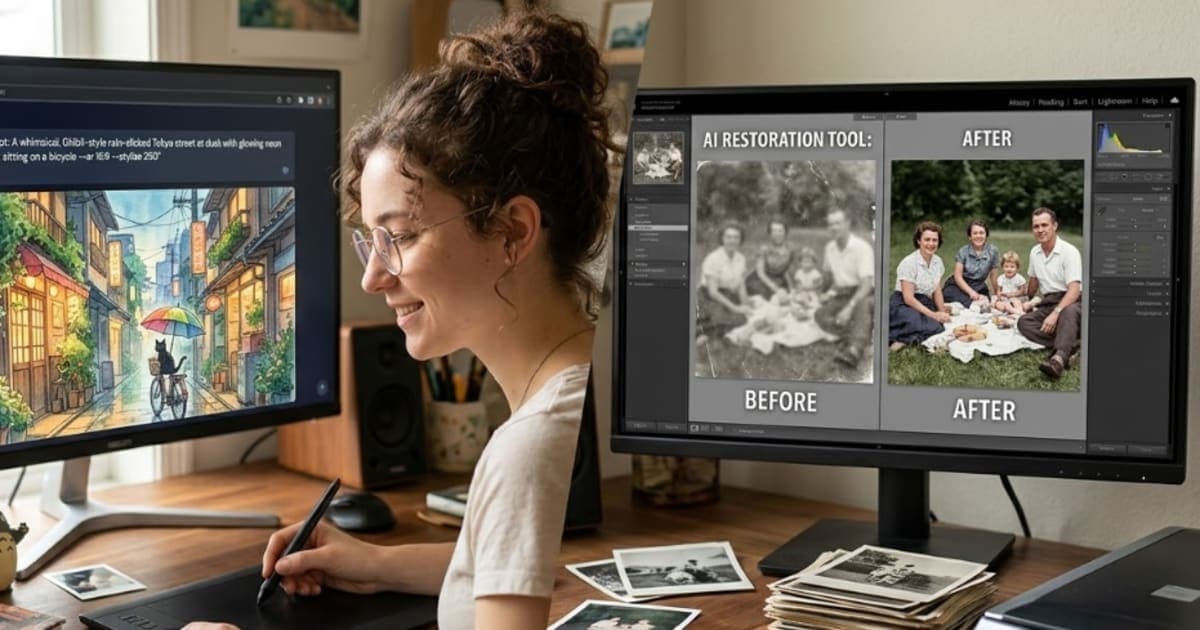
Studio Ghibli films are not new. Spirited Away came out in 2001. My Neighbor Totoro is from 1988. And yet "Ghibli style" remains one of the most searched aesthetic prompts across every major AI image platform — Midjourney, DALL-E, Stable Diffusion, and the newer models that have followed.
The reason isn't nostalgia exactly. Or it's not only nostalgia.
Ghibli's visual language does something very specific: it makes ordinary things feel significant. A kitchen with steam rising from a pot. A field in the late afternoon light. A train crossing a flooded plain at dusk. Nothing about these scenes is extraordinary — but in Ghibli's hands, they feel like the most important moments in the world. The brushwork is visible. The colours are warm and slightly soft. The light behaves the way you remember light feeling rather than the way a photograph captures it.
That quality — warmth, texture, the sense that someone painted this by hand — is genuinely rare in the age of AI-generated imagery. Most AI art in 2026 trends toward hyper-detailed, technically perfect, and somehow cold. Ghibli style is the opposite of all of that. Which is exactly why people keep reaching for it.
When someone prompts "Ghibli-style version of my apartment" they're not asking for accuracy. They're asking for the same thing Miyazaki's films do with ordinary Japanese homes and countryside — they want to see their actual life through a lens that makes it feel like it matters. That's a remarkably human thing to want, and AI happens to be good at delivering it.
The Copyright Problem Nobody Has Solved
It would be dishonest to write about Ghibli-style AI without mentioning the controversy that's been running alongside the trend for years.
The models generating these images were trained on thousands of frames of hand-drawn animation — work produced by Ghibli artists over decades. That training happened without those artists' explicit consent. Hayao Miyazaki has been publicly and vocally opposed to AI art in general, describing early AI animation as "an insult to life itself." His studio has not licensed its style to any AI company.
The legal question — can you copyright a visual style? — remains genuinely unresolved. Courts in multiple countries are still working through cases involving AI training data. What's clear is that the ethical discomfort is real even when the legal framework hasn't caught up. The people generating beautiful Ghibli-style images of their neighbourhood are usually not thinking about this. But the artists whose decades of work made those images possible often are.
This doesn't make the trend go away. But it's part of the honest picture.
AI Photo Restoration — The Other Trend That Won't Die
The second category is less glamorous but arguably more meaningful.
Searches for "AI restore old photo," "AI remove scratches from photo," "unblur old photo AI," and "black and white photo colorization" have been climbing steadily for years. The technical capability that drives this has improved dramatically — but the reason people keep searching for it hasn't changed at all.
People have photos of their grandparents that are faded, scratched, blurry, or printed on deteriorating paper. They have early digital photos from the 2000s that look terrible on any modern screen. They have film photos that were scanned at low resolution and never properly digitised.
Those photos contain people who are no longer alive. Moments that cannot be recreated. And for years, restoring them properly required either professional photo editing skills or paying someone who had them.
AI changed that. In 2026, tools like Remini, Topaz Photo AI, Adobe's generative fill features, and several others can take a blurry, scratched 1950s portrait and produce something that looks like it was taken yesterday. The AI has been trained on enough facial data that it can reconstruct features from blurry inputs with unsettling accuracy. It can add colour to black and white photos by reading contextual clues — the tone of someone's skin, the era-appropriate colours of their clothing, the light in the room.
The result is a version of your grandmother at thirty that feels real in a way the faded original no longer does. That's not a small thing. People are not using this for novelty. They're using it to feel less far from people they've lost.
When Both Trends Meet — The Ghibli Filter
The most interesting user behaviour happens when these two categories overlap.
"Ghibli-style from photo" and "turn my photo into Ghibli art" have been consistently popular search queries. Someone takes an actual photograph of their local park, their street, their house — and asks an AI to restyle it in Ghibli's visual language.
The result is different from either straight photo enhancement or pure Ghibli generation. It's personal. The geography is real — recognisable to anyone who knows the place — but the mood has been transformed. The slightly overgrown corner of the park that looks ordinary in a photo becomes exactly the kind of corner where a soot spirit might be hiding. The late evening light on your building's exterior becomes the kind of glow that appears in the last act of a Ghibli film when everything is about to resolve.
It's your actual memory, but elevated. Your life, validated by the most beloved aesthetic in animation history.
That's genuinely powerful as a creative experience, which is why it keeps happening regardless of whatever the current AI hype cycle is focused on.
The Tools Actually Worth Using in 2026
For Ghibli-style generation:
Midjourney remains the strongest for aesthetic quality. Prompts like "Ghibli style, soft watercolour backgrounds, warm afternoon light, [your scene]" with the --stylize parameter turned up produce the most consistent results. Version 6 handles the painterly texture better than earlier versions.
DALL-E 3 (through ChatGPT) is more accessible and handles specific scene descriptions well. Less stylistically consistent than Midjourney but easier to prompt conversationally.
Stable Diffusion with community-trained Ghibli LoRA models gives you the most control if you're willing to put in the setup time.
For photo restoration and enhancement:
Topaz Photo AI is the current standard for upscaling and noise removal. It handles old film photos particularly well and the face recovery feature is genuinely impressive on portraits.
Remini is the most accessible mobile option. Upload a blurry photo, get a sharp one back in seconds. Quality has improved significantly in the last year.
Adobe Photoshop's AI features (Neural Filters > Photo Restoration) are worth using if you're already in the Adobe ecosystem. The scratch and damage removal has gotten much better.
MyHeritage In Color specifically for black and white colorisation — it's trained on historical photo data and handles period-appropriate colorisation better than general-purpose tools.
What These Two Trends Tell You
The fact that these two categories stay popular while everything else in AI cycles in and out says something specific.
People aren't using AI primarily to replace human creativity or automate their workflows. The most sustained use cases are emotional ones — making memories feel more present, making ordinary moments feel more beautiful, recovering connections to people who are gone.
The technology is genuinely impressive. But the reason people keep coming back to these specific things isn't the technology. It's that these particular applications touch something that most AI tools don't reach.
The dream version of your street. Your grandmother at thirty, clear and real. Your messy flat, transformed into somewhere a Ghibli protagonist might live.
None of that is about efficiency. All of it is about meaning. And apparently, after everything AI has promised to automate and optimise, meaning is still what people are actually searching for.