The doctor-engineer-lawyer conversation has been India's default career script for forty years.
It's not wrong exactly — those professions still pay well and carry real social weight. But in 2026, a different conversation is happening in hiring rooms, on LinkedIn, and in the salary negotiations of people in their late twenties who three years ago would have been thrilled with a ₹12L package.
The AI job market in India is not a bubble. It's a structural shift — the kind that happens once or twice in a generation and completely rewrites who gets paid what and why.
Demand for high-level AI expertise is projected to exceed supply by nearly 40% in 2026. That gap doesn't close quickly. And while it stays open, the people who have the right specific skills are essentially writing their own salary numbers.
₹30 lakh is not the ceiling here. For several of these roles, it's the floor.
Here's what those skills are and what you actually need to learn.
1. LLM Engineering and Finetuning
Everyone has used ChatGPT. Almost nobody can actually build with it — the way enterprises need to build with it.
Pre-trained models are impressive in demos. In production, they're a starting point. An Indian bank can't deploy a generic LLM that doesn't understand RBI regulations. A healthcare company can't use a model that gets medical terminology wrong. A state government building a citizen services chatbot needs an AI that speaks fluent Hindi or Tamil or Bengali — not just passable.
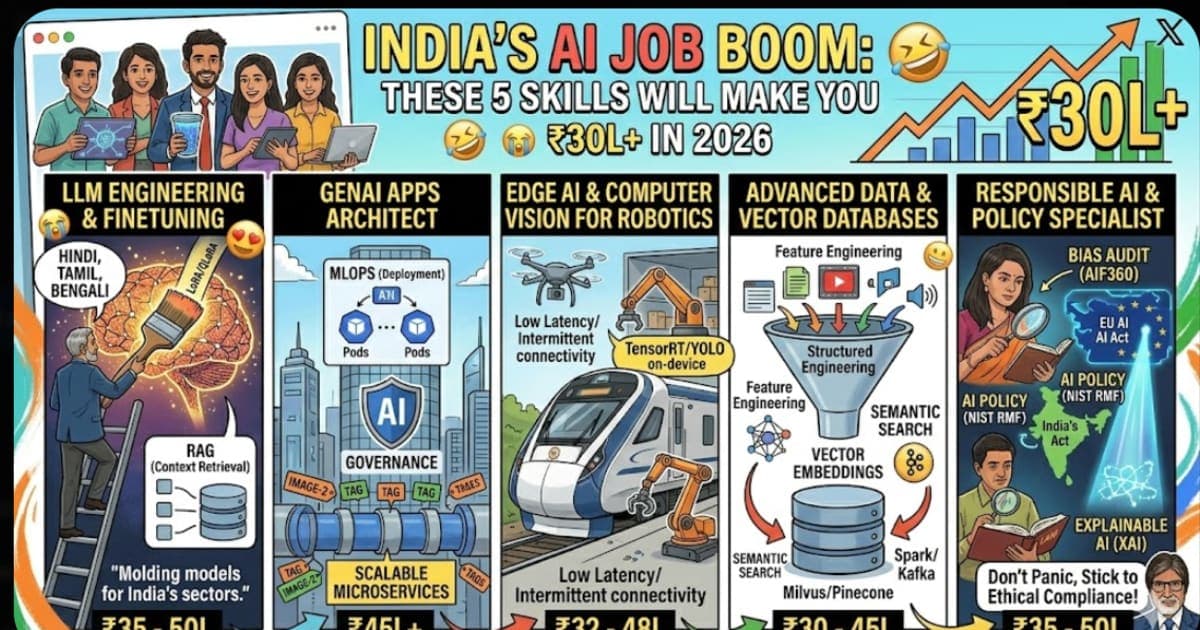
LLM Engineers are the people who take a raw model and make it actually useful for a specific context. The techniques that matter: LoRA and QLoRA — methods that let you finetune a large model efficiently without needing supercomputer-level hardware. RAG (Retrieval-Augmented Generation) — connecting the model to a company's private database so it gives accurate, current, verified answers instead of hallucinated ones.
Tools you need to know: PyTorch, Hugging Face, LangChain. These aren't optional extras. They're the job.
Salary range: ₹35 – 50L for proven experience in Bengaluru and Hyderabad. More for senior roles.
2. Generative AI Applications Architect
Building a model and deploying a model are completely different problems.
A lot of Indian companies spent 2024 and 2025 running AI proof-of-concepts — small internal demos, limited user tests, exciting PowerPoint presentations to leadership. In 2026, the question is: how do we actually ship this thing at scale, reliably, without it leaking user data or generating responses that end up in a news article for the wrong reasons?
That's the GenAI Applications Architect's job. They design the entire system — not just the model, but the infrastructure around it. How it scales when ten thousand users hit it simultaneously. How it stays compliant with India's Digital Personal Data Protection Act. How it handles the cost of running large model inference without the bill becoming the headline.
What you need: MLOps pipeline design, Kubernetes for scalable microservices, cloud infrastructure across AWS SageMaker, Azure AI, or GCP Vertex AI. And critically — AI Governance. The ability to define guardrails that stop an application from hallucinating, from producing toxic content, from making decisions it wasn't supposed to make.
This is a strategic role. Companies don't hire one and then let them go. They build entire teams around them.
Salary range: ₹45L+ For senior or managerial positions, significantly higher.
3. Edge AI and Computer Vision
for Robotics
Most people still think of AI as something that lives in the cloud — you send a request, a server somewhere processes it, you get an answer.
That model works fine for a chatbot. It doesn't work for an autonomous drone navigating Mumbai traffic, or a robotic picking arm in a Flipkart warehouse making split-second decisions, or an agricultural drone that needs to identify a diseased crop row while flying over a field with patchy internet connectivity.
These systems need intelligence that runs on the device itself — low latency, low power consumption, no dependency on a server that might be three seconds away.
Edge AI is the discipline of making complex models run on constrained hardware. The skill set: taking something like a YOLO or Swin Transformer model and optimizing it to run on an NVIDIA Jetson or Google Coral chip — through quantization, pruning, and compilers like TensorRT. Plus ROS — the Robot Operating System — for integrating AI with actual physical hardware.
This combination — hardware understanding plus deep AI knowledge — is rare. India's manufacturing, logistics, and agriculture sectors are automating fast and they need these people now.
Salary range: ₹32 – 48L The rarity of the skill set means negotiating power is genuinely high.
4. Advanced Data Engineering
and Vector Databases
AI is only as good as what it can find and understand.
The move from traditional SQL databases to vector databases is one of the less-discussed but genuinely important infrastructure shifts happening in enterprise tech right now. Standard databases search for keywords. Vector databases understand semantic meaning — context, similarity, intent. For any LLM application using RAG, the model is only as accurate as the retrieval system feeding it information.
That retrieval system is a vector database. The people who build, optimize, and manage them are becoming foundational to every serious AI deployment.
Tools to master: Pinecone, Milvus, Qdrant, Chroma for the vector layer. Sentence Transformers for embedding — Word2Vec is the baseline, not the standard. Spark and Kafka for the real-time data pipelines feeding the whole system.
This is the kind of role that doesn't get the flashy job titles but sits underneath every impressive AI product a company ships.
Salary range: ₹30 – 45L at mid-level experience. Senior specialists go higher.
5. Responsible AI
and AI Policy Specialist
This one surprises people when it appears on a high-salary list — because it's not a purely technical role in the way the others are.
But think about what's actually at stake.
A hiring model with bias quietly filters out qualified candidates from certain backgrounds for two years before anyone notices. A legal AI hallucinates case citations and a lawyer submits them to court. A customer-facing chatbot leaks personal data in a way that triggers regulatory investigation under India's DPDP Act.
Any one of these scenarios costs a company significantly more than the salary of the person whose job was to prevent it.
The Responsible AI Specialist is that person. They audit models for bias — using tools like AI Fairness 360. They implement Explainable AI frameworks — the ability to show why a model made a specific decision, in terms that regulators and lawyers can understand. They track every evolving regulation — India's DPDP Act, the EU AI Act, whatever comes next.
This is an excellent entry point for legal professionals, policy specialists, and social scientists who want to work in AI without needing to write model training code.
Salary range: ₹35 – 50L The regulatory pressure on companies is increasing. This role's value increases with it.
The Honest Reality Check
None of these salaries arrive without the skills to back them up.
The ₹30L+ market is not looking for people who have done an online course and updated their LinkedIn headline. It's looking for people who have built something real — a finetuned model that solves an actual problem, an edge deployment that runs on actual hardware, a bias audit on an actual production system.
The gap between "I know what RAG is" and "I have built a RAG pipeline for a 10-million-document corpus" is the gap between getting screened out and getting an offer.
The market is genuinely good. The demand is real. But the shortcut is still the longest route.
Your Roadmap at a Glance
| Skill | What to Master | Role | 2026 Salary |
|---|---|---|---|
| LLM Engineering | LoRA / QLoRA, RAG, LangChain | LLM Engineer | ₹35 – 50L |
| GenAI Architecture | MLOps, Kubernetes, AI Governance | GenAI Apps Architect | ₹45L+ |
| Edge AI / Robotics | TensorRT, Quantization, ROS | Edge AI Specialist | ₹32 – 48L |
| Vector Data Engineering | Pinecone / Milvus, Sentence Transformers | Vector Data Engineer | ₹30 – 45L |
| Responsible AI | XAI, AI Fairness 360, DPDP Act | Responsible AI Specialist | ₹35 – 50L |
The structural shift is real and it is happening now — not in five years, not when "the market matures."
The demand gap between what Indian companies need and what the talent pool currently offers is wide enough that people with the right skills and three to five years of experience are having conversations about compensation that would have seemed unlikely even in 2023.
The question isn't whether these jobs exist. They do, and they pay what the article says they pay.
The question is which of these five paths matches what you're already good at — and how fast you can close the gap between where you are and where the market is willing to pay you to be.
Salary figures cited are indicative ranges based on current market data for professionals with 3–5 years of relevant experience in Tier-1 Indian cities. Actual compensation varies by company, location, and negotiation. All figures in Indian Rupees per annum including variable components.