Two phones. Two philosophies. One decision.
The Samsung Galaxy S26 Ultra launched February 25, 2026. The iPhone 17 Pro Max has been in people's pockets since September 2025. Both cost over a thousand dollars. Both are genuinely excellent. And they are built on completely different beliefs about what a phone should do for you.
This isn't a spec comparison. Those exist everywhere. This is an attempt to explain which one is right for the kind of person you actually are — and to be honest about the tradeoffs neither manufacturer will tell you about themselves.
Design: Two Very Different Ideas
of What "Premium" Means
Samsung Galaxy S26 Ultra
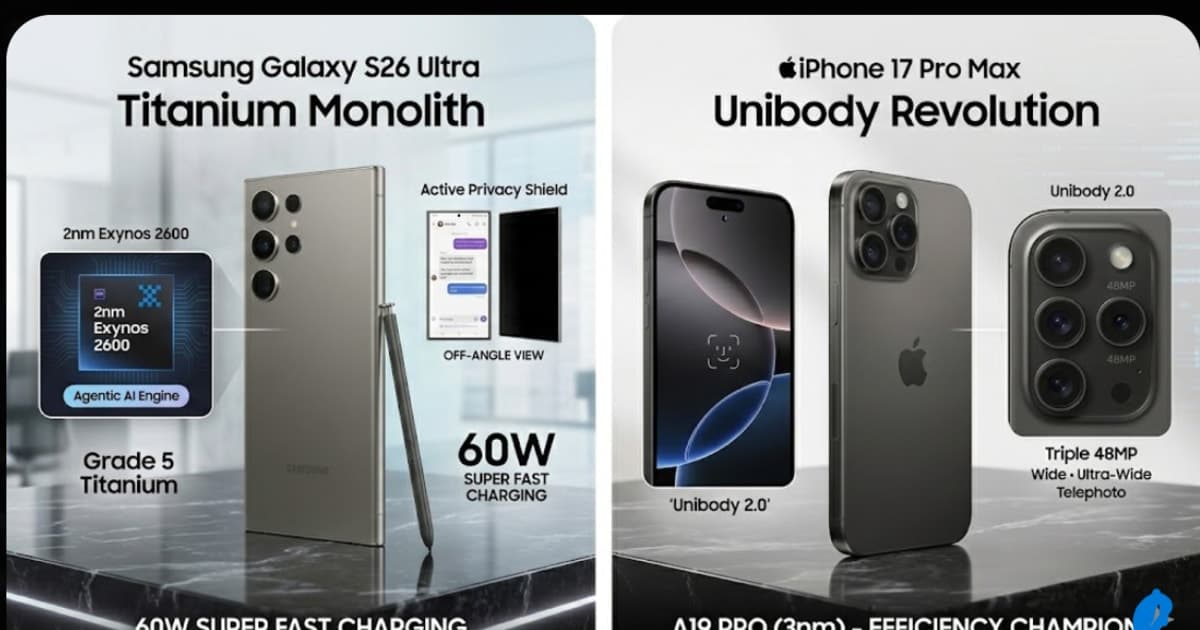
The S26 Ultra looks like it was designed for someone who uses their phone as a tool and wants it to feel like one. Grade 5 aerospace titanium chassis. Sharp professional corners. The S Pen integrated into the body the way a good pen lives in a jacket pocket — there when you need it, invisible when you don't.
At 7.9mm thin and 214g, it is the lightest Ultra Samsung has made. That is not a small thing. Previous Ultra models asked you to accept weight as the price of capability. This one doesn't.
The S Pen this generation has a haptic motor that mimics pen-on-paper resistance. It sounds like a detail. After an hour of writing with it, it doesn't feel like one.
Apple iPhone 17 Pro Max
Apple's design direction this year is "Unibody 2.0" — a seamless transition from the back glass to the titanium frame that makes the device feel like a single machined object rather than assembled parts.
The iPhone 17 Pro Max is thinner in terms of feel than its dimensions suggest — Apple's chamfering and edge geometry do a lot of work. But it is heavier at 231g, a consequence of the large battery and the MagSafe cooling magnets inside the chassis.
If the S26 Ultra looks like a precision instrument, the iPhone 17 Pro Max looks like something you'd keep in a velvet case. Neither is wrong. They just appeal to fundamentally different aesthetics.
Display: Same Size,
Completely Different Priorities
Both screens are 6.9 inches. Beyond that, they diverge.
| Feature | Samsung S26 Ultra | iPhone 17 Pro Max |
|---|---|---|
| Panel | Dynamic AMOLED 2X | Super Retina XDR OLED |
| Peak Brightness | 3,000 nits | 3,000 nits |
| Refresh Rate | 1Hz – 120Hz | 1Hz – 120Hz |
| Resolution | QHD+ | FHD+ (ProMotion) |
| Killer Feature | Active Privacy Shield | Under-Display Face ID |
Samsung's answer: The Active Privacy Shield is a hardware-level privacy filter built into the panel. Toggle it on and the screen narrows its viewing angles at the pixel level. The person next to you on the train sees a black screen. You see full brightness, full color, full 120Hz — completely unaffected.
This is not a software trick and not a stick-on film. It works without compromising what you see. For anyone who regularly works in public spaces, this is the feature that makes the S26 Ultra worth the price before you've looked at anything else.
Apple's answer: The Dynamic Island is now a Dynamic Dot. Under-display Face ID has finally arrived, giving the iPhone 17 Pro Max the full-screen experience Apple has been building toward for several years. The result is a display that simply has no interruptions — no pill, no notch, nothing except screen.
Performance: The 2nm Era Begins
Both chips are built on a 2nm process. The conversation has shifted from who has the fastest chip to who has the most useful one.
Snapdragon 8 Elite Gen 5 (Samsung)
Qualcomm's chip is built around the Agentic Engine — a dedicated processor for running large language models entirely on-device. Your AI tasks don't leave the phone. Your data doesn't go to a server. The processing happens on the device in your hand.
In raw multi-core benchmarks, the Snapdragon leads. In gaming performance at sustained loads, it leads. The NPU improvement — 39% over the previous generation — is the number that matters most for what these phones actually do in 2026.
Apple A19 Pro (iPhone)
Apple's advantage is efficiency, not peak power. The A19 Pro doesn't win every benchmark category. It wins the benchmark that doesn't appear in spec sheets: performance per watt.
App launch speeds, video rendering, ProRes encoding — the A19 Pro handles these with a thermal profile that keeps the device cool under sustained creative workloads. The Neural Engine is tuned specifically for Siri's new on-screen awareness — contextual AI that reads what's on your display and acts without being asked.
Neither chip is slow. The question is what kind of performance matters to you.
Cameras: Two Philosophies,
Both Excellent
Samsung S26 Ultra
The 200MP main sensor now has a variable aperture — f/1.4 to f/2.4. In practical terms: more natural background separation in portraits without computation, and significantly more light in low-light photography without artificial sharpening.
The telephoto system is now two 50MP lenses — one at 5x, one at 10x. The 100x Space Zoom is no longer just a party trick; combined with AI stabilization, it produces usable images at distances that previously required dedicated glass.
For video, the APV codec is Samsung's ProRes equivalent. Near-lossless 8K at 30fps. The kind of file that survives color grading in post without falling apart.
iPhone 17 Pro Max
Apple's camera decision this year is philosophically interesting: all three lenses are 48MP. Same sensor size, same resolution. The result is that switching between wide, ultrawide, and telephoto during video produces no color temperature jump, no detail drop, no perceptible transition.
For filmmakers who cut between focal lengths, this is the most useful thing Apple has ever done to a camera system.
ProRes Log 2.0 records 12-bit color directly to external SSDs via USB-C 4.0. The iPhone 17 Pro Max remains the device of choice for serious video work — not because of resolution, but because of how the footage behaves in post-production.
Software: Open Versus Controlled
Samsung One UI 8.5
Samsung's bet is openness. One UI 8.5 lets you choose which AI runs your life — Google Gemini, Bixby, or a locally hosted model that never touches the cloud.
The "Circle to Act" feature is the kind of implementation that sounds like a demo until you use it daily: circle anything on your screen, and the phone takes action — finds products, books tables, adds items to carts, opens maps to addresses. It connects intent to action in fewer steps than any previous interface.
Apple iOS 26
Apple's bet is seamlessness. Siri in iOS 26 is not a voice assistant you summon — it is a presence that reads your context and acts before you ask.
Flight mentioned in a text message: Siri checks traffic to the airport, looks at your calendar, suggests a departure time. All on-device via Private Cloud Compute. Apple's data privacy architecture is the most audited in the consumer technology space — and it shows in how the system behaves.
The Apple ecosystem integration — Watch, Mac, iPad, AirPods — remains the most seamless in consumer technology. If you live in that ecosystem, iOS 26 tightens it further. If you don't, it's irrelevant.
Battery and Charging:
The Gap Is Closing
Samsung S26 Ultra: 5,000mAh. 60W Super Fast Charging 3.0. 0% to 75% in approximately 30 minutes. This is a charging speed that changes behavior — a short charge actually means something.
iPhone 17 Pro Max: 5,088mAh. 40W wired charging. Slower to fill, but real-world battery endurance — social media, video calls, navigation, the actual usage patterns of daily life — runs approximately 10% longer than the Samsung. The A19 Pro's efficiency is the reason. The battery lasts longer not because it's bigger but because the chip asks less of it.
Full Specifications
| Feature | Samsung Galaxy S26 Ultra | Apple iPhone 17 Pro Max |
|---|---|---|
| Release Date | February 25, 2026 | September 19, 2025 |
| Display | 6.9" Dynamic AMOLED 2X, QHD+ | 6.9" Super Retina XDR OLED |
| Refresh Rate | 1Hz – 120Hz Adaptive | 1Hz – 120Hz ProMotion |
| Peak Brightness | 3,000 nits | 3,000 nits |
| Display Feature | Active Privacy Shield | Under-Display Face ID |
| Processor | Snapdragon 8 Elite Gen 5 | Apple A19 Pro |
| RAM | 12GB / 16GB LPDDR5X | 12GB LPDDR5X |
| Storage | 256GB / 512GB / 1TB | 256GB / 512GB / 1TB / 2TB |
| Main Camera | 200MP f/1.4 Variable Aperture | 48MP Wide |
| Ultrawide | 50MP | 48MP |
| Telephoto | 50MP 5x + 10MP 3x Optical | 48MP 8x Optical |
| Front Camera | 12MP Dual Pixel | 18MP Centre Stage |
| Video | 8K @ 30fps APV Codec | 4K @ 120fps ProRes Log 2.0 |
| Battery | 5,000mAh | 5,088mAh |
| Wired Charging | 60W (75% in 30 mins) | 40W (50% in 20 mins) |
| Build Material | Grade 5 Aerospace Titanium | Aerospace Aluminium Unibody |
| Dimensions | 163.6 × 78.1 × 7.9 mm | 163.4 × 78.0 × 8.75 mm |
| Weight | 214g | 231g |
| OS | Android 16 / One UI 8.5 | iOS 26 |
| Starting Price | $1,299 (256GB) | $1,199 (256GB) |
The Actual Decision
Choose the Samsung Galaxy S26 Ultra if: You use your phone as a mobile workstation. You handle sensitive information in public spaces regularly. You shoot video you intend to edit. You take notes, sign documents, or sketch with the S Pen. You want to choose your own AI ecosystem rather than inherit one.
Choose the iPhone 17 Pro Max if: You are already in the Apple ecosystem and want the version of it that works without friction. You shoot video you want to cut between focal lengths. You want the most consistent camera output across all lenses. You want a device that feels like a single designed object rather than a collection of features.
Both of these phones are the best their manufacturers have ever made. The choice between them is not about quality. It is about which set of tradeoffs matches the way you actually live.
Samsung Galaxy S26 Ultra available for pre-order now, retail from March 11, 2026. iPhone 17 Pro Max available now globally. Pricing: S26 Ultra from $1,299 / iPhone 17 Pro Max from $1,199.