Samsung held its Unpacked event in San Francisco on February 25, and the Galaxy S26 series landed largely the way the leaks suggested — but with a few surprises that the spec sheets don't fully capture.
The short version: the Ultra is genuinely different this year in ways that matter. The base S26 is the best small flagship Samsung has ever made. And the gap between the two has never been more clearly defined.
Here is what you actually need to know.
The S26 Ultra: Three Things
That Change the Conversation
1. The Privacy Display Is Real
and It Works
Every year there is one feature that sounds like a marketing talking point until you actually use it.
The built-in Privacy Display on the S26 Ultra is that feature.
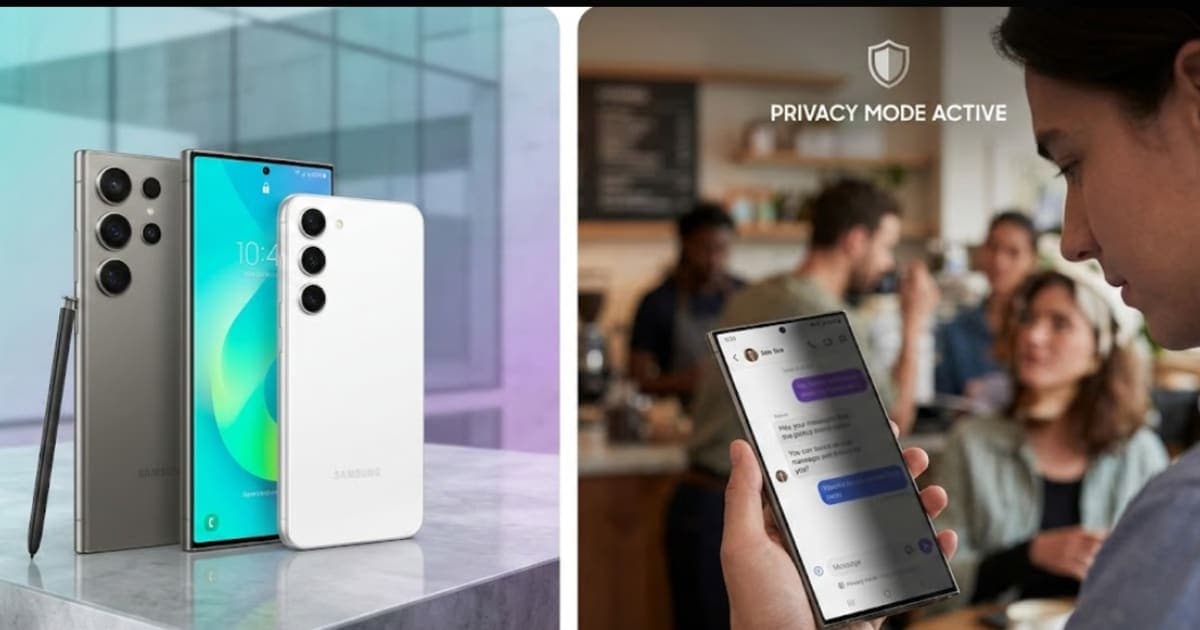
It is hardware-level — integrated directly into the 6.9-inch QHD+ Dynamic AMOLED 2X panel, not a film sitting on top of it. When you toggle Privacy Mode, the viewing angle narrows dramatically. From the side, the screen goes dark. From the front, you see exactly what you always did: 120Hz, full brightness, full color accuracy, completely unaffected.
The old plastic screen protectors that claimed to do this achieved it by making the screen worse for everyone, including you. This achieves it without compromise.
For anyone who works on a laptop or reads documents in public spaces — on trains, in coffee shops, in open-plan offices — this is not a gimmick. It is a feature you will use every single day and notice the absence of on every other device you own.
2. The APV Codec Is
the ProRes Moment for Android
Samsung has been making cameras that rival dedicated devices for years. With the APV codec, they've finally addressed the last significant gap.
APV — Advanced Processing Video — is Samsung's answer to Apple's ProRes. It allows nearly lossless 8K recording at 30fps, capturing enough data that editors can adjust exposure, recover highlights, and grade color in post without destroying the image.
If you've ever shot compressed video on a smartphone and then watched it fall apart the moment you tried to push the shadows or pull the highlights, you understand why this matters.
Add the new Horizontal Lock in Super Steady mode — which keeps the horizon stable even when the device tilts — and the S26 Ultra becomes a serious argument against carrying a separate camera for anything short of a professional production.
3. It's Lighter Than Any Ultra Before It
The S26 Ultra weighs 214 grams. That is the lightest an Ultra has ever been and it is noticeable in about thirty seconds of holding it.
The bezels are thinner, the edges are slightly more ergonomic than the hard industrial lines of the S24 and S25 generations, and the S Pen is still there — still integrated, still pressure-sensitive, still the feature that no other flagship has bothered to match.
The Ultra has always been the device for people who want maximum capability in a single device and don't mind carrying something substantial. In 2026, it's finally stopped asking you to compromise on weight to get that capability.
The S26: The Small Flagship
Finally Gets Its Battery
The standard Galaxy S26 is 167 grams and 6.3 inches. If those numbers sound right to you, the rest of this section is good news.
The single most common complaint about the base Galaxy S model over the past three years has been battery life. A 4,000mAh cell in a device used by heavy users was not getting through a full day without a top-up.
The S26 moves to 4,300mAh. That is not a massive number on paper, but combined with the efficiency of the new chipsets (more on those below), real-world testing suggests it makes a meaningful difference — genuine all-day performance for users who push the device hard.
The display is a 6.3-inch FHD+ Dynamic AMOLED 2X panel. It doesn't have the Privacy Display hardware of the Ultra, but it gets Samsung's new ProScaler AI — which upscales streaming content to near-QHD quality in real-time. In practice, Netflix and YouTube look better on this panel than the resolution number suggests they should.
This is the phone for people who want flagship performance in something they can actually use one-handed without thinking about it. Samsung has been making this phone for several years. This is the best version of it.
The Chipset Situation:
Honest Assessment
The processor split is back, and it's worth understanding before you buy.
North America and China get the Snapdragon 8 Elite Gen 5 across the entire lineup — S26, S26+, and S26 Ultra.
Europe, India, and most other markets get the Snapdragon 8 Elite Gen 5 in the Ultra only. The S26 and S26+ in these regions run the Exynos 2600.
Here is the honest version of what that means:
The Snapdragon 8 Elite Gen 5 leads in raw peak performance — 19% faster CPU, 39% more NPU power. It is a fast chip.
The Exynos 2600 is the world's first 2nm smartphone processor. In early benchmarks, it runs cooler during sustained loads and is more power efficient. For gaming sessions that go past twenty minutes, thermal throttling matters more than peak benchmark numbers — and the Exynos has an argument to make.
The NPU jump on both chips is where the real story is. Samsung's "Agentic AI" framing isn't just marketing language — the on-device AI processing is meaningfully faster this generation, and it shows in the camera system and the Galaxy AI features.
Cameras: What Actually Changed
The megapixel numbers are familiar. What changed is underneath them.
S26 Ultra: The 200MP main sensor keeps its resolution but gains a significantly wider f/1.4 aperture. In low light, that aperture change is more impactful than any megapixel increase would be — more light reaches the sensor, which means less noise, better detail in shadows, and more natural background separation without computational trickery.
The telephoto system is now a 50MP 5x and a 10MP 3x, and both benefit from AI-powered Nightography Video — which extends the night video improvements Samsung has been building for years out to the zoom lenses, not just the main camera.
S26: Triple camera — 50MP main, 12MP ultrawide, 10MP telephoto. The upgrade here is the Agentic AI ISP, which uses the NPU to analyze what's in the frame and process different elements differently. Skin tones get one treatment. Foliage gets another. The background gets another.
The result is images that look more like what your eye saw and less like what the sensor captured — which is the goal that computational photography has been chasing for a decade.
Charging: Progress, With Caveats
The Ultra finally gets fast charging that matches its price point. 60W Super Fast Charging 3.0 hits 75% in 30 minutes. That is a usable number — the kind of number that changes behavior, where plugging in while you shower actually means something when you leave.
The base S26 stays at 25W wired. It does gain Fast Wireless Charging 2.0 at up to 20W, which is a meaningful wireless improvement. But the wired number will continue to be the thing that Android users in other ecosystems point to.
Seven-year software update commitment across both devices. An S26 bought today gets Android updates until 2033. That number is still the best in the Android ecosystem and deserves more attention than it typically gets.
Price and the Actual Decision
Galaxy S26 (12GB / 256GB) $899 / £799
Galaxy S26 Ultra (12GB / 256GB) $1,299 / £1,279
Galaxy S26 Ultra (16GB / 1TB) $1,799
Both available for pre-order now. Retail availability: March 11, 2026.
Which One Is Yours
The decision is more straightforward this year than it has been for a while.
Buy the S26 Ultra if: you handle sensitive information in public, you shoot video seriously, or you want the most capable single device Samsung has ever made and the price doesn't stop you.
Buy the S26 if: you want flagship performance in something that fits in your pocket without reorganizing your pocket, and you don't need the Privacy Display or APV video.
What you don't have to do is settle. Both of these are excellent phones. The Ultra is just excellent in ways the S26 was never designed to be — and for the first time in a few years, the distance between them is worth the price difference.
Samsung Galaxy S26 series launched February 25, 2026, in San Francisco. Pre-orders open now. Retail availability begins March 11, 2026. Seven-year software update support confirmed for all S26 models.