For the first half of this decade, buying a flagship phone meant comparing numbers.
Megapixels. Gigahertz. Charging watts. Nits of brightness. The spec sheet was the conversation, and the conversation made sense because the numbers actually translated to visible, daily differences.
By 2025, that stopped being true. Every flagship had a brilliant screen. Every flagship had a camera that embarrassed dedicated hardware from five years earlier. Every flagship lasted a full day. The numbers converged and the conversation ran out of interesting things to say.
In 2026, the conversation shifted somewhere nobody fully predicted — not to a new spec, but to something that doesn't appear on a spec sheet at all.
Trust.
The question consumers are asking now isn't "how good is the camera?" It's "what does this device do with everything it knows about me?" And for the first time, the answers different manufacturers give to that question are diverging dramatically enough to actually drive purchasing decisions.
The Problem That Existed
Before Anyone Named It
Here's something that happened millions of times a day for the last ten years and nobody had a solution for:
A lawyer sits in a coffee shop, reviewing a client document on their phone. The person at the next table can read it. The lawyer knows this. They angle the screen slightly, shift in their seat, cup their hand around the display — and none of it really works.
A doctor checks patient notes on a commuter train. An executive reviews acquisition terms in an airport lounge. A therapist reads case notes between sessions in a waiting room.
Every one of these people has been doing an awkward physical performance of privacy for a decade, because the hardware gave them no actual option.
Stick-on privacy filters existed. They worked by making the screen worse for everyone, including the person holding it — dimmer, slightly blurred, with degraded touch sensitivity, and an aesthetic that made a $1,300 device look like it had a piece of tinted plastic taped to the front of it.
Because it did.
What Samsung Actually Built
The Active Privacy Shield on the Galaxy S26 Ultra is worth understanding properly, because the engineering behind it is less obvious than it sounds.
Standard mobile displays are specifically designed for wide viewing angles. The engineering goal has always been to keep the image clear and accurate even from 80 degrees off-axis — because that's what makes a screen look good in a retail store when it's displaying a demo reel and someone walks past it.
Samsung essentially reversed that goal for Privacy Mode.
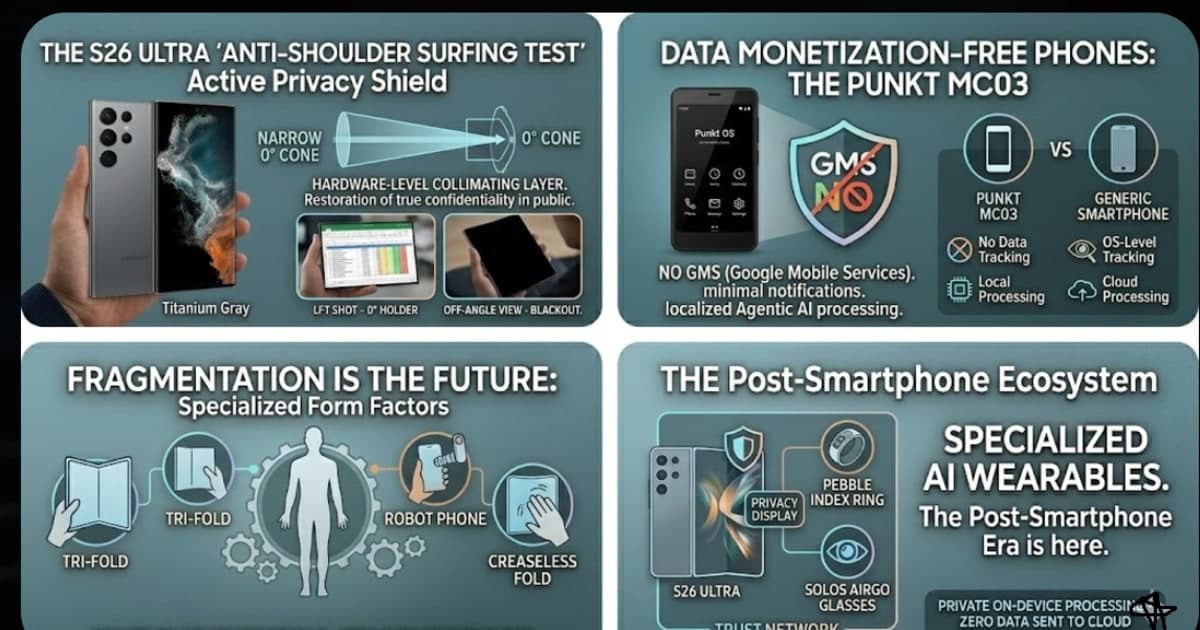
Inside the panel, above the light-emitting pixels, is a layer of microscopic liquid crystal structures. In normal mode, they're inactive — the display behaves exactly like any other AMOLED panel. When you toggle Privacy Mode from the quick settings tile (or let an Agentic AI workflow trigger it automatically when you open certain apps), those structures rotate. They collimate the light — take it from scattering broadly in every direction and redirect it into a tight cone pointing directly forward.
The result, from where you're sitting: full QHD+, full HDR10, full 120Hz, no change whatsoever.
The result, from the adjacent seat: a phone that looks powered off.
Not dark. Not hard to read. Off. Black. Nothing.
We tested this in a busy café with a spreadsheet of deliberately sensitive-looking data on the screen. From directly in front: completely normal. From 45 degrees to the side: the screen appeared completely dark to everyone who tried to look.
One person at the next table actually asked if the phone had died.
That's the feature working exactly as designed.
The Deeper Privacy Problem
the Shield Doesn't Solve
The Active Privacy Shield handles what the person next to you can see. It doesn't handle what Google can see. Or what your carrier knows. Or what seventeen different apps are quietly cataloguing in the background about where you go, what you search for, what you buy, how long you spend looking at which content, and what that pattern of behavior predicts about your next purchasing decision.
This is the part of smartphone privacy that is much harder to solve with a hardware layer, because it's not a visibility problem — it's a business model problem.
The standard smartphone OS, whether it's Android or iOS, operates on what is effectively a freemium data arrangement. You pay for the hardware. The software optimization, the ecosystem services, the seamless integration that makes everything just work — that's subsidized by your behavioral data, which flows into advertising profiles and predictive models whether you think about it or not.
Most people have made their peace with this. A growing number haven't.
The Punkt MC03:
A Phone That Doesn't Know You
The MC03 launched at $699 in 2026 and is, by any mainstream metric, a worse phone than the S26 Ultra.
Slower processor. No flagship camera. No ecosystem integration. No Google Play Store.
Its entire marketing campaign is built on a single sentence: "We do not monetize your data because we do not collect it."
That's not a spec. It's a promise. And for the specific person the MC03 is designed for, it's worth more than any benchmark number.
What "No GMS" Actually Means
The MC03 doesn't run standard Google-Android. It runs a hardened fork of Android with Google Mobile Services removed entirely.
No Play Store. No default Gmail. No background location pinging for Google Maps traffic data. No app usage cataloguing. No search history feeding an advertising profile.
Your location history doesn't exist on a Google server because the MC03 never sends it. Your behavioral patterns aren't being analyzed because nothing on the device is collecting them.
For core functionality — apps, navigation, communication — the MC03 uses privacy-focused alternative marketplaces and open-source software. The experience is more deliberate, requires more setup, and occasionally requires more patience.
That's the trade-off, stated honestly.
The OS Feels Like a Design Decision,
Not a Limitation
The Punkt OS interface is black and white. Stark. Intentionally minimal. It doesn't use notification design to manufacture urgency. It doesn't have an infinite scroll anything. The visual language says, clearly, "use the phone for what you need and then put it down."
That's either deeply appealing or completely baffling, depending on who you are. For the people who buy the MC03, it's the point.
The on-device AI — voicemail transcription, translation, basic task automation — is processed locally. The audio doesn't go to a server. The text doesn't get analyzed remotely. The processing happens on the hardware in your hand and stays there.
The Honest Compromise
Choosing the MC03 in 2026 means accepting friction that the mainstream ecosystem has spent fifteen years engineering away.
Tap-to-pay without Google Wallet takes additional configuration. Finding mapping software that doesn't track you requires research and setup. Certain apps simply don't exist outside the Google ecosystem and have no equivalent.
Punkt knows this. The MC03 isn't designed for mainstream adoption. It's designed for the person who has looked at the data-freemium arrangement and decided the convenience isn't worth the cost — not a financial cost, but a cost in autonomy and anonymity that you can't get back once it's gone.
That person is buying a statement as much as a phone. The MC03 just happens to be a well-built statement.
Two Very Different Answers
to the Same Question
The S26 Ultra and the Punkt MC03 are both, in 2026, privacy products. They solve different parts of the same problem for different kinds of people.
The S26 Ultra says: stay in the ecosystem you're in, keep the apps you rely on, keep the seamless integrations — but here's a hardware layer that gives you real, functional, daily-use protection against the most immediate physical privacy vulnerability you face.
The MC03 says: the ecosystem itself is the privacy problem, and the only real solution is to step outside it entirely.
Neither answer is wrong. They're aimed at genuinely different people with genuinely different risk tolerances and priorities.
What's new in 2026 is that both answers exist as credible, purchasable, well-engineered products. For most of the smartphone era, privacy was either an abstract concern or a niche obsession.
Now it's a purchasing category. With options.
The specs war ended when every phone got fast enough. The trust war is just starting — and unlike megapixels, there's no number on a spec sheet that tells you who's winning it.
Samsung Galaxy S26 Ultra with Active Privacy Shield: available now, from $1,299. Punkt MC03: available now, $699. On-device AI processing availability varies by region and configuration.