Every January, CES fills a Las Vegas convention center with prototypes, concepts, and hardware that mostly won't exist in a consumer's hands for another eight to twelve months.
March is when that changes.
March is when the press releases start landing at 6 AM before anyone's had coffee. When the "special events" get scheduled with two weeks' notice. When the things that were shown behind glass in January become things you can actually order.
This March, the volume is unusually high — and the thread running through almost everything launching is the same: AI that doesn't live in a chatbox anymore. AI that's been stitched directly into the operating system, the chip, the workflow, the thing you're already doing.
Here's what's actually worth paying attention to.
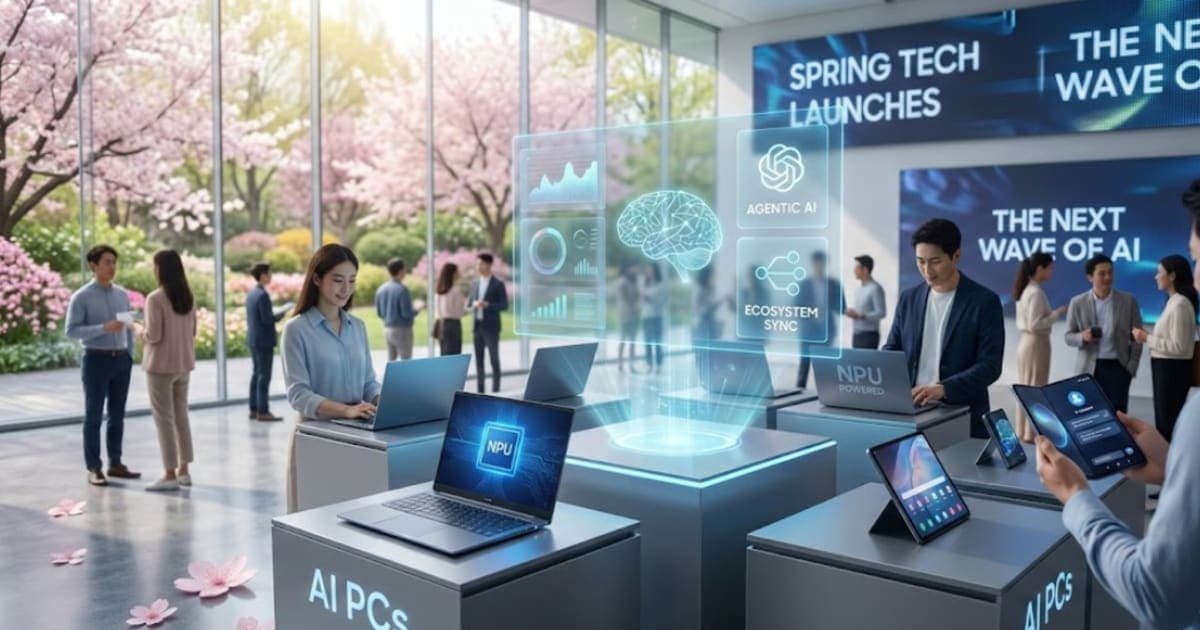
The "AI PC" Is No Longer a Marketing Term
For most of computing history, buying a laptop meant comparing two numbers: CPU speed and RAM. Then GPU benchmarks entered the conversation for anyone doing creative or gaming work.
In March 2026, the number everyone is suddenly talking about is the NPU — Neural Processing Unit. Dedicated silicon designed specifically to run AI models locally, on the device, without sending your data to a server somewhere in Virginia.
Intel's Lunar Lake architecture, AMD's Ryzen 9000 series, and Apple's M5 chips are all built around this. Dell, HP, and Lenovo have a combined wave of laptop launches this month, all of them leading with the same claim: generative text, image creation, and advanced coding assistance, running entirely on the machine in front of you.
The privacy argument is real and it matters. The latency argument is real and it matters more. When the AI processing happens on your device rather than in the cloud, the response isn't waiting on a network connection. It's just there.
Edge computing has been a buzzword for about a decade. This month, it becomes a product category at every price point.
Apple's March Moment
Apple rarely does March quietly, and this year is no exception.
A significant iPad lineup refresh is expected — centered on what the rumored M5 chip's NPU capabilities can do for professional creative work. The positioning is a shift: tablet as localized creative powerhouse rather than tablet as large iPhone. For designers, illustrators, and video editors who've been waiting for on-device AI to reach a level where it genuinely accelerates their workflow rather than just demonstrating it can — this update is the one to watch.
The Apple Intelligence cross-device continuity update arriving this month is the other piece of the story. The ability to begin a complex generative task on an iPhone and hand it off to a Mac mid-process — with the local NPU managing the workload migration without interruption — is the kind of feature that sounds like a demo trick until you use it once and realize you've rearranged how you work.
The privacy framing Apple wraps around all of this is consistent and genuine: the hardware-software integration that keeps data on the device rather than routing it through external servers is a real differentiator, not just a marketing position.
Windows Copilot Stops Being a Sidebar
Microsoft spent most of 2024 and 2025 introducing Copilot as an assistant that lived in the corner of your screen — useful, occasionally impressive, slightly separate from everything else.
The spring Windows 11 update changes that framing.
The direction is toward Copilot as the central nervous system of the OS — present across applications, aware of what's on your screen regardless of which app you're in, capable of offering assistance that connects context across your workflow rather than responding to isolated prompts.
The natural language OS control feature is the one getting the most attention in developer circles: the ability to change complex system settings or diagnose a network problem by describing what you want in plain language, bypassing the traditional layers of control panels and settings menus that have accumulated over decades of Windows updates.
Whether this lands as genuinely useful or as a more elaborate version of asking your computer to do things it still doesn't quite understand — that's the question March will start answering.
The Shift From Chatbot to Agent
This is the actual story of March 2026, and it's worth stating plainly before getting into specifics.
For two years, AI to most consumers meant a conversation interface. You typed something, it responded. Sometimes impressively. The underlying paradigm was: you ask, it answers.
What's rolling out this month is different. Agentic AI — systems that don't just respond to prompts but take actions, interact with external services, and execute multi-step tasks without requiring you to manage each step.
Google's Gemini and OpenAI's latest GPT variants are both pushing updates in this direction. The practical version: a single prompt that plans a trip, books the flights, makes the restaurant reservations against your dietary preferences, and populates your calendar — interacting autonomously with third-party websites to complete each step.
That's not a demo. That's shipping this month.
The failure modes are real — agentic systems make mistakes with consequences that a chatbot never could, because a chatbot never actually did anything. But the capability shift is significant enough that "AI assistant" as a category is going to mean something different by the end of March than it did at the start.
The Open Source Side of This
The enterprise AI story gets the headlines. The open source story is quietly more interesting.
Meta's Llama series continues to advance, and the developer community this month is focused on efficient model quantizing — the process of making large AI models run on smaller, consumer-grade hardware without meaningful capability loss.
What this produces is a wave of niche, highly specific productivity applications built on models that don't require corporate cloud infrastructure. A legal research tool that runs offline. A medical documentation assistant that never touches an external server. A coding tool fine-tuned specifically for the framework you actually use.
The democratization of AI development is genuinely happening, and it's happening in developer communities on GitHub and Hugging Face rather than in keynote presentations.
The Companies to Watch
A quick orientation on who's doing what this month:
Apple — iPad hardware refresh and the next Apple Intelligence rollout stage. The M5 NPU capabilities are the headline.
Google — Gemini integration updates across Android and Search. The agentic capabilities are the story.
Microsoft — Copilot+ PC push continues. The Windows spring update is the most significant OS change in this cycle.
NVIDIA — GTC conference downstream effects. Consumer GPU and cloud service announcements tend to ripple out from their March timeline.
Samsung — Rolling Galaxy AI features to mid-tier and legacy devices. Less glamorous than a flagship launch, more significant in terms of how many people actually experience the technology.
What March 2026 Actually Is
It's not one device. It's not one announcement.
It's the month where a set of technologies that spent two years being described as transformative stop being described and start being used. By people who aren't early adopters. By people who just bought a laptop and it happened to have an NPU in it. By people who updated their phone and found their assistant had gotten considerably more capable without them doing anything.
That's a different kind of shift than a product launch. It's quieter. It doesn't have a keynote. But it's the one that actually changes how things work.
The hype cycle for generative AI lasted about two years. March 2026 is where the implementation cycle begins in earnest.
This article is a technology trend analysis piece based on publicly available product announcements, developer conference previews, and industry reporting as of early March 2026.