The smartwatch has spent a decade trying to be everything.
Fitness tracker. Notification mirror. Payment terminal. App platform. Camera remote. GPS navigator. Sleep coach. ECG machine.
It's done all of these things at a level that could generously be described as "fine." Not great. Not the best tool for any of those jobs. Fine. Adequate. The Swiss Army knife of your wrist — which is great until you need an actual knife.
In 2026, consumers figured this out and started buying differently. Not one device that does everything, but several devices that each do one thing so well you stop thinking about the hardware entirely.
That shift has a name now: Specialized AI Wearables. And it's the most interesting thing happening in consumer tech right now — partly because the products are genuinely good, and partly because the philosophy behind them is a quiet rebellion against the last decade of gadget design.
Smart Rings: The Category
Just Got Interesting
Smart rings have been, let's be honest, a niche product for people who find smartwatches too socially awkward and want a smaller screen to not look at.
The pitch was always: wear this instead of a watch, get your readiness score, learn you're "7/10 recovered," and go about your day slightly more aware of your HRV than you were before.
That's not nothing. But it's not enough to anchor a category.
In 2026, two very different product philosophies are competing for your finger. They are not in the same market, even though they look similar from the outside.
The Pebble Index 01:
For Your Brain, Not Your Body
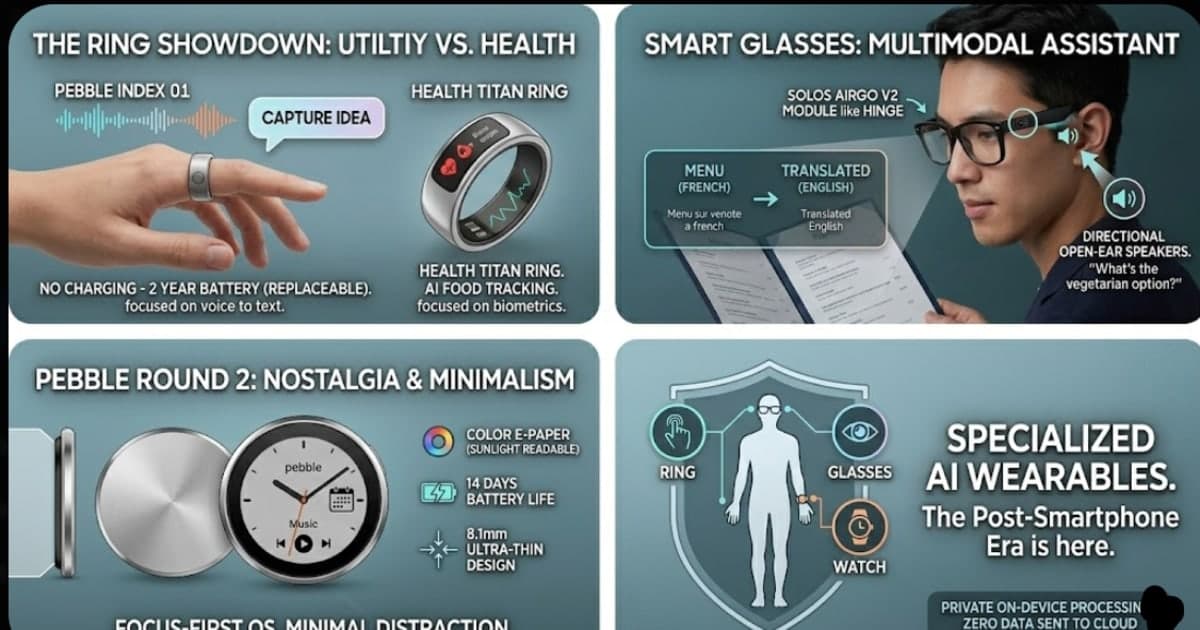
The Index 01 launched in early 2026 for $99 and immediately confused everyone who reviewed it — because it doesn't track anything.
No heart rate sensor. No sleep tracking. No step counter. No screen.
What it has: a high-fidelity microphone and one button.
Here's what that actually means in daily use: you're in a meeting and an idea occurs to you — the kind that disappears if you don't capture it immediately. You press the button on your finger, whisper eight words into the ring, and it's in your Notion workspace before anyone notices you moved.
The on-device 2nm NPU transcribes and categorizes the note locally. Nothing goes to the cloud until it syncs to your app. The whole interaction takes about four seconds and is invisible to everyone around you.
The battery is a replaceable silver-oxide cell that lasts up to two years. Because there's no optical sensor draining power continuously, the ring doesn't need charging. Ever. You swap the battery roughly when you'd change the battery in a wall clock.
This is a specific kind of product courage — building a device that does one thing and refuses to apologize for not doing anything else. The Index 01 is the productivity tool of the year precisely because it didn't try to be anything other than that.
Oura Ring 4 and Samsung Galaxy Ring:
The Health Titans Go Deeper
Oura and Samsung went in the opposite direction — not simpler, but more capable.
The Oura Ring 4's standout feature is AI-powered food tracking. Hover your hand over a plate. The infrared sensors and the app's computer vision estimate your caloric intake and metabolic impact without you logging anything manually.
Is it perfectly accurate? No, and Oura doesn't claim it is. Is it accurate enough to give you useful data without the psychological burden of manually logging every meal? Early users say yes, pretty convincingly.
Samsung's Galaxy Ring update is more immediately practical: gesture-based agentic control. A double-pinch dismisses a notification on your S26 Ultra. A snap takes a photo remotely. Small things, but the kind that make you feel slightly like you're living in a different decade than everyone around you.
The honest split: Buy the Oura if health optimization is the job you're hiring a ring to do. Buy the Pebble Index 01 if you lose ideas and you're tired of it. Buy the Galaxy Ring if you're already in the Samsung ecosystem and want your hardware to talk to itself.
Smart Glasses:
Finally Not Embarrassing
The smart glasses category spent about eight years being a punchline.
Google Glass made people look like they were wearing a Bluetooth earpiece on their face. Every attempt since has either been too bulky, too expensive, too limited, or all three.
In 2026, two products have changed that conversation — one that's available now and one that might not exist yet but is generating more buzz than most products that do.
Solos AirGo V2:
The Quiet Winner
The AirGo V2 costs $299 and looks like a pair of mid-range sunglasses. That second part is the whole point.
Inside the temples: a 16MP ultra-slim camera, directional open-ear speakers, and SolosChat 3.0 — a multimodal AI that sees what you see and talks in your ear about it.
Practical example: you're at a restaurant, the menu is in French, and you don't speak French. You look at the menu and ask, out loud or under your breath, "what's the vegetarian option?" The answer comes through the open-ear speaker about two seconds later.
Real example from early reviews: a user in Tokyo navigating a train system with no English signage, using the glasses to read and translate every sign in real time, described it as "having a local whispering in your ear the whole time." That's a useful device.
The SmartHinge system lets you swap the temple arms for fresh batteries mid-day, giving you effectively unlimited daily runtime if you carry a spare set of temples in your bag.
The Infinix AI GLASSES Pro:
Still a Rumor, Already a Story
Leaked prototype footage started circulating in February and the tech press hasn't fully recovered.
If the leaks are accurate — and enough of the detail is internally consistent that most observers think they are — Infinix has built a pair of glasses with a Micro-LED waveguide display that projects navigation arrows and contextual information directly onto the lens.
Actual AR. In something that looks like glasses rather than a construction helmet.
No confirmed release date. No confirmed price. No official statement from Infinix. But the conversation it's generating says something important about where this category is going — because people aren't skeptical that it's possible anymore. They're just waiting to see if it ships.
Pebble Round 2: The Minimalism
Play Nobody Saw Coming
Here's the product that shouldn't be a story in 2026 but somehow is.
The Pebble Round 2 launched in January for $199. It has a color e-paper display, a 14-day battery life, and an operating system that deliberately doesn't support apps.
No app store. No third-party installs. Notifications, calendar, music controls. That's the list.
The original Pebble community — which has spent years in a kind of quiet grief since the company folded in 2016 — received this like a message from the past. But what's interesting is who else is buying it.
People who own Apple Watches. People who own Galaxy Watches. People who look at their wrist fifty times a day and realize they've spent forty-five of those interactions doing something they didn't intend to do.
The e-paper display is always on, uses almost no power, and reads better in direct sunlight than any AMOLED panel. You glance at it, you get the information, you look away. The watch doesn't try to keep you there.
That's the Pebble Round 2's entire design philosophy in one sentence: it wants you to look at it for two seconds and then get back to your actual life.
In 2026, that's apparently a radical product decision.
What This All Actually Means
Nobody's saying the smartphone is dead. It's not. It probably won't be for another decade at least.
But its position has shifted. It's no longer the center of the personal tech universe — the one device that everything else orbits and defers to. It's becoming one node in a distributed system of specialized hardware that each does one job better than a smartphone ever could.
Think about what that ecosystem looks like in practice: a Pebble Index 01 on your finger capturing thoughts silently in meetings. Solos AirGo V2 on your face translating the world in real time. Pebble Round 2 on your wrist keeping you connected without pulling you in.
Your phone is in your pocket. You check it when you choose to, not because something lit up and demanded your attention.
That's not a utopia. But it's a genuinely different relationship with technology than most people have had for the last ten years.
And in 2026, the hardware to build it is finally actually available.
Products referenced: Pebble Index 01 ($99, available now), Oura Ring 4 (available now), Samsung Galaxy Ring 2026 update (available now), Solos AirGo V2 ($299, available now), Pebble Round 2 ($199, launched January 2026). Infinix AI GLASSES Pro: unconfirmed, no official release date.