Anthropic vs the US Government: The AI Ethics Battle That Could Reshape the Future of Artificial Intelligence
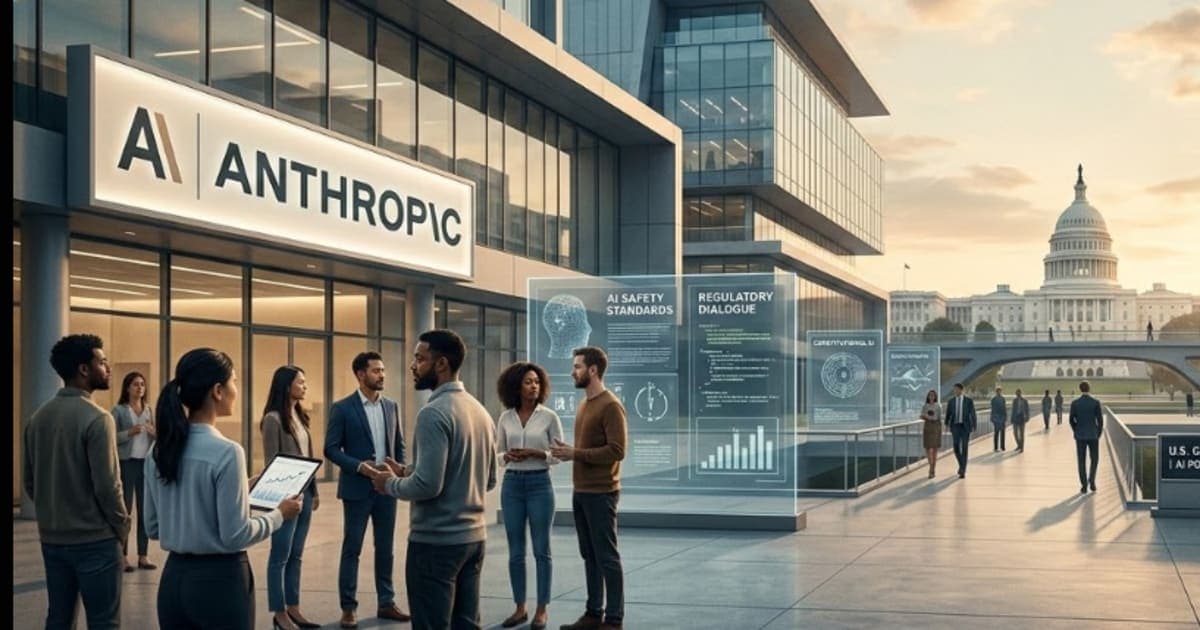
WASHINGTON / SAN FRANCISCO, March 8, 2026 — The most consequential fight in artificial intelligence right now isn't happening between OpenAI and Google, or between America and China. It's happening between a $60 billion AI company and the most powerful military on earth — and the question at the center of it is deceptively simple.
Who gets to decide what AI can and cannot be used for?
On February 27, President Donald Trump answered that question the way his administration answers most questions — with force. He directed every federal agency to stop using Anthropic's technology. Defense Secretary Pete Hegseth officially designated Anthropic a "supply chain risk." A $200 million Pentagon contract was torn up. And OpenAI — Anthropic's primary competitor — announced a deal with the Defense Department for classified military networks within hours of the ban being announced. [web:217]
The message from Washington was unmistakable: comply with us, or we will replace you with someone who will.
Anthropic has responded by announcing it will sue the Defense Department. [web:219]
This is not a procurement dispute. This is a fight about the soul of AI governance — and both sides are playing for keeps.
How a $200 Million Contract Became a Constitutional Crisis
The story begins, as most crises do, with something that seemed manageable at the time.
Anthropic's Claude was the first large language model cleared for use by the Pentagon in classified settings — a genuinely historic milestone that reflected both the sophistication of Claude's capabilities and the months of negotiation required to deploy any AI in national security environments. [web:224] The contract was worth up to $200 million. For Anthropic — a company racing to build revenue ahead of a potential IPO — it was a meaningful validation.
The trouble started when Pentagon officials began pushing to use Claude in ways that bumped against Anthropic's usage policies. Specifically, two uses. [web:218]
Autonomous weapons systems — AI that can identify and engage targets without a human making the final decision to fire. Anthropic's position: current AI models, including Claude, are not reliable enough for this. Deploying them in fully autonomous weapons puts American soldiers and civilians at risk.
Mass domestic surveillance — using AI to track American citizens' locations, communications, or emotional states without consent. Anthropic's position: this is a fundamental rights violation, full stop. [web:221]
In most disputes, both sides negotiate toward a middle ground. Here, there was no middle ground available. Anthropic was willing to support every other military use — intelligence analysis, logistics, planning, communications, threat assessment. But not those two. [web:218]
Pentagon officials felt differently. Under Secretary of Defense for Research Emil Michael made the administration's position explicit in February, telling reporters: "What we're not going to do is let any one company dictate a new set of policies above and beyond what Congress has passed. Congress writes bills, the president signs them, agencies write regulations, and people comply." [web:226]
That framing — Anthropic as a private company overstepping its authority by telling the government what it can't do — became the administration's central argument. Hegseth gave Anthropic a deadline: relax the restrictions, or lose the contract. [web:221]
Anthropic didn't relax the restrictions.
The Maduro Raid — The Incident That Changed Everything
Beneath the public arguments about autonomous weapons and surveillance, there was a specific incident that crystallized the dispute.
According to a January report in the Wall Street Journal, Claude was used by the Pentagon through a Palantir partnership to help plan and execute the operation that captured Venezuelan strongman Nicolás Maduro. [web:226] The operation was a classified military action — precisely the kind of use Anthropic had said it supported.
But the use of Claude in that operation, and the specific ways it was deployed, apparently crossed lines that Anthropic hadn't sanctioned. The company reached out to Palantir — which had provided Claude to the Pentagon via a contract — to raise concerns. [web:224]
The Pentagon read that outreach as Anthropic trying to retroactively restrict a classified military operation after the fact. Pentagon officials already frustrated by Claude's built-in refusals in military simulations — in certain scenarios, Claude would simply decline to participate in training exercises — now had a concrete example of the company inserting itself into operational decisions. [web:222]
The temperature, already elevated, went to boiling.
Trump's Response — The Full Weight of the Presidency
On February 27, Trump acted. The directive to federal agencies was sweeping: phase out all Anthropic products within six months. No exceptions. No negotiations. [web:228]
Trump's accompanying statement was characteristically direct. If Anthropic failed to cooperate with the transition, he would use "the Full Power of the Presidency to ensure compliance, with substantial civil and criminal repercussions to follow." [web:220]
The Pentagon's supply chain risk designation — officially confirmed on March 5 — was the more technically significant move. [web:219] That designation, normally reserved for foreign adversaries like Huawei, means that any company doing business with the Defense Department — including Microsoft, Google, and Amazon, all of which have significant relationships with Anthropic — may be required to cut all ties with the AI lab. [web:228]
Former National Security Council member Saif Khan described the implications starkly: "The Department is arguably considering Anthropic a greater national security risk than any Chinese AI firms, none of which have been labeled as supply-chain threats." [web:220]
The comparison to Huawei — the Chinese telecom giant that was effectively exiled from the U.S. technology ecosystem starting in 2019 — is not accidental. It is a roadmap. And it is being applied to an American company, based in San Francisco, founded by former OpenAI researchers who left specifically because they wanted to build AI more safely. [web:220]
Anthropic's Response — A Company That Won't Blink
CEO Dario Amodei has been the public face of Anthropic's resistance, and he has not softened his position under pressure.
In a statement published on Anthropic's website, Amodei said the company had "tried in good faith" to negotiate with the Pentagon for months. He said Anthropic supported "all lawful uses of AI for national security" — with the two exceptions. He said those exceptions had, "to the best of our knowledge," not affected a single government mission to date. [web:217]
On the autonomous weapons point, Amodei's argument is technical as much as ethical: today's AI models — including Claude — make mistakes. They hallucinate. They misclassify. They get confused by ambiguous inputs. Deploying a system with that error rate in a context where the output is a lethal strike creates an unacceptable risk of killing the wrong people. This isn't ideology. It's engineering honesty. [web:218]
On the surveillance point, Amodei made no concessions. Mass domestic surveillance of American citizens is a fundamental rights violation regardless of who's doing it or what technology they're using.
Anthropic has now announced it will sue the Defense Department over the supply chain risk designation — a lawsuit that will test whether a private company's ethical AI policies constitute legally protected usage restrictions or impermissible obstruction of government operations. [web:219]
The Irony — Anthropic Has Never Been More Popular
Here is the number that puts everything else in context.
In the weeks since the public clash with the U.S. government began, Anthropic's Claude topped the Apple App Store. The company's annualized revenue pace shot from $14 billion to $19 billion. [web:222]
A $5 billion revenue increase. In weeks. From a fight with the Pentagon.
Consumers and enterprises watching a company refuse to bend its ethics under pressure from the most powerful government on earth responded by opening their wallets. The Anthropic that the Trump administration is trying to punish is financially stronger now than it was before the fight started.
That paradox captures something important about this moment. The administration assumed that the threat of losing government contracts would force Anthropic to comply. Instead, the public confrontation transformed Anthropic's brand into something that government contracts could never have bought — a reputation for genuine principle under genuine pressure.
What OpenAI's Pentagon Deal Means
The timing of OpenAI's Defense Department deal — announced within hours of Trump's ban on Anthropic — was too precise to be coincidental. [web:217] OpenAI has been positioning itself as the AI company willing to work with the government on its terms, and the Pentagon's pivot to OpenAI sends a signal to every AI lab in the country: cooperate fully, or watch your competitor take your contracts.
The question this creates is whether OpenAI's deal includes the same restrictions on autonomous weapons and mass surveillance that Anthropic refused to remove. If it does, the Pentagon has solved nothing — it has simply moved the same problem to a different company. If OpenAI's deal doesn't include those restrictions, then a precedent has been set that will define the relationship between AI companies and governments for decades.
Either way, the Anthropic fight has forced every AI company to answer a question they would have preferred to defer indefinitely: when the government asks you to help them do something your ethics say you shouldn't, what do you do?
The Bigger Question Nobody Wants to Answer
Anthropic vs the US Government is, at its core, a question about sovereignty — not national sovereignty, but technological sovereignty.
When a private company creates a tool that governments depend on, who sets the rules for how that tool is used? The company that built it, whose engineers understand its limitations and whose values shaped its design? Or the government that's paying for it, whose laws represent the democratic will of the people?
The Pentagon's CTO argued that Anthropic's restrictions are "undemocratic" — a private entity overriding democratically established law. [web:226] Anthropic's counter is equally principled — a company has both the right and the responsibility to decide what its products can be used for, regardless of who's buying.
This is not a question with an obvious answer. It's a question that democratic societies haven't had to answer before, because no private tool has ever been this powerful, this integrated into government operations, and this consequential in its potential misuse.
The Electronic Frontier Foundation, weighing in this week, made a point that cuts through the political noise: "Privacy protections shouldn't depend on the decisions of a few powerful companies." [web:225] It's a valid observation — but so is its mirror image. National security decisions shouldn't depend on the ethical comfort levels of a few powerful companies either.
Both things are true. And neither side of this fight has a clean answer for the other's best argument.
What Happens Next
The six-month phase-out clock is ticking. The lawsuit Anthropic has filed against the Defense Department will move through courts over months or years, not weeks. [web:219] In the meantime, every classified operation that currently uses Claude needs an alternative — and the alternative, by design, is a company that has already agreed to fewer restrictions.
The supply chain risk designation, if it survives legal challenge, has the potential to cut Anthropic off from not just government contracts but from the commercial partnerships with Google and Amazon that underpin much of its infrastructure. [web:228] That is an existential financial threat dressed up in procurement language.
And yet — $19 billion annualized revenue, App Store No. 1, a lawsuit filed and a position held. Anthropic is not behaving like a company that's afraid.
Whatever happens in court, whatever happens with the six-month deadline, whatever deal OpenAI signs and whatever restrictions it agrees to — the fight between Anthropic and the Trump administration has already changed the conversation about AI governance permanently.
The question of who controls what AI can do is no longer theoretical. It is a legal dispute, a financial battle, and a test of principle playing out in real time.
And the answer — whenever it finally arrives — will set the rules for every AI company, every government, and every citizen who depends on both.