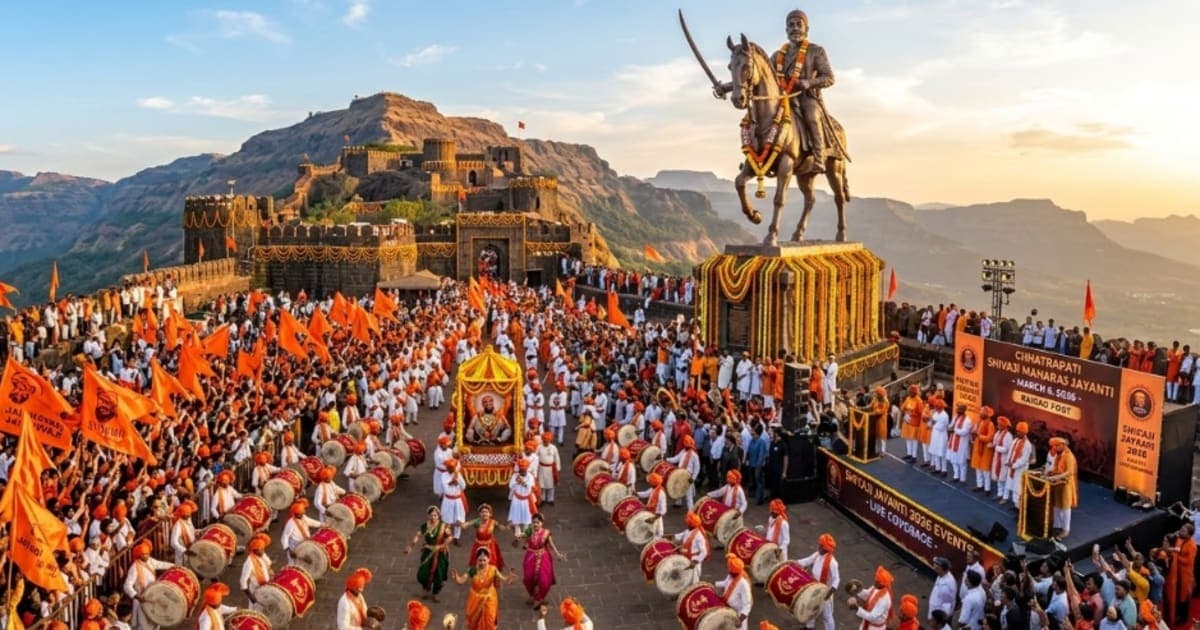
Jai Shivaji! Maharashtra Roars on
Chhatrapati Shivaji Maharaj Jayanti 2026
It starts before sunrise.
Somewhere on the trail up to Shivneri Fort,
a torch is already lit.
A family from Nashik — grandfather, father, teenage son —
climbing in the dark,
not because anyone told them to,
not because there's a government order,
but because some things
you simply do.
By the time the sun clears the Sahyadri ridge,
the dhol-tasha is already thundering
through Pune's Laxmi Road.
50 troupes. Simultaneously.
The sound doesn't travel — it arrives.
It lands in your chest
before your ears process it.
Mumbai is a wall of saffron
from Shivaji Park to the Gateway.
Raigad Fort is lit from below,
its silhouette sharp against a dark sky,
drone footage of it
already crashing Instagram.
This is Chhatrapati Shivaji Maharaj Jayanti 2026.
March 6th. Falgun Vadya Tritiya.
The day millions of Maharashtrians
choose over February 19th.
Not instead of it —
in addition to it.
Because one day, apparently,
was never going to be enough.
The Man Before the Mythology
Nearly 400 years of reverence
can sometimes smooth a person
into an icon.
Flatten the texture.
Turn a human being into a statue.
Shivaji Bhonsale was not a statue.
Born in 1630 at Shivneri Fort
to Shahaji Bhonsale and Rajmata Jijabai,
he inherited not an empire
but a situation.
The Deccan was carved between
the Adilshahi, the Nizamshahi,
and a Mughal empire
that considered the whole subcontinent
its administrative problem to solve.
The boy who would become Maharaj
grew up watching his mother
refuse to accept that reality.
Jijabai didn't just raise a king.
She raised a conviction —
that Hindavi Swarajya,
self-rule for the people of this land,
was not a fantasy.
It was a project.
It just needed someone
willing to begin it.
He began it at 16
when he captured Torna Fort
with a handful of Mavla soldiers
nobody in Bijapur took seriously.
Three Things Shivaji Did
That Nobody Else Was Doing
He Understood the Sea
In the 17th century,
the Arabian Sea belonged to the Portuguese,
the British, and the Dutch.
They used it as a highway
to extract wealth from India's western coast
and as a shield
that no Deccan power could cross.
Shivaji looked at the sea differently.
He looked at it and saw a frontier
that nobody had claimed from the Indian side.
He built a navy.
Not borrowed boats —
a commissioned naval force
with purpose-built warships
and fortified coastal bases.
Sindhudurg. Vijaydurg. Janjira (contested).
Forts in the water,
islands turned into weapons.
The Siddi of Janjira never fell to him —
that particular fight went unfinished —
but every European naval commander
operating off the Konkan coast
from the 1660s onward
knew the Maratha fleet
had to be accounted for.
India's naval tradition,
as a strategic priority
rather than a logistical afterthought,
starts here.
The Indian Navy didn't choose
INS Shivaji as the name
of their engineering school by accident.
He Rewrote the Rules of War
The Mughal and Adilshahi armies
were large, well-equipped,
and trained for set-piece battle.
Elephant cavalry. Heavy artillery.
Formations that had defeated
every enemy they'd faced
in open terrain.
Shivaji never gave them open terrain.
Ganimi Kava — guerrilla warfare
as doctrine, not desperation —
turned the Sahyadri ranges
into the most effective military asset
any general has ever had.
Hit fast. Disappear faster.
Raid the supply line before the battle.
Win the fort before anyone knows
you're trying.
Sinhagad — taken by Tanaji Malusare
in a night climb up a sheer cliff face
with a monitor lizard as an anchor
for the climbing rope.
History or legend?
Probably both.
Either way, the fort was taken.
At Pratapgad, when Afzal Khan
arrived with an army and a plan
to end the Maratha rebellion at its source,
Shivaji arrived with a wagh nakh —
tiger claw — hidden in his palm
and left the meeting
as the only person walking out of it.
Military academics still study these campaigns.
Not as historical curiosities —
as operational models
for asymmetric warfare in difficult terrain.
He Governed Like No One Expected
This is the part that gets less attention
than the battles,
and it might be the more important part.
The Ashta Pradhan Mandal —
eight-minister council —
was built on competence.
Not caste. Not family connection.
Not loyalty to the right patron.
You could run a ministry
if you could run a ministry.
He paid his soldiers.
Actually paid them,
on schedule,
in coin,
which was not common practice
in 17th-century armies
anywhere in the world.
He issued standing orders
that mosques and temples of conquered territory
were not to be desecrated.
Women were not to be harassed.
Farmers were not to have their crops seized
without payment.
These weren't just rules.
They were what made ordinary people —
Mavla hill farmers,
coastal fishermen,
village headmen across the Deccan —
choose Swarajya over the existing order.
You don't build an empire
with 2,000 mountain soldiers
unless the people around you
actually want what you're building.
They wanted it.
Because he showed them
it was for them.
March 6, 2026: What's Happening Right Now
Shivneri Fort, Junnar
Before the sun was fully up,
the trail to the birthplace
was already a river of people.
Saffron flags. Families.
Old men who've made this climb
every Tithi Jayanti
for 40 years running.
Inside the fort, the cradle ceremony —
a symbolic rocking of Maharaj's infancy —
was performed at dawn.
The chant of Jai Bhavani, Jai Shivaji
bouncing off 400-year-old stone walls.
Pune, Laxmi Road
If you've never stood
in the path of a Pune dhol-tasha pathak,
you don't fully understand
what the word rhythm means.
50 troupes today.
Simultaneously.
The sound carries four blocks
before you can see the procession.
Historical tableaus of the Ramayana.
Povadas — traditional ballads —
about the escape from Agra,
the killing of Afzal Khan,
the coronation at Raigad.
Sung by performers
whose grandparents sang the same songs
at the same festival.
Mumbai: From Shivaji Park to the Gateway
Bike rallies since early morning.
Shiv-Sammelan events
with historical plays
running on outdoor stages.
Gateway of India
draped in saffron light after dark.
The size of the Shivaji Park gathering
this year is being compared
to the post-consecration Rama Navami crowds
in terms of sheer emotional weight.
Raigad: The Capital Fort
The drone footage of Raigad at night
has already done what drone footage does —
circled the world in hours.
The fort where he was crowned
Chhatrapati in 1674,
where the royal umbrella was held
over the head of a man
who had built a kingdom
from 2,000 farmers and a conviction —
lit from below,
torches along the ramparts,
mashals against a black sky.
#ShivajiJayanti2026 has trended
on every Indian platform since 5 AM.
The global Maharashtrian diaspora —
London, Toronto, Dubai, Houston —
is watching the Raigad live stream
from their living rooms.
Some of them are crying.
Nobody finds that excessive.
The Date Debate: Why Both Days Are Right
Every year, someone asks:
is it February 19th or the Tithi date?
The short answer is: yes.
February 19th is fixed, administrative,
and allows for a public holiday
that schoolchildren, government offices,
and employers can plan around.
It standardises the celebration
across a diverse, modern calendar.
The Tithi date — Falgun Vadya Tritiya,
March 6th this year —
connects the celebration
to the actual lunar alignment
under which Shivaji was born.
It moves. It's ancient.
It requires you to look up
the panchang every year.
And that's exactly why
people who follow it
feel it's the more authentic choice.
You're not celebrating a slot
on the Gregorian calendar.
You're celebrating the actual cosmic moment.
In 2026, the March 6th turnout
has reportedly matched —
possibly exceeded —
the February 19th official events.
That tells you something
about where the emotional weight sits
for a significant portion of Maharashtra.
Both are right.
Both matter.
The king deserves both.
Words That Survived 400 Years
The quotes circulating today —
in WhatsApp forwards, Instagram stories,
painted on rally banners —
have survived because they're not
historically interesting.
They're immediately useful.
"Even if there were a sword
in the hands of everyone,
it is willpower that establishes a government."
In a world that confuses
access to information
with the ability to act,
this lands differently than it used to.
"Freedom is a blessing,
and one must strive to secure it
with courage and determination."
Not given. Secured.
The verb matters.
And from the Marathi literary tradition,
the opening of the Wawde stotra
that's being chanted at Raigad right now:
"निश्चयाचा महामेरू,
बहुत जनांसी आधारू,
अखंड स्थितीचा निर्धारू,
श्रीमंत योगी..."
A mountain of resolve,
a support for countless people,
unwavering in his purpose,
the wealthy ascetic.
Wealthy ascetic.
A king who held a kingdom
and remained, at his core,
someone who measured himself
not by what he owned
but by what he protected.
What This Day Actually Asks of Us
The mashals will burn until midnight.
The dhol-tasha will quiet by morning.
The saffron will come down
and the streets will return
to their regular chaos.
And then what?
Shivaji Maharaj's legacy
isn't preserved in celebrations —
it's preserved in choices.
The choice to govern with integrity
when corruption is easier.
To protect the farmer
when exploiting him is more profitable.
To look at a sea everyone else thinks
belongs to someone else
and decide to build a fleet.
He didn't wait for permission.
He didn't wait for resources.
He didn't wait for the moment
to feel perfectly right.
He started at 16
with what he had
and built toward what he believed.
That's the Jayanti message
that survives every political speech,
every rally, every WhatsApp forward.
The land. The people. The courage to begin.
Jai Bhavani. Jai Shivaji.
Live coverage of Shivneri, Raigad,
and Pratapgad ceremonies available
on Maharashtra Tourism's official
YouTube channel throughout March 6, 2026.