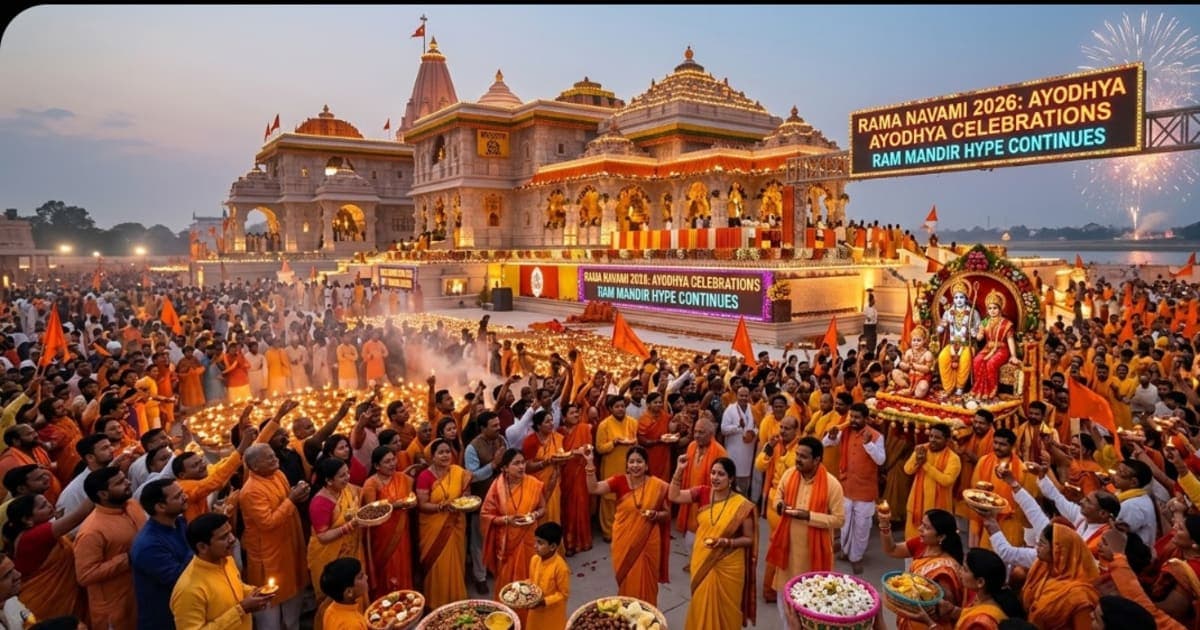
Rama Navami 2026: Dates, Ayodhya
Guide, Fasting Recipes & Everything
You Actually Need to Know
There's a particular kind of quiet
that falls over an Indian household
at noon on Rama Navami.
The pressure cooker stops.
The phone gets put face-down.
Someone lights an agarbatti.
And for about fifteen minutes,
even the most distracted member of the family
looks toward the mandir in the corner
and just... breathes.
That moment —
that collective exhale across a billion homes —
is what Rama Navami actually is.
Everything else: the Ayodhya crowds,
the Surya Tilak engineering,
the viral reels, the political speeches —
all of it is decoration around
that quiet noon moment.
This year, that moment lands at 12:27 PM
on Thursday, March 26, 2026.
Here's everything you need
to make the most of it.
The Dates: Nail These First
Hindu calendar timings can get confusing fast
when panchang websites give you
five different answers.
Here's the clean version:
| Event | Date | Time (IST) |
|---|---|---|
| Navami Tithi Begins | March 26, 2026 | 11:48 AM |
| Puja Auspicious Window | March 26, 2026 | 11:13 AM – 1:41 PM |
| Exact Birth Moment (Janma Muhurat) | March 26, 2026 | 12:27 PM |
| Navami Tithi Ends | March 27, 2026 | 10:06 AM |
The one time you need to remember: 12:27 PM, March 26.
That's the midday window —
the Madhyahna Kaal —
when Lord Rama was born
in the ancient Hindu astronomical reckoning.
Everything else in the day
organises itself around this moment.
Some Vaishnav traditions observe
celebrations extending into March 27
given the tithi overlap.
But if you're doing one puja,
one aarti, one moment of stillness —
12:27 PM on the 26th is your anchor.
Ayodhya 2026: What You're Actually Walking Into
Let's be honest about something first.
The 2025 Rama Navami
brought roughly 800,000 people to Ayodhya
in a single day.
This year, with the full temple complex functional,
the Surya Tilak system fine-tuned,
and international visibility at an all-time high,
1 to 1.5 million people are expected
on March 26 alone.
That's not a pilgrimage anymore.
That's a small city appearing overnight
in a mid-sized UP town.
Plan accordingly.
The Surya Tilak: The Moment Everyone Comes For
Inside the Ram Janmabhoomi Mandir,
there is a precision optical system
built into the temple architecture —
mirrors, lenses, calibrated angles —
that channels a beam of sunlight
directly onto the forehead of Ram Lalla
at exactly midday on Rama Navami.
No electricity. No LEDs. Just sunlight
doing what ancient astronomers
and modern engineers together
decided it should do.
It lasts about four minutes.
If you're inside the sanctum sanctorum
when it happens, people say
you don't need anyone to explain
why this temple matters.
You just understand it.
Getting inside for that exact moment
requires either the Sugam Darshan booking
(more on that below) or arriving
by 5 AM and accepting the queue.
The Day's Full Schedule at the Mandir
4:30 AM — Mangal Aarti.
The first aarti of the day.
Ram Lalla wakes to conch shells and bells.
If you can manage the early start,
this is actually more intimate
than the midday rush.
Morning hours — Shringar.
The idol is adorned in royal yellow robes
woven with gold thread.
Special floral decorations.
The temple smells of roses and camphor
for the entire morning.
12:00 PM – 12:30 PM — Surya Tilak.
The moment. The sunbeam.
The collective sharp intake of breath
from everyone watching.
Afternoon onwards — Janmotsav celebrations.
Bhajans, Kathas, continuous aarti.
The temple trust distributes prasad
through organised queues.
Sunset — Saryu Ghat Aarti.
Walk from the temple toward the river.
The Saryu ghats at dusk on Rama Navami
look like someone scattered
ten thousand diyas across dark water.
Photographed by everyone.
Felt by everyone more.
Getting There Without Losing Your Mind
Go on March 24th or 25th.
Not the 26th if you can help it.
Road closures tighten from the night of the 25th.
Most state highways within 20 km
get converted to one-way
or pedestrian-only by dawn on the 26th.
If you must arrive on the 26th,
pre-book a hotel or dharamshala
inside Ayodhya city itself.
Parking beyond 5 km from the temple
is essentially mandatory —
shuttle buses run from designated lots.
For Darshan itself, three realistic options:
1. General Queue:
Free. Deeply democratic.
Also potentially 8-10 hours.
Bring water, a small towel,
comfortable footwear,
and absolutely no expectations about timing.
2. Sugam Darshan:
The temple trust's managed-entry system.
Limited slots. Books up months ahead.
Check the official Shri Ram Janmabhoomi
Teerth Kshetra website immediately
if this is your plan.
March slots are almost certainly
exhausted by now —
but cancellations do appear.
3. Digital Darshan:
Genuinely not a consolation prize.
The official live stream during the Surya Tilak
and 12:27 PM aarti
has crashed YouTube twice
in previous years due to viewer load.
Watching from home on a large screen
with your family around you
is its own kind of experience.
What to wear:
It's late March in UP.
Temperatures will be 28-33°C.
Light cotton. Covered shoulders and legs.
Sandals are easier to remove
at the temple entrance than laced shoes.
A small dupatta or stole for women
is practical and expected.
Fasting on Rama Navami:
The Food That Doesn't Feel Like a Sacrifice
Here's the thing about Vrat food
that nobody who hasn't eaten it understands:
it's genuinely delicious.
Not "good for fasting food" delicious.
Actually delicious.
The rules: no grains (wheat, rice),
no regular salt (use Sendha Namak —
Himalayan rock salt only),
no onion, no garlic.
What you can eat:
sabudana, makhana, fruits, dairy,
nuts, and certain flours
like singhara (water chestnut)
and rajgira (amaranth).
Panakam: The Ancient Energy Drink
If you're in South India
or have South Indian neighbours,
you already know this one.
If you don't, fix that this year.
What it is: Cold water with jaggery,
freshly crushed black pepper,
dry ginger (saunth), and a few tulsi leaves.
Sometimes a squeeze of lime.
Why it works:
Jaggery gives you steady glucose.
Pepper and ginger settle the stomach
during a day of fasting and movement.
Tulsi adds something that's difficult
to describe clinically
but feels clarifying.
Make it the night before.
Keep it in a clay pot or glass vessel.
Drink it cold throughout the day.
It genuinely works better than most
commercial electrolyte drinks
for sustained energy on a fasting day.
Sabudana Khichdi: The Non-Negotiable
Everyone has their recipe.
Everyone thinks their recipe is correct.
Here is the actual correct approach:
Step one that most people skip:
Soak sabudana for a minimum of four hours.
Six is better. Overnight is best.
Drain completely before cooking.
If your khichdi is coming out sticky and clumpy,
this is why.
The rest:
Ghee in a heavy pan.
Jeera until it pops.
Green chilli — two, not one.
Roasted peanuts (coarsely crushed,
not powder, not whole).
Sabudana on medium heat.
Sendha namak. Lemon at the end.
Fresh coriander if you have it.
The texture you're looking for:
individual pearls, slightly translucent,
non-sticky, with peanut crunch
in every third or fourth bite.
Serves as breakfast, lunch, and honestly
a midnight snack if there's any left.
Makhana Kheer: The Reward
Makhana — fox nuts, lotus seeds —
are having a moment in health circles right now.
High protein. Low fat. Genuinely nutritious.
But forget the nutritional pitch.
Makhana kheer is just deeply good.
Dry roast makhana in a little ghee
until they're crunchy and slightly golden.
Set aside half for texture.
Crush the other half coarsely.
Reduce full-fat milk slowly —
30 minutes minimum, stirring often —
until it's thick and creamy.
Add the crushed makhana.
Simmer 10 minutes.
Add sugar (or jaggery for purity),
cardamom, a few strands of saffron
bloomed in warm milk.
Top with the whole roasted makhana
just before serving.
Serve warm or chilled.
Both versions are correct.
The Prasad Plate: Kala Chana and Sooji Halwa
This is what gets distributed
in most North Indian homes
to guests and family on Rama Navami.
Not technically a fast food —
this is celebratory food.
Kala Chana:
Soaked overnight. Pressure cooked.
Tossed in a dry masala of ginger,
black pepper, amchur, and sendha namak.
Garnished with fresh ginger julienne.
Simple. Perfect. Every time.
Sooji Halwa:
Ghee first — more than you think.
Roast sooji until it turns
the colour of a pale sunset
and smells like it should.
Sugar syrup in slowly.
Cardamom. Cashews fried separately in ghee.
Halwa should leave the sides of the pan cleanly
and have a slight sheen.
If it looks dry, add more ghee.
Yes, more ghee.
These two together —
the humble protein of chana
against the celebratory sweetness of halwa —
is the balance that defines
the festival's spirit.
Dharma and joy. Restraint and celebration.
Fasting and feasting.
Both, always both.
Celebrating at Home: Making It Feel Real
Your entrance:
Marigold garland across the door.
Mango leaves (torana) strung above.
Rangoli if someone in the house does it.
If not, even a simple row of diyas
at the threshold works perfectly.
Your mandir:
Fresh flowers —
lotus and marigold are traditional.
A yellow cloth or dupatta
as the backdrop for Ram Lalla's murti
or framed image.
Yellow is the colour of the day.
The reading:
Ram Raksha Stotra in the morning.
Sundarkand in the afternoon
if you have the time.
Even 20 minutes of the Ramayana —
read, not just played in the background —
changes the texture of the day
in ways that are hard to explain
but immediately felt.
At 12:27 PM:
Stop whatever you're doing.
Light a lamp.
Ring the bell.
Do your aarti.
Even three minutes of complete attention
is more powerful than
three hours of distracted ritual.
The live stream:
Ram Janmabhoomi Teerth Kshetra
broadcasts the Surya Tilak and midday aarti
live on their official YouTube channel
every Rama Navami.
Last year it crossed 2 million concurrent viewers.
This year will be more.
Pull it up on the largest screen you have
at 12:15 PM.
You'll be glad you did.
Why 2026 Feels Different
The first year after the consecration
was about arrival.
Everyone wanted to witness
the thing that had happened.
The second year was about confirmation —
yes, it's real, yes it works,
yes the darshan is possible.
2026 is the first year
it stops being news
and becomes tradition.
That's actually the more significant moment.
The cameras are still there.
The crowds are bigger than ever.
But the energy has shifted
from spectacle to practice.
People are coming for the Katha,
for the community, for the belonging
to something that has existed
for thousands of years
and will exist for thousands more.
Maryada Purushottam —
the Perfect Man who followed dharma
even when it cost him everything —
resonates differently
in a world that seems to run
on the opposite principle.
Maybe that's why the crowds
keep getting bigger.
Not just belief.
Need.
March 26th. 12:27 PM.
Wherever you are.
Tithi timings based on Drik Panchang
calculations for IST. Regional variations
may apply. Verify with your local
temple or pandit for specific muhurat.