The trade war stopped being a newspaper headline and became a price tag.
That's the shift that happened somewhere in early 2026 — the moment when "America First tariff policy" stopped being something you read about in the business section and started being something you noticed at the electronics store, the car dealership, and eventually the grocery shelf.
If you're an Indian consumer, the geopolitical framing doesn't change your EMI. The question that actually matters is: how much more am I paying, for what, and when does it stop?
The honest answer is that it doesn't stop. It compounds.
Here's what's happening and where it hits hardest.
Your Next Phone or Laptop
Just Got More Expensive
India's electronics manufacturing looks impressive on paper — the PLI scheme, Apple building iPhones in Chennai, "Make in India" branding on everything from tablets to televisions.
What the branding doesn't say is that the high-value components inside those devices — the processors, the imaging sensors, the chips that make a modern smartphone actually smart — come from U.S. companies like Qualcomm and Intel, or from supply chains that pass through American IP at some point.
When the U.S. imposes a blanket 25% tariff on tech components, that cost doesn't disappear somewhere in the supply chain. It arrives at the factory, it gets added to the bill of materials, and it shows up in the retail price that you see in the store.
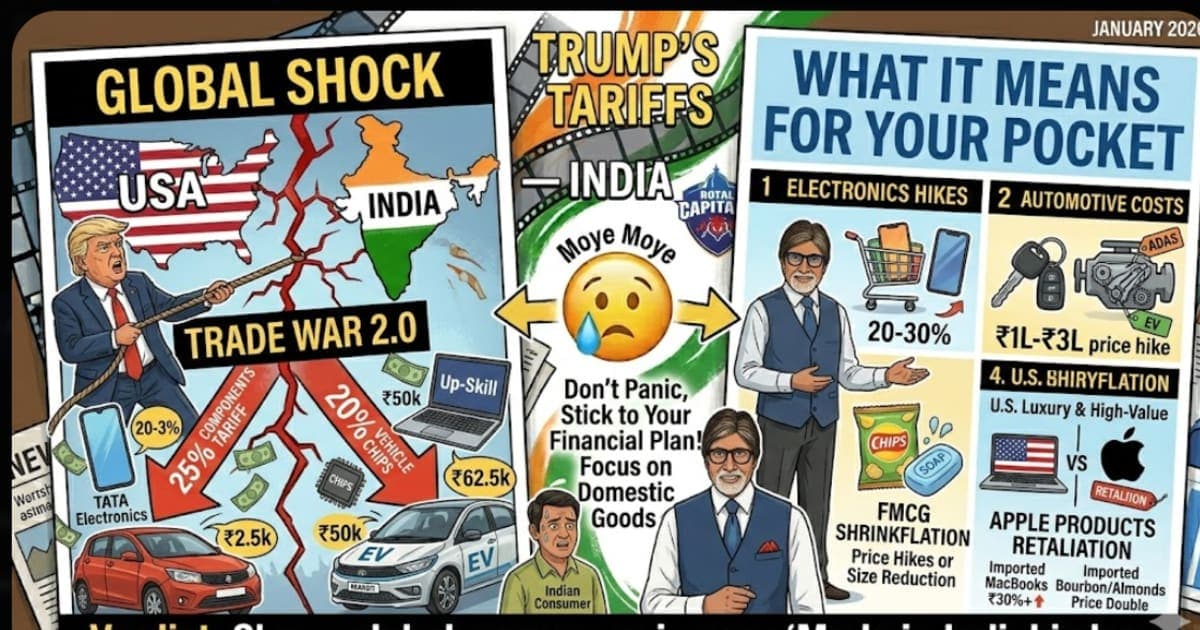
The math is uncomfortable but straightforward. Your ₹50,000 laptop becomes ₹62,500. Your ₹1,00,000 phone becomes ₹1,25,000. Not because the phone got better. Because a tariff decision made in Washington travelled through a supply chain and landed in your pocket.
The practical consequence: upgrade cycles slow down. The phone you were planning to replace this year gets one more year. The laptop you've been putting off buying gets put off longer.
The Car You Want
Just Got Further Away
India manufactures over 90% of its auto components domestically — which sounds like insulation from this kind of shock until you look at what the remaining 10% actually is.
Semiconductors. Engine management systems. Advanced driver-assistance tech — the cameras, radar, and processing that go into everything from lane-keeping assist to emergency braking. These are the expensive, high-margin components that modern vehicles cannot function without, and they come from U.S. and U.S.-adjacent supply chains.
A 20% tariff on this category doesn't sound dramatic until you price it out. On a mid-range SUV, that's a ₹1 lakh to ₹3 lakh addition to the sticker price — before the dealer margin, before the GST calculation, before the insurance.
The EV situation is worse in a specific way. Indian electric vehicle manufacturers are in the middle of trying to build cost-competitive products in a market where price sensitivity is everything. They depend on U.S. chip technology and, in several cases, imported battery components. A tariff shock at this stage doesn't just raise prices — it disrupts the business model that made the pricing possible.
The green mobility push that everyone from NITI Aayog to your local EV startup has been building toward just hit a significant headwind.
The ₹10 Packet That
Quietly Shrank
Tariffs are inflationary in ways that don't always announce themselves.
The obvious impact is on imported goods or goods made with imported inputs. The less obvious impact is what happens when energy prices move.
The U.S. is now a significant supplier of crude oil and LNG to India. Any friction in that relationship — whether through direct tariffs on energy exports or retaliatory measures that raise the cost of our energy imports — feeds directly into fuel prices at the pump.
Fuel price increases don't stay at the pump. They move through every supply chain that uses trucks, trains, or ships to get goods from where they're made to where they're sold — which is every supply chain.
The ₹10 packet of chips or soap doesn't disappear. It either becomes ₹12 — which is the honest version — or it stays ₹10 and becomes slightly smaller, which is the version that doesn't trigger the same complaint but costs you the same amount.
Shrinkflation is the polite word for it. "Paying more for less without being told directly" is the accurate one.
India's Response —
And What It Costs You Too
India is not going to absorb this quietly. We didn't in 2018 when we matched Trump's steel tariffs, and the 2026 version of that response will be more significant.
The likely targets are U.S. imports with strong domestic substitutes — products where India can raise duties without losing something irreplaceable.
Apple products. A manufactured-in-India iPhone is one thing. An imported MacBook or iPad Pro is a different category — one where retaliatory tariffs are both politically easy and economically manageable. Prices on imported Apple hardware could reach levels that make them genuinely prohibitive for most of the market.
American liquor and almonds. This list came back from Trade War 1.0 like a recurring villain. U.S. bourbon, California wine, and American almonds — the last being a staple of the "healthy snacking" category that has grown significantly in urban India — will all face duty hikes that could double their retail price.
Harley-Davidson and imported bikes. Already expensive. After retaliation, we're talking about a level of pricing that moves these from "expensive aspiration" to "theoretical object."
The catch with retaliation is that it costs the retaliating country too. Indian consumers who buy these products pay the higher prices. The government collects more duty, but the consumer absorbs the difference.
The Sectors Where
This Affects Your Career
This isn't only about what you buy. It's about how you earn.
Pharmaceuticals
India is the pharmacy of the world — not a metaphor, an actual market reality. More than 40% of Indian pharmaceutical exports go to the United States. Generic medicines that keep U.S. healthcare even marginally affordable are largely made here.
Trump's stated goal of pharmaceutical independence means tariffs on Indian generics — even a modest 10–15% — that fundamentally alter the economics for companies like Sun Pharma and Dr. Reddy's. If they can't maintain low prices in the U.S. market, American insurers and pharmacy chains switch to domestic alternatives that cost significantly more but don't carry the tariff liability.
For Indian pharma, this is a potential jobs crisis that is currently being discussed very quietly. Slower R&D spending. Reduced hiring. And a question nobody wants to ask out loud: if the high-volume U.S. export market shrinks significantly, does the factory economics that allows India to produce cheap medicines for its own population also come under pressure?
Information Technology
The Indian IT sector — TCS, Infosys, Wipro, and the hundreds of mid-size firms behind them — generates roughly 60% of its revenue from North America. It was already navigating a slowdown in U.S. tech spending. Add the threat of higher H-1B visa fees, new taxes on offshore services, or simply the uncertainty that causes clients to delay contracts — and you have a sector that is simultaneously its most important decade and its most anxious one.
The on-site opportunity that defined a generation of Indian tech careers is structurally different now. Not gone, but different — harder to access, more expensive to maintain, less automatically available than it was five years ago.
The Silver Lining
That Comes With Conditions
The same trade war that is raising your phone price is simultaneously creating something real for Indian manufacturing.
Trump's tariffs on China are severe enough that U.S. companies are actively looking for alternatives. Apple's announcement that 25% of all iPhones will be manufactured in India is the headline version of a shift that is happening across electronics, components, and logistics.
This is real job creation. Real investment. Real manufacturing capacity being built in Tamil Nadu and other states that have positioned themselves for this moment.
The condition: to qualify for U.S. market access and avoid being caught in the "China content" net, Indian manufacturers have to demonstrate minimal Chinese components in their supply chains. Which means switching from cheaper Chinese parts to more expensive Korean or Taiwanese alternatives.
Which means the phone assembled in India for an American market still costs more to make than it did before the tariffs. The job is here. The savings aren't.
The Actual Number
Here's what the 2026 tariff landscape means in plain terms:
| What You're Buying | The Risk | The Real Cost |
|---|---|---|
| Smartphone / Laptop | 25% component tariff | ₹10,000–₹25,000 added to price |
| New Car / SUV | 20% chip and sensor tariff | ₹1L–₹3L price increase |
| Daily groceries / FMCG | Input and fuel cost inflation | Shrinkflation or 10–15% price hike |
| Imported Apple hardware | Retaliatory duty | Prices become prohibitive |
| U.S. whiskey / almonds | Retaliatory duty | Prices double or more |
The era of cheap, globally frictionless commerce that India benefited from for twenty years is over — not paused, not interrupted, over.
Supply chains that were built for efficiency are being rebuilt for political alignment. That process is expensive and the cost is distributed broadly and unevenly across every economy connected to the U.S. market — which is every economy.
For the average Indian consumer in 2026, "America First" is not an American political slogan. It's the reason the phone you wanted costs more, the car you planned for costs more, and the packet of almonds at the supermarket quietly shrank without changing the price.
Nobody voted for that. But everyone is paying for it.
Tariff rates referenced are based on announced and proposed measures as of February 2026. Actual consumer price impacts vary by product, manufacturer and supply chain structure. This article is for informational purposes only and does not constitute financial or investment advice.