Your EMI Isn't Dropping Yet.
Here's the Honest Truth About India's Inflation Reset.
Walk into any bank branch in Mumbai right now
and ask a relationship manager one question:
"When is my home loan rate coming down?"
Watch the pause that follows.
The careful smile.
The phrase — always the same phrase —
"We are monitoring the situation."
That pause has a name.
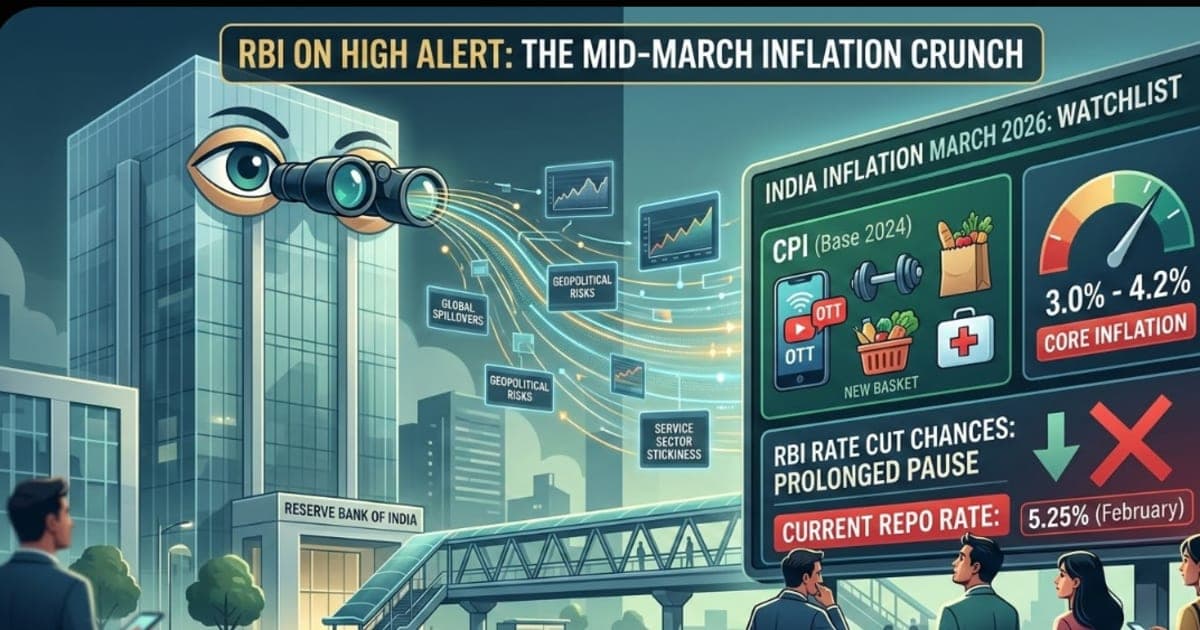
It's called the RBI's Neutral stance.
And based on everything happening
with India's inflation data right now,
that pause is staying put
for longer than most people hoped.
Here's what's actually going on —
without the central bank speak.
The Number That Looks Great
But Isn't the Whole Story
January 2026. Headline CPI: 2.75%.
On paper, that's a win.
Comfortably inside the RBI's 2–6% tolerance band.
Finance Twitter celebrated briefly.
WhatsApp groups forwarded the headline.
A few anchors called it "historic low inflation."
Then the economists opened the data.
Because 2.75% is measured against a new ruler.
February 2026 brought India's biggest
statistical overhaul in 14 years —
MoSPI officially shifted the CPI base year
from 2012 to 2024.
This wasn't just a clerical update.
It rewired how India counts price pressure.
Old basket vs new basket:
| Component | Old Weight (2012) | New Weight (2024) | Change |
|---|---|---|---|
| Food & Beverages | ~46% | 36.75% | -9.25% |
| Services (Health, Education, Transport) | Lower | Higher | +significant |
| New items added | None | OTT platforms, rural rent, pen drives | New |
Food — the most volatile item in the basket,
the thing that spikes when onion prices double —
just got a smaller vote.
Which means the headline number is
technically smoother, cleaner, calmer.
A 45-degree summer looks less intense
if you change how you measure temperature.
The number the RBI actually watches?
Core inflation: 3.4%.
Services. Rent. Healthcare. Education.
Sticky prices. Prices that don't fall
when the monsoon is good.
Prices that don't care
what the tomato crop looks like.
That 3.4% is the real conversation
happening inside Mint Street right now.
Why Sanjay Malhotra Is Playing Defense
The RBI kept the repo rate at 5.25%
in the February meeting.
After 125 basis points of cuts
over the previous easing cycle,
Governor Sanjay Malhotra
essentially told the market:
we are watching. We are not moving.
Three reasons for that caution —
and they're all legitimate.
The Base Effect Trap
Here's the math problem they're sitting with.
January 2026 inflation looks low
partly because January 2025 was high.
That comparison — this year vs last year —
is called the base effect.
And it flatters the current numbers artificially.
By Q1 and Q2 of FY27,
those flattering comparisons disappear.
The RBI's own projections show inflation
climbing back toward 4.0%–4.2%
by mid-year.
Cut rates now on the back of a statistical illusion,
and you're easing into an inflation uptick.
That's the kind of mistake
that takes two years to fix.
The Gold and Silver Problem
This one caught everyone off guard.
The new CPI basket assigns real weight
to jewellery and precious metals.
And gold/silver had a spectacular run —
jewellery inflation in certain segments
clocked 46% to 160% over some periods.
That's not food. That's not fuel.
That's a category the RBI
has essentially zero tools to influence.
They can't lower the price of gold
by adjusting the repo rate.
But they can refuse to add more liquidity
into an economy where asset prices
are already running hot.
The Budget's Free Cash
The 2026 Union Budget was generous.
Income tax cuts. Consumption push. Infrastructure spend.
All legitimate, all growth-positive.
But more money in household wallets
means more spending capacity.
More spending capacity without corresponding
supply expansion means prices creep up.
The RBI wants to watch one full quarter
of consumption data before deciding
whether that extra cash is inflating demand
or just filling a genuine gap.
"If the economy is growing at 7.4%
and inflation is behaving,
why touch the dial?"
That's the internal logic on Mint Street.
Hard to argue with, honestly.
When Do Rates Actually Drop?
Here's the honest answer:
Not March. Probably not April.
Realistically, Q3 2026. Maybe Q4.
| Signal RBI Is Watching | Current Status | Rate Cut Impact |
|---|---|---|
| Headline CPI | 2.75% — low | ✅ Positive |
| Core Inflation | 3.4% — sticky | ⚠️ Cautious |
| GDP Growth | 7.4% projected | ❌ No urgency |
| US Fed direction | Paused | ⚠️ Wait and watch |
| Rupee stability | Under pressure | ❌ Negative |
| Monetary Stance | Neutral | ⏸️ Holding |
Two things would change this calculus fast.
One: The US Federal Reserve starts cutting.
When the Fed eases, emerging market pressure
on the Rupee softens.
That gives the RBI room to move
without triggering capital outflows.
Two: Domestic consumption shows
genuine signs of slowing.
Not catastrophic. Just a clear signal
that the economy needs a push
rather than a restraint.
Until one of those happens,
Malhotra's hand stays where it is.
The Three Risks Nobody's Talking Enough About
The 2024 base year makes the charts look pretty.
Doesn't make the underlying risks disappear.
Imported Inflation via the Rupee
Rupee at ₹92 and climbing.
Every dollar-denominated import — crude oil,
electronics components, industrial chemicals —
costs 10% more than it did six months ago.
India doesn't make enough of its own chips.
Doesn't refine enough of its own specialty chemicals.
Doesn't produce enough domestic crude.
Rupee weakness is a slow, grinding
inflationary pressure that doesn't show up
in the onion price.
It shows up in your electricity bill,
your phone upgrade cost,
and the quietly expanded price tag
on half the products in a D-Mart aisle.
Services Inflation Is Glue
Tomatoes that hit ₹120/kg in June
are ₹30/kg by September.
Volatile. Painful. Temporary.
Your gym membership that went from
₹2,500 to ₹3,200 per month?
It's not going back to ₹2,500.
The physiotherapy session that was ₹800
and is now ₹1,100?
The school fee that jumped 12%?
The rent?
Services pricing is sticky in a way
food pricing simply isn't.
And the new CPI basket just gave services
a much bigger seat at the table.
Core inflation staying at 3.4%
in a "good" inflation environment
tells you exactly how sticky this category is.
The Geopolitical Wildcard
Strait of Hormuz disruption.
Oil at $122/barrel.
The Middle East situation fluid
and getting more complicated by the day.
A sustained crude price spike
doesn't just hit petrol and diesel.
It hits plastics. Fertilisers. Transport costs.
FMCG supply chains.
It hits everything, slowly, then all at once.
The RBI can model domestic variables.
It cannot model what happens
if Iranian naval activity
keeps tankers out of the Gulf for three weeks.
What This Means for Your Money
Stop waiting for a rate cut to rescue your EMI.
Work with what exists.
If You Have a Home Loan
Your floating rate isn't moving for six months.
Minimum.
Use that certainty productively.
Prepay principal if you have surplus.
Even ₹50,000-1 lakh annually
cuts 2-3 years off a 20-year loan
more effectively than a 25-bps rate cut would.
When the cut does come —
and it will, eventually —
you'll have a smaller principal to benefit from.
Double win.
If You're a Fixed Deposit Person
Right now might be your window.
Real interest rates — FD rate minus inflation —
are actually positive and meaningful.
A 5-year FD at 7.25-7.5%
against inflation at 2.75%
gives you real purchasing power gains.
Lock in before the eventual rate cut
compresses those FD rates.
The window won't stay open forever.
If You're in Equities
7.4% GDP growth is legitimately
good news for the broad market.
But the "prolonged pause" creates
a quiet pain point:
companies with heavy debt.
Mid-cap industrials, real estate developers,
infrastructure players with leveraged balance sheets —
they're paying 5.25% repo-linked borrowing costs
for longer than their financial models assumed.
Some of them built projections
on a rate cut that hasn't arrived.
Be selective. Prefer low-debt businesses
in sectors with genuine pricing power.
Let the over-leveraged ones show their hand first.
The Bigger Picture
India's statistical overhaul is legitimate
and long overdue.
Using 2012 as a base year
in 2026 was genuinely absurd —
we didn't have Zomato subscriptions in 2012.
We didn't have WFH rent markets.
We barely had smartphones.
The new basket is more honest.
More representative.
That's a good thing.
But honest numbers don't automatically
mean comfortable numbers.
A more sophisticated basket
picks up more sophisticated pressures.
Services inflation that the old basket
would have half-captured
now has full representation.
The RBI knows this.
Which is why Malhotra isn't celebrating
a 2.75% print.
He's asking what Q2 FY27 looks like
when the base effect normalises
and services keep grinding upward.
The Neutral stance isn't timidity.
It's the right call for this moment.
The Indian economy is growing
at a pace most of the world envies.
Inflation is manageable.
The direction is broadly right.
The job now is to not break something
by moving too fast.
Your EMI will get a break.
Just not this quarter.
Data sourced from MoSPI January 2026 CPI release,
RBI February 2026 policy statement,
and MoSPI CPI base year revision circular, February 2026.
This is economic commentary, not financial advice.