If you checked your portfolio this morning and felt something drop in your stomach, you're not alone.
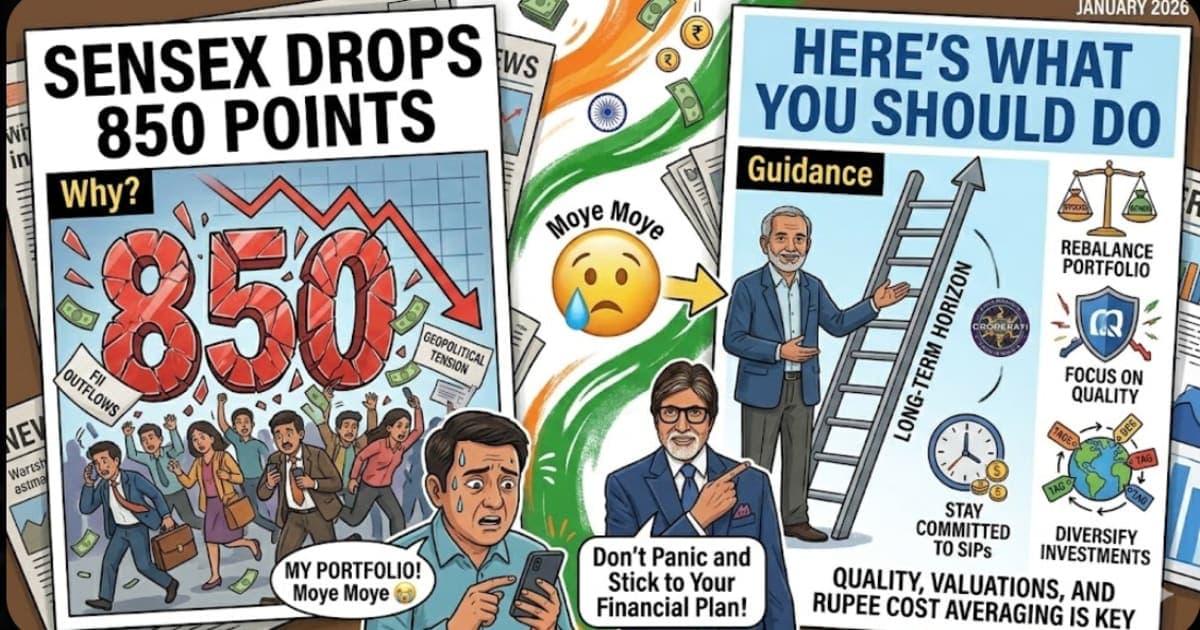
The BSE Sensex fell over 850 points on February 28, 2026 — one of the steeper single-day drops in recent months. Red screens, anxious WhatsApp forwards, and the usual chorus of people who are either panicking or pretending they saw it coming.
Neither of those responses is particularly useful. Here's what actually happened and what, if anything, you should do about it.
Why Did It Fall?
It's rarely one thing. Anyone who tells you a market move this size had a single cause is either oversimplifying or selling something.
Today was a combination of four things hitting at the same time.
The Fed situation
The US Federal Reserve has been the background noise of global markets for the last two years, and it hasn't stopped. Recent data out of America suggested inflation is proving more stubborn than expected — which means rate cuts that markets were quietly pricing in for mid-2026 might not arrive on schedule.
When US interest rates stay high or go higher, bonds become more attractive relative to equities. And when that happens, foreign institutional investors — who have been a significant driver of the Indian market's recent run — start pulling money out of emerging markets and parking it somewhere safer.
That flow reversal hits Indian markets quickly and visibly.
Geopolitical noise
The ongoing tensions in Europe and parts of the Middle East haven't resolved — they've just faded from the front page without actually going away. Markets had largely priced in "manageable instability." Any sign that the instability is becoming less manageable triggers a flight to safety that you can watch happen in real time on a Bloomberg screen.
Energy prices are the specific concern. A disruption there flows through to inflation, which flows through to central bank decisions, which flows through to everything else.
Domestic headwinds
India is still one of the fastest-growing large economies. That's real and it matters. But some of the recent data has been pointing toward a moderation in momentum — rural consumption softer than expected, input costs squeezing margins for a number of companies, some earnings misses in the last quarter that didn't make headlines but showed up in how fund managers were quietly repositioning.
None of this is alarming in isolation. Together, on a day when global sentiment is already nervous, it's enough to accelerate a sell-off.
Profit booking
The Sensex had a strong run in the months leading up to today. Strong runs accumulate what traders call "froth" — positions that exist not because of conviction in the underlying business but because the price kept going up and momentum trading works until it doesn't.
When sentiment turns, those positions unwind fast. Some of what you saw today was people who made money in the rally deciding this was a good moment to take it off the table.
That's not a crisis. That's a market working the way markets work.
What You Should Actually Do
This is the part where most finance articles tell you to "stay calm" in a way that somehow makes you feel less calm. So let's try to be more specific than that.
If you're in SIPs — do nothing
Seriously. Nothing.
SIPs are designed for exactly this. You invest a fixed amount at regular intervals, which means today you're buying more units for the same money than you were last month. That's not a problem. That's the mechanism working.
The worst thing you can do with a SIP during a correction is pause it. You lock in the loss and miss the recovery. The second worst thing is to check it every day until it recovers. Neither helps.
If you're holding individual stocks —
check the thesis, not the price
The question isn't "should I sell because it's down?"
The question is: "has anything changed about why I bought this?"
If the answer is no — the business is still solid, the fundamentals haven't shifted, you bought it for the long term — then a market-wide correction is not a reason to exit. It's noise.
If the answer is yes — something in the quarterly results or the sector outlook has genuinely changed — that's worth acting on regardless of what the market did today.
Don't make decisions based on today's number. Make them based on whether the original reasoning still holds.
If you have cash sitting idle —
this is what "long-term opportunity" actually looks like
Contrarian investing sounds good in theory and is genuinely hard in practice, because it requires buying when everything feels bad.
If you have surplus cash — money you genuinely don't need for the next three to five years — and you've been waiting for valuations to look more reasonable, today is a more reasonable entry point than last month was.
Don't put it all in today. Stagger it over the next few weeks or months. Focus on quality — companies with strong balance sheets, real cash flows, a business model that makes sense in multiple economic scenarios.
Don't try to call the bottom. Nobody does that reliably. Just buy good businesses at better prices than you could a month ago and hold them for long enough that today's drop becomes invisible on the chart.
Rebalance if you need to —
but not reactively
If today's drop has shifted your equity-to-bond ratio significantly away from where you want it, rebalancing makes sense. Sell some of the assets that have held value and add to equities while they're cheaper.
This is disciplined portfolio management. It feels counterintuitive because you're adding to something that just went down, but that's exactly what rebalancing is supposed to do.
What doesn't make sense is rebalancing into a more defensive position purely because today was red. That's reacting to a number, not managing a portfolio.
The Longer View
850 points sounds large and it is a large number. In percentage terms, on a Sensex that's been trading at these levels, it's a significant but not unusual single-day correction.
The India growth story — demographics, infrastructure investment, digital economy, the structural reforms that have been building for years — none of that changed today. A Fed data point and some geopolitical noise don't reroute a decade of structural tailwinds.
Short-term volatility is not the same as long-term risk. Most investors confuse them because they feel the same in the moment — the same anxiety, the same urge to do something.
The something to do, most of the time, is less than you think.
Check your allocation. Make sure your SIPs are running. Look at your time horizon rather than today's screen.
And maybe close the portfolio app for the rest of the weekend.
BSE Sensex fell approximately 850 points on February 28, 2026. This article is for informational purposes and does not constitute financial advice. Consult a SEBI-registered financial advisor before making investment decisions.