Nifty at 23,151 and Falling — Why Analysts Say 23,000 Is the Line That Cannot Break
MUMBAI, March 16, 2026
The Nifty 50 closed at 23,151 on Friday, March 13. It is currently trading near 23,166 today, down sharply from its 2026 opening levels but holding — barely — above the 23,000 psychological support that every technical analyst in the market has circled in red. [web:275][web:285]
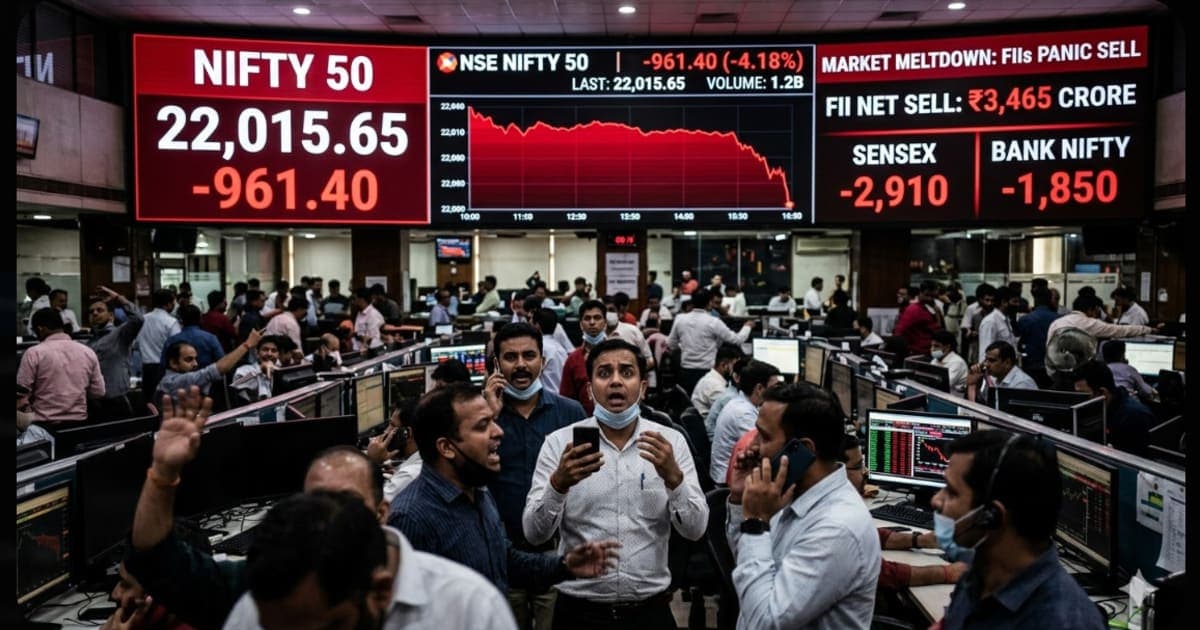
The question that matters right now is not "how did we get here" — that story is the Hormuz blockade, the Rupee at 92.3, FII outflows of ₹3,465 crore in a single session, and oil stubbornly above $100. The question that matters is what the charts say about where we go next, what the fundamentals say about the year-end, and whether there is any sector showing genuine strength in a market where almost everything is red.
The Technical Picture — Three Lines That Define the Next Month
23,000: The floor that must hold.
Bajaj Broking Research's pre-market analysis for today was unambiguous: the Nifty has formed a "sizable bearish candle with a lower high and a lower low" on the weekly chart, slipped to an 11-month low, and in the process breached both the 100-week EMA and the rising trendline connecting the lows of 2023 and 2025. [web:276] That combination of a trendline breach, an EMA break, and a multi-month low in a single week is a technically significant deterioration — not a routine correction.
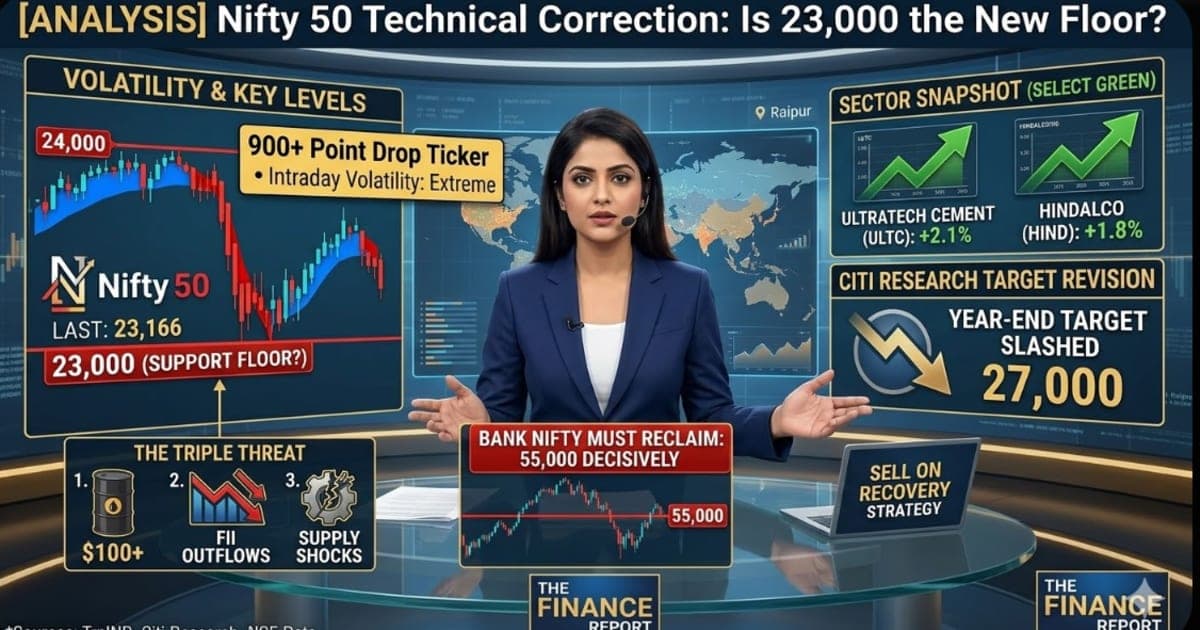
The immediate support cluster is 23,000 to 22,900. [web:275] This zone has held on two previous tests in 2025. Round-number psychology reinforces the technical significance: 23,000 is the level where retail investors running stop-losses, algorithmic systems programmed with round-number parameters, and discretionary traders all have orders clustered.
If 23,000 breaks on a daily closing basis — not an intraday dip but an actual end-of-day close below 23,000 — the next meaningful demand zone is 22,700 to 22,400. [web:276] Below that, technicians are pointing to 22,500 as the deeper support before the market tests the 22,000 area where structural long-term buyers historically reenter. [web:275]
23,400 to 23,750: The supply wall.
Any recovery from 23,000 faces a dense supply zone between 23,400 and 23,750. [web:275] These are levels where investors who bought during the January to February range are now sitting with losses and will use any bounce to reduce exposure. That selling pressure — technical in its mechanics but sentiment-driven in its cause — means recoveries are likely to be shallow and short-lived until the macro environment visibly changes.
24,000 to 24,250: The major resistance.
The 24,000 level is now a "massive supply wall" in the language of technical analysts. [web:275] The market spent several weeks in this zone earlier in 2026. The investors who bought there are underwater and will sell into any approach toward their entry price. Reclaiming 24,000 on a sustained basis requires either a significant positive macro development or an extended period of sideways consolidation that allows the overhang to clear.
The current bias from every technical desk analysed: "Sell on recovery." [web:279] Not an outright short — the oversold RSI readings and the proximity to 23,000 support mean the risk of a sharp short-covering bounce is real. But the structure of the chart does not support buying positions until the market demonstrates it can hold above 23,750 on a closing basis with improving breadth.
Bank Nifty — Why 55,000 Is the Bull/Bear Line
The Bank Nifty closed at 53,757 on Friday. [web:275] Its structure is arguably worse than the headline Nifty — it has been underperforming the broader index since January and is currently in a distinctly bearish configuration.
The critical levels for Bank Nifty: [web:275][web:276]
- Support at 53,200 / 52,800: The first test of these levels is already in progress. A close below 52,800 opens the path to 52,200 to 52,000, where structural demand from long-term institutional buyers is expected.
- Deep support at 52,500 to 51,800: If 53,600 fails to hold, this becomes the next significant demand pocket. [web:276]
- Resistance at 54,200 / 55,100: Any intraday bounce faces the first supply zone at 54,200 and the next at 55,100 — the level at which Bank Nifty was trading before the most recent leg of selling began. [web:275]
- The bull/bear dividing line at 55,000 to 56,000: Above 55,000, the Bank Nifty structure begins to look constructive. Below it, every rally is a selling opportunity. [web:276]
The reason Bank Nifty underperforms in this specific macro environment: banks are the transmission mechanism for oil and currency shocks into the real economy. Rising oil means higher inflation, which means the RBI holds rates elevated, which compresses net interest margins. A weaker Rupee means higher import financing costs, more stressed SME borrowers in trade-heavy sectors, and increased credit risk in the retail and unsecured loan books. Every factor driving the Nifty lower hits banks first and hardest.
The "sell on recovery" strategy is most applicable to Bank Nifty specifically — recoveries toward 54,200 to 55,000 are the level at which risk-reward for short positioning becomes attractive until the macro environment resolves.
The Green Pockets — Why Metals Are Different
While financials and consumption stocks are the primary casualties of the current environment, metals and cement are seeing relative strength. UltraTech Cement and Hindalco are among the few large-cap names trading in positive territory today.
The logic is straightforward: the same oil price environment that crushes India's import bill and pressures the Rupee simultaneously drives global commodity prices higher. Hindalco — which has significant international aluminium operations through its Novelis subsidiary — benefits from higher global aluminium prices. When oil is above $100, energy-intensive commodity production economics shift in favour of producers who have already paid their capital costs.
UltraTech's relative strength is a different signal. Cement demand is driven by domestic infrastructure and real estate activity, not global commodities. The government's infrastructure push — the ₹11.11 lakh crore capex budget for FY27 — continues regardless of the Hormuz situation. When the broader market falls on macro fears, infrastructure-linked stocks that are insulated from the direct import cost shock can become relative safe havens. Not because they are rising — they aren't, on most days — but because they are falling less.
The sectoral rotation signal from this week: investors are moving out of rate-sensitive financials and consumption stocks and into commodity producers and infrastructure plays. That rotation will continue as long as oil stays above $100 and the rate outlook remains uncertain.
Citi and Nomura — The Target Cuts That Frame the Year
Both Citi and Nomura have now formally revised their December 2026 Nifty targets lower, and the revisions are material. [web:278]
Nomura cut its year-end target from 29,300 to 24,900 — a 15% reduction. [web:282] The rationale: a potential 10-15% risk to consensus earnings estimates for FY27 if oil remains elevated, combined with a P/E multiple compression from 21x to 18.5x to account for higher risk premium.
Citi reduced its target from 28,500 to 27,000. [web:280] The brokerage lowered its target P/E multiple from 20x to 19x one-year forward earnings, citing macroeconomic headwinds from oil prices and supply disruptions. Citi also removed Mahindra & Mahindra and Mahanagar Gas from its top picks list — the former sensitive to consumer financing conditions, the latter directly exposed to the LPG price environment. [web:280]
Citi still expects the RBI to hold rates unchanged at its April policy meeting, with a possible shift toward a growth-supportive stance if the government absorbs most of the energy inflation through fiscal measures rather than allowing it to pass through to CPI. [web:280]
The Bloomberg consensus of analyst 12-month Nifty targets remains around 29,800 — implying 28% upside from current levels. [web:286] But that consensus was set before the Dubai Airport drone attack, before the Fujairah strike, before the full escalation of the past 72 hours. It will be revised lower over the coming week as more brokerages update their models.
The gap between the most bearish institutional target (Nomura at 24,900) and the most optimistic consensus view (Bloomberg at 29,800) is itself a measure of uncertainty. Nobody has high conviction about where this ends because the key variable — when and how the Hormuz situation resolves — is genuinely unknowable.
The Strategy Framework for the Week
Short-term traders: The 23,000 level is the pivot. Below 23,000 on a close, the structure accelerates lower toward 22,700 to 22,400. Above 23,400, a relief rally toward 23,750 is possible. Sell recoveries into resistance; do not chase bounces until 23,750 is reclaimed and held. [web:279]
Positional investors (2-4 week horizon): The "sell on recovery" framework is appropriate until Bank Nifty decisively reclaims 55,000. No single sector or individual stock can sustainably rally in an environment where the financials index is below 54,000. [web:276]
Long-term SIP investors (3+ year horizon): The Nifty is at an 11-month low. Siddhartha Khemka of Motilal Oswal said it clearly: "market direction is likely to remain sensitive to developments in the West Asia conflict, movements in crude oil prices and the trend in foreign fund flows." [web:276] Easing geopolitical tensions would provide relief. Until there is evidence of that easing, stay the course on existing positions and use the current level to accumulate quality large-caps in tranches rather than bulk deployment.
The Nifty at 23,166 is not a buying signal. It is not a panic-selling signal. It is a "watch the 23,000 level, watch the Bank Nifty at 55,000, watch Brent crude overnight, and do not make large directional bets until the macro picture clarifies" signal.
Until the tankers move through Hormuz freely, the charts will continue to look like this.