Nifty Down 961 Points — What Actually Happened Today and What It Means for Your Portfolio
MUMBAI, March 16, 2026
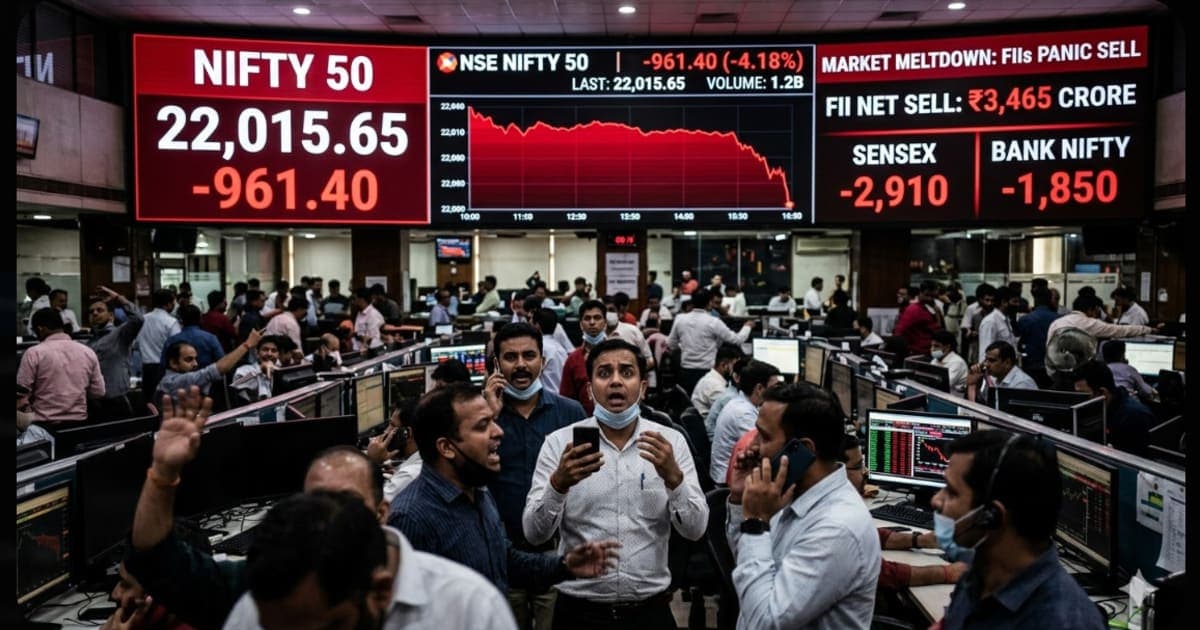
The Nifty 50 closed at 22,161 today, down 961 points — a 4.16% single-session decline that ranks among the worst trading days of 2026. The Sensex fell 3,072 points. Every major sectoral index closed in the red. The mid-cap and small-cap indices fell harder than the headline numbers suggest, with several counters hitting lower circuits before noon.
If your portfolio looks terrible tonight, here is exactly what happened, why it happened, and what the technical picture says about what comes next.
The Trigger — Not One Thing, Everything at Once
Single-day crashes of this magnitude rarely have a single cause. Today's selloff was the convergence of four separate pressure points hitting simultaneously.
FII selling at scale. Foreign Institutional Investors offloaded equities worth over ₹3,465 crore in a single session. This is not routine profit-booking. This is systematic de-risking — fund managers in New York, London, and Singapore reducing exposure to emerging markets because the risk-reward calculation for holding Indian equities has deteriorated. The specific triggers: oil above $105, the Rupee at 92.3, and a geopolitical environment in West Asia that shows no sign of resolving. When global oil prices rise sharply, India's current account deficit widens, inflation rises, and the central bank's room to support growth narrows. Every fund manager running a global emerging markets book ran the same model this weekend and arrived at the same conclusion: reduce India weight.
The Dubai Airport incident. The Iranian drone strike on a fuel tank near Dubai International Airport this morning was a direct escalation signal. UAE air defences intercepted 21 drones and 6 ballistic missiles in a single day. The Fujairah oil port — India's primary alternative crude import route when Hormuz is disrupted — was also struck. Markets opened with this news already priced into sentiment, and there was no positive development through the session to counteract it.
Oil holding above $100. Brent crude remained above $100 through the entire trading session. For an economy that imports 85% of its crude, this is not a temporary input cost problem. It is a structural compression on corporate margins, consumer spending power, and fiscal headroom. Every sector that runs on fuel — aviation, logistics, manufacturing, FMCG distribution — saw selling pressure today as analysts revised earnings estimates downward.
Technical breakdown. The Nifty 50 sliced through its 200-day moving average (DMA) during morning trade and never recovered above it. The 200 DMA is the most widely watched long-term technical indicator in equity markets — when an index breaks below it with conviction and volume, it signals that the trend has shifted from bullish to bearish on a structural basis. Algorithmic trading systems that are programmed to sell on 200 DMA breaks added fuel to the fire after the initial FII selling triggered the breach.
The Numbers — Sector by Sector
No sector was spared, but the damage was not uniform.
Oil & Gas stocks: Paradoxically, upstream companies like ONGC and Oil India should benefit from higher crude prices. They fell anyway — because the market is pricing in government pressure to cap domestic fuel prices and absorb the cost at the PSU level rather than passing it to consumers. ONGC fell 3.2%. Reliance, whose refining margins are compressed by high crude, fell 4.8%.
Banking and Financials: The Nifty Bank index fell 4.9% — steeper than the headline index. The reasoning: rising oil prices and a weaker Rupee mean higher inflation, which means the RBI holds rates higher for longer, which compresses net interest margins and raises credit risk in the consumer and SME loan books. HDFC Bank fell 4.1%. ICICI Bank fell 4.7%. Kotak fell 5.2%.
Aviation: IndiGo fell 6.8%. Air India's parent InterGlobe fell in sympathy. The fuel surcharge announcement has already been made — markets are now pricing in whether the surcharges are enough to offset the full ATF cost increase, and the answer from analysts today was: probably not.
Metals and Infrastructure: Slightly more resilient, as global commodity prices tend to rise in the same environment that drives oil higher. But "slightly more resilient" in today's session meant down 2-3% rather than down 4-5%.
DIIs as the cushion. Domestic Institutional Investors — mutual funds, insurance companies, pension funds — bought approximately ₹2,100 crore worth of equities through the session, partially offsetting FII selling. This is the SIP money at work: systematic monthly inflows from retail investors through mutual funds that get deployed regardless of market conditions. It softened the fall but could not reverse it against the scale of FII selling.
The Technical Picture — What the Charts Say
The 200-day moving average breach is the headline technical event. But there are three other levels that analysts are watching closely.
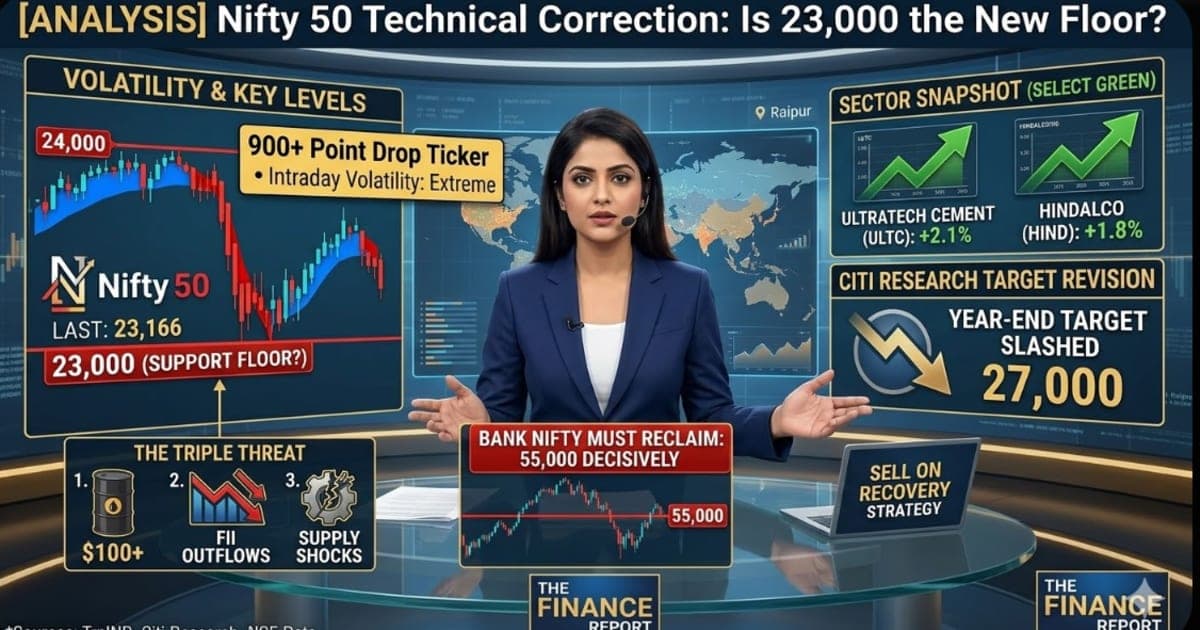
22,100 — Immediate support. The Nifty closed at 22,161 today, meaning it is approximately 60 points above this level. This is a horizontal support zone defined by multiple previous swing lows and the 61.8% Fibonacci retracement of the October 2025 to January 2026 rally. If the index opens below 22,100 tomorrow morning — particularly on heavy volume — it signals the next leg down is beginning.
The margin call risk below 22,100. Leveraged positions — traders who have bought Nifty futures or individual stocks on margin — are typically carrying stop-loss levels clustered just below major support zones. A breach of 22,100 would trigger automated stop-losses and margin calls simultaneously, creating a cascade of forced selling that accelerates the move downward. This is the "falling knife" scenario that analysts are warning against.
21,400 — Next major support. If 22,100 breaks, the technical picture does not offer strong support again until approximately 21,400 — the low of the August 2025 consolidation period. That is a further 3.4% decline from today's close.
The RSI picture. The Nifty's 14-day Relative Strength Index has now moved into oversold territory below 35. RSI oversold conditions do not mean the market will bounce immediately — they mean selling has been excessive relative to recent averages and the risk of a relief rally is rising. In a strong downtrend driven by genuine macro headwinds, oversold RSI can stay oversold for extended periods.
What DIIs Cannot Do Alone
The Domestic Institutional Investor buying today is being framed by some commentators as a "safety net." It is worth being precise about what that means and what it does not mean.
DIIs buying ₹2,100 crore against FII selling of ₹3,465 crore means net institutional selling of ₹1,365 crore — the market fell despite DII support, not because DII support failed to materialise. The SIP inflow into equity mutual funds is approximately ₹23,000-25,000 crore per month — roughly ₹1,000-1,100 crore per trading day. Fund managers deploying that money today helped prevent a worse outcome. They cannot, by themselves, reverse a trend that is being driven by global macro factors that domestic buyers cannot offset at scale.
The DII cushion matters at the margin. It does not change the direction until the FII selling pressure eases — and that pressure will only ease when the Hormuz situation shows resolution, oil pulls back below $90, or the Rupee stabilises at a level that makes Indian equities attractive to foreign investors on a risk-adjusted basis.
None of those conditions are present today.
What Should You Actually Do
The honest answer, which is less satisfying than a confident call: it depends entirely on your time horizon and why you own what you own.
If you are a SIP investor with a 5-10 year horizon: Today's session is noise in the context of your investment period. The companies whose funds you own are not worth 4% less today than they were on Friday because their businesses have deteriorated. They are worth 4% less because FIIs are selling emerging market exposure due to a geopolitical crisis that will eventually resolve. Continue your SIPs. Do not stop because the market fell hard.
If you are a trader with leveraged positions: The 200 DMA breach is a genuine technical warning. The 22,100 level is the line to watch. If you are long with leverage and your stop-loss is below 22,100, that stop-loss level is not theoretical — it may be tested tomorrow morning depending on overnight global developments.
If you are sitting on cash wondering whether to buy the dip: The "falling knife" warning from analysts is specifically directed at you. Buying a stock or index that is in a downtrend driven by genuine macro headwinds — not a technical correction but an actual deterioration in the economic environment — before the trend reverses is a reliable way to catch the knife rather than the handle. The question is not "is this cheap" but "what changes the macro picture?" Until there is an answer to that question, the dip can continue dipping.
The macro picture changes when: Hormuz reopens, oil falls back below $90, the Rupee stabilises above 90, and FII flows turn neutral or positive. Those are the signals to watch — not the intraday chart patterns.
Tomorrow Morning's Checklist
Before markets open at 9:15 AM, watch:
- Brent crude overnight — if it moves above $108, expect further opening weakness.
- US markets close — Asian markets will take their cue from Wall Street's response to the Dubai Airport situation.
- Rupee in pre-market — if it opens above 92.5, the RBI may intervene; watch for confirmation.
- Any Hormuz diplomatic development overnight — a ceasefire signal or negotiation announcement would be the single most market-positive event possible.
- Nifty futures at SGX — the Singapore Nifty futures give a pre-market indication of where the index will open.
Today was bad. Whether tomorrow is worse, a pause, or a relief bounce depends on information that does not yet exist.
The Nifty is at 22,161. The 200 DMA is broken. The support is at 22,100. The macro headwinds are real and unresolved.
"Avoid catching the falling knife" is the correct short-term recommendation. "Stay the course on SIPs" is the correct long-term recommendation. Both can be true at the same time.