The 8th Pay Commission Will Raise Government Salaries — But Will It Actually Beat the War-Time Price Rise?
NEW DELHI, March 16, 2026
The 8th Central Pay Commission, chaired by Justice Ranjana Prakash Desai, is currently in its active consultation phase. The feedback deadline is April 30, 2026. [web:250] The commission is expected to submit its final recommendations by May 2027, with implementation retroactive to January 1, 2026. [web:253] When it lands, it will revise salaries and allowances for approximately 50 lakh central government employees and 65 lakh pensioners. [web:253]
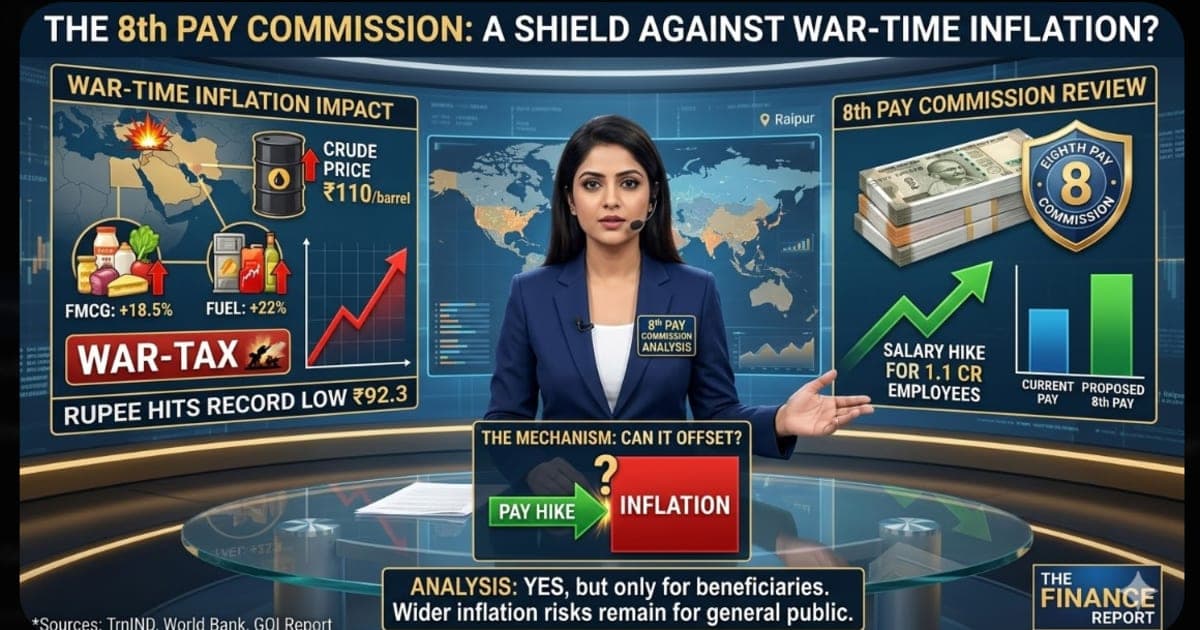
The political timing of fast-tracking this review — as the Rupee sits at 92.3, oil trades above $100, and the cost of an LPG cylinder has hit a record high — is not accidental. The government is accelerating a process that was already scheduled, partly because the economic environment is creating the kind of salary erosion in real terms that produces a specific kind of political pressure: quiet, sustained, and disproportionately concentrated in exactly the states and voter segments that matter most to the ruling coalition.
The question worth asking seriously is not "will salaries go up" — they will — but whether a pay commission revision can actually offset the specific inflation that Indian households are experiencing right now. The answer is nuanced, and it requires separating what the 8th CPC can do from what it cannot.
What the Numbers Actually Look Like
The expected fitment factor range sits between 1.83 and 2.86, depending on which analysis you follow. [web:252][web:257] The most cited central estimate from employee unions and independent analysts converges around a fitment factor of 2.28 to 2.57 — producing an effective salary increase of roughly 20-34% on basic pay from current levels. [web:245][web:255]
In concrete terms: a Level 1 employee currently earning ₹18,000 in basic pay could see that figure rise to anywhere between ₹32,940 (fitment factor 1.83) and ₹54,000 (fitment factor 3.0, the demand from unions like FNPO). [web:244][web:247] A mid-level officer at Level 10 currently drawing ₹56,100 would see basic pay move to approximately ₹1,02,000 to ₹1,28,000 depending on the approved factor.
Dearness Allowance — currently projected at 70% of basic pay by January 2026 — will be merged into the basic salary for revised calculations before the new fitment factor is applied. [web:255] This is standard practice across pay commissions, and it means the effective starting base for the 8th CPC calculation is already significantly above the nominal ₹18,000 minimum.
The arrears component is the part that will feel most immediate once implementation happens: every month from January 2026 to the actual disbursement date will accumulate as a lump-sum back payment. For a Level 7 officer, that could mean a one-time arrear payment of ₹1.5 to ₹2 lakh landing in their account on implementation day. That is a meaningful one-time stimulus — both for the individual household and for the consumer economy.
The Inflation It Needs to Beat
Here is where the shield analogy gets complicated.
The "war-tax" on Indian households is not being applied uniformly. It is a set of cost increases that fall differently on different income levels and consumption baskets.
Fuel. Petrol and diesel have risen approximately 18-22% from their pre-crisis levels. For a government employee who commutes by motorcycle or uses an auto-rickshaw, this is a direct monthly expenditure increase of ₹500 to ₹1,500 depending on commute distance and city. For an employee driving a car, the impact is ₹2,000 to ₹4,000 per month higher than January levels.
LPG. The 14.2kg domestic cylinder has increased by ₹150-200 since the Hormuz crisis began, on top of the series of price increases through 2025. For a family using 1.5 cylinders per month, this is an additional ₹225-300 monthly expenditure.
FMCG and food. The fuel price increase flows through the entire food distribution and logistics chain with a lag of four to six weeks. Vegetable prices, packaged food, dairy distribution costs — all of these are working through higher freight costs right now. The CPI food component is likely to show a 1.5-2.5 percentage point acceleration in the March data.
The aggregate "war-tax" on a median government employee household: approximately ₹3,500 to ₹6,000 per month in additional expenditure compared to December 2025. Annualised, that is ₹42,000 to ₹72,000 in additional costs.
The 8th CPC salary increase, when it arrives, will deliver substantially more than that in monthly take-home terms for most levels. A 25-30% basic pay increase for a Level 7 employee earning ₹44,900 basic translates to approximately ₹11,000-13,500 more per month in basic pay — well above the war-tax estimate.
The Catch — Timing, Implementation, and What "Retroactive" Actually Means
The arithmetic above looks reassuring for government employees. The problem is timing.
The commission's report is due by May 2027. [web:253] Government review, acceptance, and notification of the revised pay structure will take additional months after that. The realistic implementation date — when the revised pay actually appears in salary accounts — is likely to be late 2027 at the earliest, with arrears paid at that point.
Between now and late 2027, there is no 8th CPC relief. The inflation is happening today. The salary increase is arriving in 18 months minimum. The government employee household dealing with ₹105 oil and ₹1,100 LPG cylinders in March 2026 is doing so on their current 7th CPC salary.
The retroactive structure means the money will eventually be made whole — the arrears payment will cover the gap between January 2026 and implementation. But "eventually whole" in 18 months is cold comfort when the monthly household budget is stressed today.
This is the central limitation of using a pay commission as an economic cushion against real-time inflation. Pay commissions are structural salary revisions designed around multi-year planning cycles. Inflation driven by a war in the Strait of Hormuz moves in weeks and months. The instruments are mismatched in their timelines.
What the Government Could Actually Do Right Now
The 8th CPC acceleration is a medium-term measure being discussed as if it addresses an immediate problem. There are instruments the government has available that would actually provide near-term relief:
Excise duty cut on petrol and diesel. The government retains approximately ₹19.90 per litre in central excise on petrol and ₹15.80 on diesel. A partial cut of ₹5-8 per litre — similar to the November 2021 cut — would reduce fuel prices immediately and slow the pass-through inflation into FMCG and food. The fiscal cost at current consumption volumes is approximately ₹65,000-85,000 crore annualised. That is a significant but not insurmountable fiscal decision.
LPG subsidy restoration for non-PMUY households. The ₹300 subsidy under PM Ujjwala Yojana covers BPL households but not the urban middle class that is also being squeezed. Extending a targeted subsidy to below-median income non-PMUY households would cost approximately ₹12,000-15,000 crore annually at current scale.
DA interim relief ahead of the CPC report. The government could announce an interim Dearness Allowance hike ahead of schedule — the next DA revision is due in July 2026 — to partially compensate for inflation erosion before the full CPC recommendation arrives. This is precedented and does not require the full commission machinery to deliver.
None of these are being actively discussed in the public domain this week. The 8th CPC review acceleration is. The distinction matters: one is a structural revision that will deliver real money to government employees in 2027, and the other is immediate relief that costs fiscal headroom today.
The 1.15 Crore People This Does Not Reach
The final and most important limitation of the 8th Pay Commission as an inflation shield is its coverage.
Central government employees and pensioners number approximately 1.15 crore people. India's workforce is approximately 56 crore. The private sector employee in Indore whose transport company just announced a 15% freight surcharge, the contract worker whose employer has no mechanism for passing through a pay commission revision, the agricultural labourer whose input costs have risen but whose wages have not — none of them receive any benefit from whatever the 8th CPC recommends.
The war-tax being imposed by the Hormuz disruption is universal. The 8th Pay Commission shield covers roughly 2% of India's workforce.
It is a meaningful improvement for the people it covers. It is not a macroeconomic answer to a macroeconomic problem.
The Strait of Hormuz is the real variable. Until the tankers move freely again, the shield has a very large gap in it.