The 126% Shockwave: What the Drastic US Tariff
Means for India's Solar Ambitions
India's solar export boom to the United States took roughly three years to build.
It took one announcement to threaten all of it.
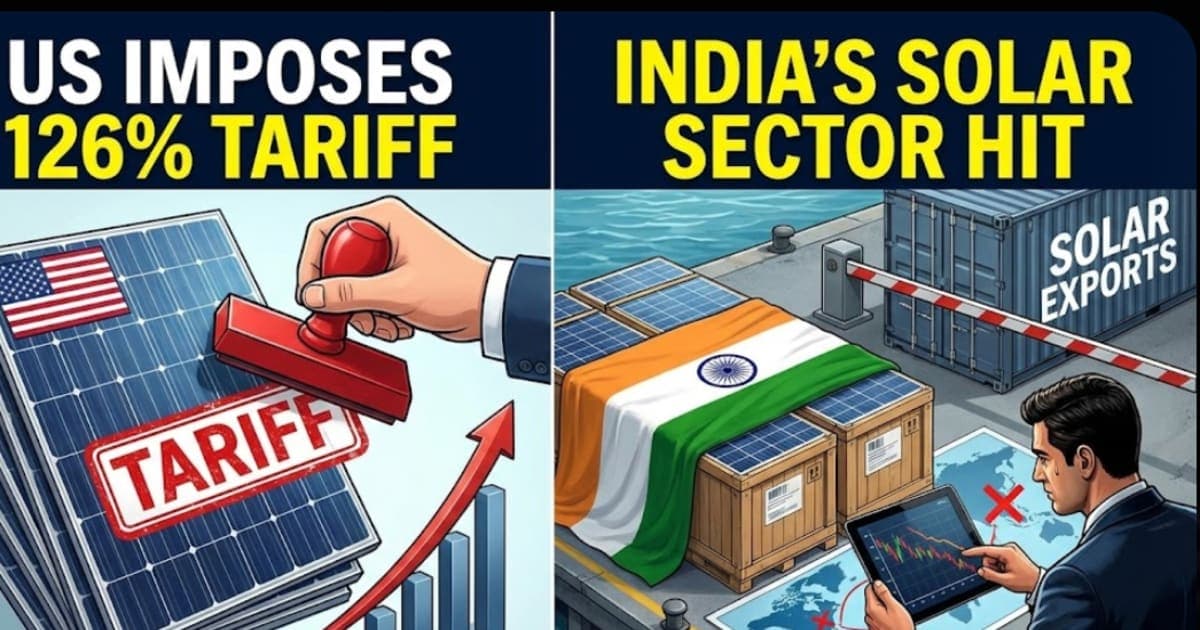
The US Department of Commerce has imposed preliminary countervailing duties of 125.87% — effectively 126% — on solar cells and modules imported from India. That number doesn't just make Indian exports expensive in the American market. It makes them functionally nonviable. The door that opened so dramatically after 2022 has swung shut with considerable force.
What happens next — to Indian manufacturers, to the domestic market they'll now be flooding, and to the US-India trade relationship that was supposed to be getting friendlier — is the question the renewable energy sector is urgently trying to answer.
How a 126% Number Gets Calculated
The tariff didn't come from nowhere, and understanding the specific mechanism that produced that number matters.
The US investigation began in August 2025, triggered by a petition from the Alliance for American Solar Manufacturing and Trade — a coalition that includes First Solar and Hanwha Qcells. Their argument: foreign governments were subsidising their domestic solar industries heavily enough to allow artificially cheap panels into the US market, threatening billions in American manufacturing investment.
That argument applies to several countries. Why did India end up at 126%?
Two Adani Group companies — Mundra Solar Energy and Mundra Solar PV — were selected as "mandatory respondents" in the investigation. When those companies withdrew from proceedings and declined to provide requested information, the US Commerce Department applied what's called "Adverse Facts Available" — their harshest methodology, used specifically when respondents don't cooperate with investigations.
The resulting penalty rate was 125.87%.
Because those two companies were the primary respondents, that rate was then applied as the preliminary benchmark for almost all other Indian solar exporters — companies that had nothing to do with the non-cooperation decision.
The entire Indian solar export sector is now carrying a tariff rate that exists because two specific companies didn't respond to a regulatory request.
That is the number. That is how it got there.
What Was Actually at Stake
To feel the weight of this, you need to understand what the US market had become for Indian solar manufacturers in a remarkably short time.
When the US imposed steep duties on solar imports from Cambodia, Malaysia, Thailand, and Vietnam — concluding that Chinese manufacturers were routing products through those countries to evade tariffs — American buyers needed new suppliers urgently. India stepped in.
The growth was not gradual. Indian solar exports to the US hit $792.6 million in 2024 — a nine-fold increase from 2022 levels. Between 2021 and 2024, over 90% of India's solar PV module exports went to the United States. By the first half of 2025, India — alongside Indonesia and Laos — accounted for 57% of all US solar module imports.
That market share didn't build over decades. It was constructed in roughly three years on the back of a specific geopolitical opening. And now the same kind of regulatory decision that created the opening has effectively closed it.
The Domestic Problem Nobody Wanted
Here's the part that keeps Indian industry analysts up at night.
Driven by US demand and domestic production incentives like the PLI scheme, Indian manufacturers expanded hard and fast. By early 2026, India's installed solar module manufacturing capacity had crossed 160 GW.
India's domestic deployment demand is approximately 40-45 GW annually.
That gap — between 160 GW of capacity and 40-45 GW of domestic absorption — was manageable as long as the US market was taking the excess. The moment that changes, the surplus has nowhere to go except back into the Indian domestic market.
What a flood of surplus modules into the domestic market produces is predictable: price wars, compressed margins, investment in new capacity that stalls because the returns don't justify it. The companies that expanded fastest to serve US demand are now the most exposed.
The stock market did the math immediately. Shares of Waaree Energies and Premier Energies dropped sharply following the announcement — not because investors panicked irrationally, but because the numbers on the capacity gap were already public.
What the Bigger Players Are Doing
Waaree Energies — India's largest solar manufacturer — moved quickly to reframe the situation for investors.
Their argument: they had seen some version of this coming and had been building for it. The company is accelerating plans for a 4.2 GW manufacturing facility inside the United States — bypassing import tariffs entirely by producing locally. They are also diversifying supply chains to the Middle East, partly to remove any Chinese-linked material sourcing that could attract additional anti-dumping scrutiny.
That strategy is sensible. It is also expensive, time-consuming, and not available to every Indian manufacturer — only the ones large enough to finance US manufacturing operations.
For the mid-tier and smaller exporters who built their businesses around the US demand window, the adaptation options are considerably narrower.
The Diplomatic Awkwardness
The timing of this announcement is genuinely uncomfortable from a bilateral relationship standpoint.
It arrives weeks after New Delhi and Washington had publicly agreed on a framework for an interim bilateral trade deal designed to reduce reciprocal tariffs on Indian goods to 18%. The optics of a 126% sectoral tariff landing in the middle of that process are not ideal.
The explanation is structural rather than personal. These countervailing duties operate under separate legal authority from the broader tariff frameworks that courts have been challenging and that trade negotiators have been discussing. The US Commerce Department's anti-subsidy investigations run on their own timeline, their own legal basis, and their own logic — which in this case is: protect American domestic solar manufacturing from foreign competition, regardless of what else is happening in the bilateral relationship.
That logic is consistent with the broader economic policy direction coming from Washington right now. It just happens to be inconsistent with the optics of a trade framework announced weeks earlier.
Strategic partnerships and "America First" industrial policy can coexist in the same administration. This week demonstrated what that looks like in practice.
What Comes Next
The 126% figure is preliminary. A final determination is scheduled for July 6, 2026. There is also a separate anti-dumping investigation running in parallel, which could add further penalties if products are found to have been sold below production cost.
Between now and July, Indian industry will be lobbying hard. Legal challenges are being explored. The Indian government has signaled it intends to use diplomatic channels to push back on the methodology — specifically the application of one company's non-cooperation rate to the entire industry.
Whether that produces any movement in the final determination is genuinely uncertain.
What is certain is the immediate strategic imperative: Indian solar manufacturers cannot be this dependent on a single export market again. Europe, Africa, the Middle East — markets that were secondary priorities when the US was absorbing 90% of exports — are now the primary diversification targets.
The Indian government, separately, needs to think about domestic demand stimulation to absorb the manufacturing capacity that's now looking for a home.
The sun is not the problem. It shines reliably. The business of capturing it and selling what you capture — that turns out to be as geopolitically complicated as any other trade.
A tariff number announced in Washington just proved that again.
This article is a trade and energy policy commentary piece based on publicly available US Department of Commerce preliminary findings, reported stock market movements, industry statements, and official trade data as of February 26, 2026.