The Digital Pandit: How AI Jyotish is Disrupting
India's Oldest Science
Date: February 26, 2026 Author: Technology & Culture Desk
Ask your parents how they chose their wedding date.
Almost certainly, someone visited a Panditji. Birth charts came out. Planetary positions were consulted. A muhurat was set. The process took time, cost money, required trust in a specific person's knowledge, and happened exactly once — because that's how it worked.
Now ask someone under 30 the same question.
There's a reasonable chance they checked an app first. Typed in their birth details, got a kundali analysis back in forty seconds, read about their Saturn placement during the commute home. Maybe they still visited a Panditji afterward. Maybe they didn't. But the app was the first stop.
This is not a fringe behavior anymore. Across the top seven AI Jyotish platforms in India, roughly 18 to 24 million queries are processed every single day. [web:68] Daily active users of AI astrology apps in India alone sit somewhere between 4.8 and 6.2 million. [web:68] AstroSage — India's largest astrology platform — has averaged 20% month-on-month AI revenue growth for eighteen consecutive months. [web:74]
Vedic astrology isn't just surviving the digital transition. It's growing inside it.
Why This Works at All
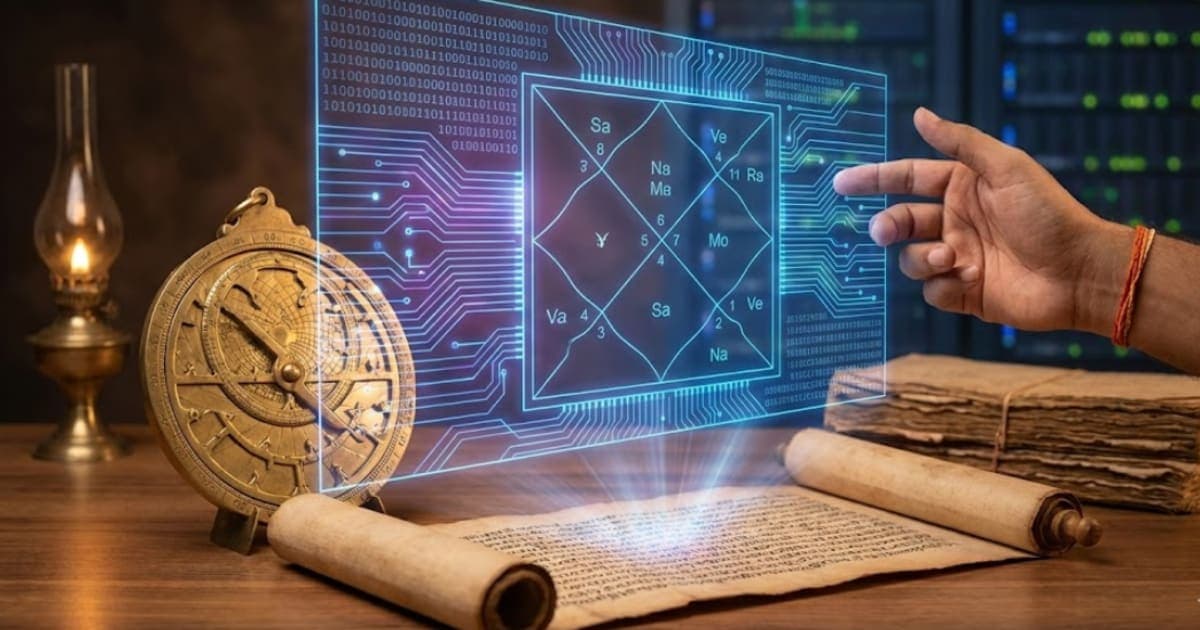
The first thing to understand is that Jyotish Shastra is not, at its foundation, a mystical discipline. It is a mathematical one.
Birth chart calculations — the precise positions of grahas, rashis, and bhavas at the exact moment and location of birth — are structured, rule-based, data-intensive work. [web:68] The dasha systems that govern timing predictions involve layered calculations that human astrologers spend years mastering. The classical texts that underpin interpretation — the Brihat Parashara Hora Shastra among them — run to thousands of verses of codified rules.
All of that is, at the computational level, a pattern recognition problem.
Which is what machine learning does.
Platforms like AstroSage, Jyai, BhriguGPT, and AstroTalk have trained models on astronomical ephemeris data and classical astrological texts simultaneously. [web:61][web:63][web:72] The output isn't a generic sun-sign paragraph from the back of a magazine. It's personalized to your specific chart, addresses current planetary transits against your placements, and arrives in natural conversational language in roughly the time it takes to pour a glass of water.
What a Panditji would spend two hours calculating and interpreting — an AI delivers in seconds. [web:66]
That gap in speed is the entire practical argument for the technology.
The Real Reason Gen Z Is Actually Using This
Convenience is the obvious answer. It's not the most interesting one.
The more interesting answer is privacy.
India's younger population — urban, educated, digitally fluent — carries a genuine cultural inheritance around astrology. The concepts aren't foreign or embarrassing. But the traditional consultation model comes with a specific kind of friction that matters enormously to this demographic.
Sitting across from a family astrologer and explaining that your career anxieties don't fit a conventional framework. Or that your relationship situation is complicated in ways that a traditional consultation isn't designed to handle without judgment. Or simply that you're not sure you believe completely but you're curious and you don't want to have that nuanced internal state witnessed by someone who will tell your mother about it.
An AI chatbot removes every one of those friction points. [web:68] It's there at 2 AM when the anxiety peaks. It doesn't have opinions about your choices. It doesn't tell anyone anything. It lets you ask follow-up questions without managing the social dynamics of a human consultation.
For a generation that normalized therapy apps, anonymous advice forums, and talking to ChatGPT about genuinely personal problems — consulting an AI about your Saturn return is not a cognitive leap. It's a Tuesday.
The numbers reflect this. 68% of urban Indians under 35 have used AI for a horoscope at least once. [web:68] In semi-urban and rural India, that number is 41% — lower but not small, and almost certainly rising.
What the Traditional Community Is
Actually Arguing
The pushback from established practitioners is worth engaging with seriously rather than summarizing as resistance to change.
The argument isn't about calculations. Nobody credible is claiming that AI can't calculate a birth chart accurately. The argument is about what calculation fundamentally cannot access.
A human astrologer sitting across from someone reads things that aren't in the chart. The hesitation before answering a question. The thing someone says they want to know versus the thing they actually came in to discuss. The difference between a person who can hear a difficult transit honestly and a person who needs the same information delivered differently. This is what practitioners mean by daivya drishti — not magic, but a quality of attentive perception that is relational and embodied in ways a language model genuinely isn't.
There's also the hallucination problem, which in this specific context isn't abstract. [web:68] AI systems generating confident but incorrect astrological interpretations — based on probabilistic guesses dressed up as analysis — could mislead someone making a real decision about marriage, relocation, or a career change. The stakes of a wrong answer from an AI astrologer at 2 AM are not trivial.
Both of these concerns are legitimate. Neither of them is going to stop 18 million daily queries.
The Hybrid That's Already Emerging
The smarter developers are reading this tension correctly.
The framing in the serious end of the market has already moved away from "AI replaces the astrologer" — which was never sustainable — toward something more honest: AI as the computational infrastructure, humans as the interpretive layer. [web:62][web:67]
Platforms like AstroTalk and Astroyogi have built models where AI handles chart generation, preliminary analysis, and pattern recognition across datasets no human practitioner could cover — while human astrologers remain available for consultation on complex or high-stakes questions. [web:62]
That model, if it develops well, actually expands what a skilled Panditji can do. Less time on calculations that software can handle. More time on the work — counseling, interpretation, remedial guidance — that requires a person in the room.
Whether that's how it plays out depends on whether tradition and technology choose engagement over opposition. The incentives are pointing toward engagement.
What's Actually Being Contested Here
Strip away the technology debate and the underlying question is much older.
What is Jyotish actually for?
If it's primarily a computational system — a way of mapping cosmic data onto human experience through mathematical rules — then AI is a natural evolution of the tool. A faster, more accessible, more scalable version of something that was always data-driven.
If it's a relational practice — something that happens between a knowledgeable person and another person seeking guidance, where the relationship itself is part of the medicine — then the AI app is a different thing entirely. Useful, perhaps. But not the same thing.
Most practitioners would say it's both. Which is probably true. And which is exactly why the emergence of AI Jyotish produces genuine debate rather than a clean answer.
India has been holding that particular tension — ancient wisdom and modern infrastructure, sacred practice and technological adoption — for longer than any tech platform has existed. The AI Jyotish moment is just the latest version of a conversation this country has been having with itself for decades.
The stars haven't moved. The questions people are asking haven't changed. The interface has.
Statistical data cited in this article — including daily active user figures, query volumes, and demographic survey data — is sourced from publicly available industry reports and platform disclosures as of early 2026. App features referenced are based on publicly listed platform capabilities.