The Iran-Israel War in March 2026 — 10 Things You Need to Understand Right Now
This is not a regional skirmish that the rest of the world can watch from a distance anymore.
The Iran-Israel war, with the United States now directly involved in active military operations, has crossed into territory that is reshaping energy markets, global travel, financial systems, and supply chains that billions of people depend on daily. The pace of developments is genuinely difficult to track. Here is a verified, grounded breakdown of the ten things that matter most right now.
1. Khamenei Is Dead — And Iran Has a New Supreme Leader
The single most consequential event of the conflict so far.
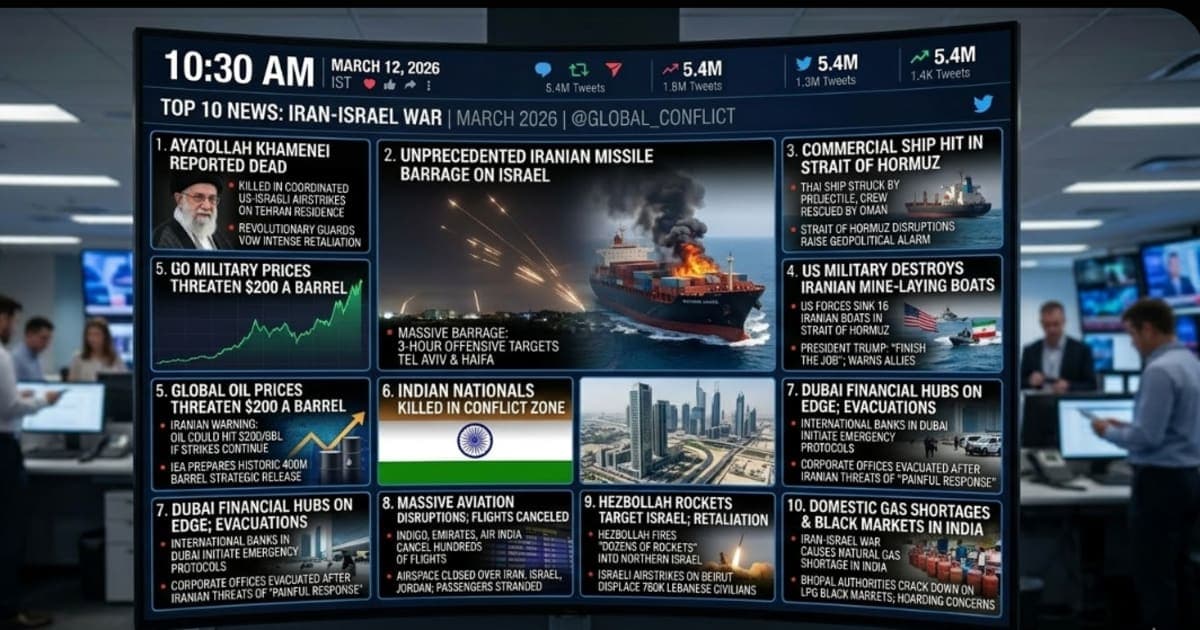
Ayatollah Ali Khamenei — Iran's Supreme Leader for 36 years, the man who has run Iran's foreign policy, nuclear programme, and proxy network since 1989 — was killed in coordinated U.S.-Israeli strikes on Tehran. His death is not a rumour or a claim by one side. Iran's own state broadcaster confirmed it, and Iran's Assembly of Experts convened under emergency conditions to name his son, Mojtaba Khamenei, as the new Supreme Leader.
The transition of power in the middle of an active war, to a figure without his father's institutional legitimacy or established relationships with the IRGC hierarchy, is one of the most significant geopolitical uncertainties of March 2026. Democracy Now reported on March 8 that Iran was "naming its new supreme leader as attacks grow on all sides." The IRGC has vowed its "most intense offensive operation" in retaliation. Whether Mojtaba can command the same loyalty from Iran's military and intelligence apparatus as his father did is a question nobody has a confident answer to.
2. Iran's Ballistic Missile Campaign Against Israel
The Iranian response to the strikes on Tehran has been the largest ballistic missile barrage Israel has faced.
A three-hour coordinated volley targeted Tel Aviv, Haifa, and western Jerusalem. Israel's layered air defence systems — Iron Dome for short-range, David's Sling for medium-range, Arrow for ballistic missiles — have been operating continuously. Interception rates have been high but not total. Sirens have been running across northern and central Israel for days. The civilian toll is real.
The scale of Iranian ballistic capability being deployed suggests that Iran's military leadership, under new political command, is choosing maximum escalation rather than a calibrated response. That decision pattern is what is making international observers most nervous about the next two weeks.
3. The Strait of Hormuz — Ships Are Being Hit
On March 9, the Mayuree Naree — a Thai-registered bulk cargo ship — was struck by a projectile while transiting the Strait of Hormuz en route to Kandla Port in Gujarat. A major fire broke out on board. Omani naval forces rescued 20 crew members from the burning vessel.
This is not the first vessel to be targeted in the current conflict, but it is among the most significant in terms of the cargo route involved. The ship was headed to an Indian port. The strait handles roughly 20% of global crude oil trade and a significant share of global LNG. Every attack on a commercial vessel transiting this waterway raises the insurance premium for every other ship attempting the same route — which effectively raises the cost of every barrel of oil passing through it, which shows up eventually in petrol prices and energy bills globally.
The U.S. military confirmed the destruction of 16 Iranian mine-laying boats near the strait. Iran has previously threatened to mine the waterway entirely. The U.S. Navy is currently preventing that. For how long, and at what operational cost, are open questions.
4. U.S. Military Involvement — What Trump Has Said
The United States is not an observer in this conflict. American forces are conducting active strikes on Iranian military infrastructure in coordination with Israel.
President Trump's public statements have been characteristically blunt. He has told American forces and allies they must "finish the job." He has also suggested, in remarks that concerned several allied governments, that the parties involved might need to "fight it out" before any ceasefire framework is viable.
Iran has responded to U.S. involvement directly — Iranian forces have targeted U.S. military installations in Kuwait, representing a significant expansion of the conflict's geographic footprint. When Iranian weapons are hitting American bases, the war has moved well beyond being a bilateral Israel-Iran exchange.
The IEA, watching the oil market implications of all of this, has reportedly been in discussions about releasing 400 million barrels from strategic reserves. If implemented, it would be the largest coordinated strategic reserve release in history — significantly larger than the emergency measures deployed during the Russia-Ukraine conflict in 2022.
5. What $200 Oil Would Actually Mean
Iran's military representatives have stated directly that sustained strikes on their infrastructure and continued disruption of the Strait of Hormuz could push global crude prices to $200 per barrel.
For context: Brent crude was trading around $70-80 per barrel for most of 2024. The war has already pushed prices significantly above that range. $200 per barrel is not a projection being made by analysts with a base case — it is a declared threat from one party in an active conflict, intended as much as a warning to the international community as it is a market forecast.
At $200 per barrel, petrol prices in India would roughly double. Diesel — which moves food, goods, and people across the country — would follow. Every manufactured product, every agricultural input, every freight cost would reflect that increase within weeks. The food price impact alone would be severe, and it would hit the most economically vulnerable populations first and hardest.
The IEA strategic reserve release is designed to signal that the international community has tools to manage this. Whether 400 million barrels is enough to hold the line against a sustained Hormuz closure is debated among energy economists.
6. Indian Nationals — Deaths Confirmed, Evacuations Underway
India's Ministry of External Affairs has confirmed the deaths of two Indian nationals in the conflict zone. A third is still missing.
Over 100 Indian medical students who were enrolled in universities in Tehran have been stranded since the escalation. The evacuation plan, as confirmed by Indian diplomatic sources, involves moving them by road from Tehran to Armenia, where commercial flights to New Delhi are being arranged. The road-to-Armenia route is being used because direct airspace between India and Iran is currently restricted.
IndiGo has cancelled 112 scheduled flights this week due to the airspace restrictions over Israel, Iran, Jordan, and parts of the Gulf. Air India and Emirates have also suspended or rerouted significant portions of their Middle East networks. Thousands of international transit passengers are stranded at hub airports, primarily Dubai, trying to reroute on alternative itineraries.
The MEA has set up helpline numbers for families of Indian nationals in the region. If you have family members in Iran, Israel, Lebanon, or Kuwait, those are the contacts to use.
7. Dubai's Financial District Is on Edge
Dubai has positioned itself for two decades as a politically neutral financial hub — the city where capital from every part of the world feels safe. That reputation is being tested.
Iran has issued explicit threats that U.S. and Israeli-linked economic institutions in the Middle East will face a "painful response." Several international banks in Dubai's financial district have initiated emergency protocols: staff evacuated from physical offices, operations shifted to remote work, security posture dramatically increased. The threat of drone strikes — a tactic Iran has used via proxy forces throughout the region — is being taken seriously by corporate risk teams in a way it wasn't three months ago.
The UAE's own air defence has been on heightened alert. Saudi Arabia's air defence systems have intercepted multiple ballistic missiles and drones targeting energy infrastructure and military airbases — the conflict has demonstrably spread beyond Israeli and Iranian territory. Whether Dubai's financial infrastructure becomes a direct target or merely operates under the shadow of that possibility will determine how much of the global capital currently parked there starts moving.
8. Lebanon and Saudi Arabia Are Being Pulled In
The conflict is no longer bilateral.
Hezbollah has launched dozens of rockets into northern Israel in this latest escalation cycle. Israeli airstrikes on Beirut in response have displaced an estimated 760,000 Lebanese civilians. Lebanon, which was still rebuilding from the 2024 conflict cycle, has been pulled back into a war that its fractured state institutions cannot manage.
Saudi Arabia's air defence systems have been actively intercepting missiles and drones aimed at energy fields and military installations. Riyadh has every incentive to stay out of this war, but Iranian proxies and direct Iranian military action are making neutrality increasingly difficult to maintain.
Turkey shot down an Iranian ballistic missile that entered its airspace — Turkey is a NATO member, and that interception carries alliance implications. Bahrain reported an air defence interceptor falling into a residential neighbourhood, injuring 32 civilians. The geographic spread of active military incidents in this conflict now covers Lebanon, Gaza, Israel, Iran, Saudi Arabia, Kuwait, Bahrain, and Turkish airspace. That is the entire Gulf and Levant.
9. The Aviation and Shipping Disruption — Ground Level
For most people not in the conflict zone, the war becomes tangible through two things: travel disruption and price increases.
On travel: IndiGo's 112 cancelled flights this week are just one airline's number. Emirates, Air India, Lufthansa, British Airways, and multiple other carriers have suspended or rerouted Middle East services. The airspace over Israel, Iran, Jordan, Iraq, and parts of the Gulf is either closed or carries risk levels that airline insurers will not underwrite at standard rates. Passengers booked on transiting itineraries through Dubai, Doha, or Abu Dhabi face rerouting via European or Southeast Asian hubs on already-full alternative flights.
On shipping: the Mayuree Naree attack has triggered immediate increases in war-risk insurance premiums for all vessels transiting the Hormuz. Tanker operators are either charging significantly more for the route or rerouting around the Cape of Good Hope — adding two to three weeks to journey times and dramatically increasing freight costs. Those costs land on importers, who pass them to consumers.
10. India's LPG Black Market and Ground-Level Shortage
The most direct domestic consequence of the conflict for Indian households is the gas shortage covered separately — but the enforcement dimension is now also making news.
In Bhopal, authorities have begun cracking down on an emerging black market for LPG cylinders. Commercial businesses — restaurants, dhabas, small manufacturers — are buying domestic cylinders at regulated prices and reselling them at commercial rates to cover the gap created by commercial LPG supply cuts. This is illegal under the Essential Commodities Act. Bhopal is the first major city where enforcement action has been reported, but the underlying conditions creating the black market — commercial gas cut by up to 35%, domestic supply protected — exist across every major Indian city.
The human consequence downstream from this is the one that gets the least attention in international coverage: the daily wage worker whose dhaba closed because the gas ran out, who is now eating one meal a day because the affordable food infrastructure in his city is partially shuttered.
Where This Goes Next
Three scenarios are circulating among analysts and diplomatic sources.
The first: U.S. and Israeli strikes degrade Iran's military infrastructure to the point where Mojtaba Khamenei's government — facing internal legitimacy questions and a military under sustained pressure — signals openness to ceasefire terms. Qatar and Oman, who have historically served as back-channel intermediaries between the U.S. and Iran, are reportedly facilitating communication. This is the scenario that stabilizes oil markets fastest.
The second: Iran mines the Strait of Hormuz before the U.S. Navy can fully prevent it, triggering a sustained closure that pushes oil toward the $150-200 range and forces emergency IEA reserve releases that buy weeks, not months.
The third: the conflict expands laterally — Saudi Arabia gets drawn in directly, Hezbollah escalates in a way that opens a full northern front for Israel, and the Gulf's financial infrastructure becomes a direct target.
None of these are predictions. All of them are possibilities that the world's energy markets, airlines, shipping companies, and governments are actively pricing into their decisions right now.
The war is ten days old as a full-scale conflict. The Strait of Hormuz is still open. The IEA reserves haven't been released yet. The new Iranian Supreme Leader hasn't fully consolidated power. Everything that happens in the next two weeks will determine which of those three paths this goes down.
Watch the strait. Watch the ceasefire back-channels. Watch Mojtaba.