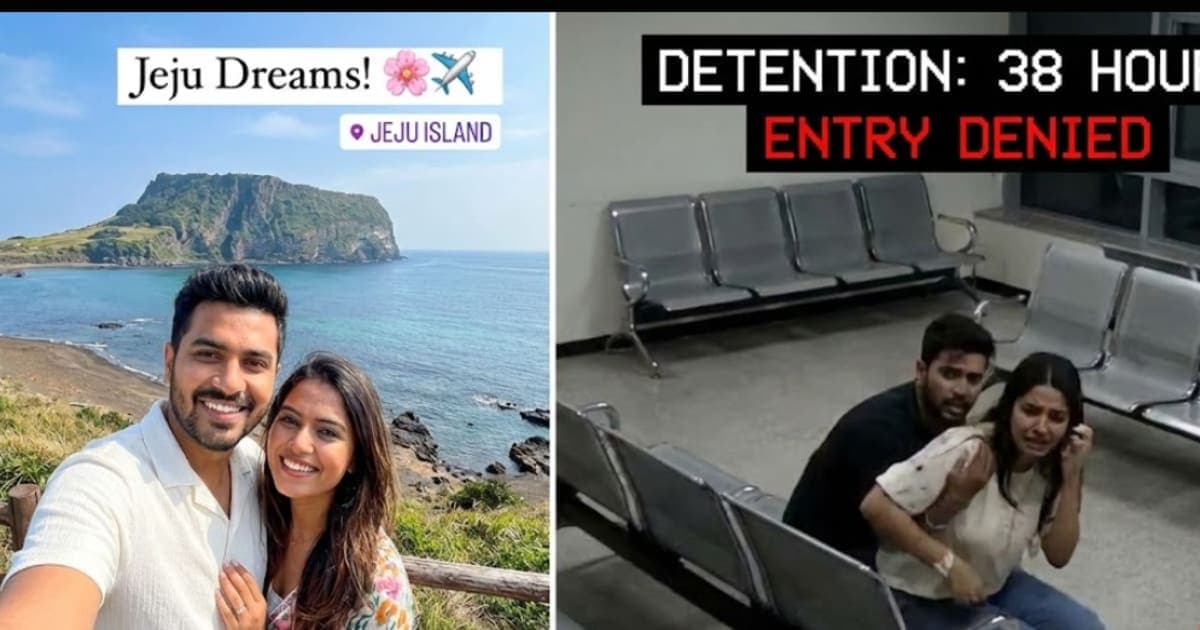
Paradise Lost: How an Influencer Couple's 38-Hour
Detention on Jeju Island Sparked a Diplomatic Incident
Aarav and Meera Sharma packed for Jeju Island the way most travel influencers pack for a destination they've been planning for months. Return tickets. Luxury hotel confirmation. Proof of funds. Content calendar mapped out by location and light conditions. Everything in order. Everything documented.
Thirty-eight hours later, they were on a flight back to Singapore with deportation stamps in their passports and an entry ban that nobody had explained to them.
The story they told when they landed — on Instagram, in a tearful video that has now been viewed millions of times — set off something that went well beyond the usual cycle of viral travel content. It ended with India's Ministry of External Affairs issuing a formal travel advisory specifically warning Indian nationals about Jeju Island. That doesn't happen often. It doesn't happen for friendly nations without serious provocation.
This is what happened.
How It Began
The couple arrived at Jeju International Airport on a direct flight from Singapore in mid-February. Jeju operates under a distinct entry policy from mainland South Korea — visitors from 180 countries can enter without a visa for up to 30 days, a deliberate tourism-boosting arrangement that the island has maintained for years.
They joined the immigration queue. They had everything.
"We were pulled out of the line without a word," Meera recounted in her video. "They took our passports, and then they demanded our unlocked phones. When we asked why, they just kept saying 'procedure' in broken English."
What followed was 38 hours in a windowless holding area — rigid metal benches, fluorescent lights on around the clock, food they describe as inedible. They were separated from each other. They were held alongside detainees from several other Southeast Asian countries. For the better part of two days, they received no translator, no legal representation, and — the detail that keeps appearing in every account they've given — no reason. Not once did anyone tell them why they were being held.
"We asked every hour: are we charged with something? Is our visa invalid? What is the discrepancy?" Aarav wrote in a detailed Instagram post afterward. "They just stared at us. We felt like criminals. We had done nothing except land as tourists."
After 38 hours, they were put on a flight to Singapore. Their passports were handed back only after landing in a third country. The stamps inside told them they were banned from re-entry. Still no explanation.
The Reaction Back Home
Their digital silence during the 38 hours had already unsettled their three-million-plus combined following. The sudden disappearance of an active travel couple mid-trip generates a specific kind of anxiety online. When the explanation came, the reaction was immediate and not quiet.
The contrast is what cut deepest, and it spread fast. South Korea has spent years and considerable cultural capital building what the marketing industry calls soft power — K-drama aesthetics, K-pop, the "Hallyu" wave, the whole carefully constructed image of a vibrant, welcoming, aspirational destination. That image has worked spectacularly in India, where Korean pop culture consumption has grown enormously over the last decade. The demographic most engaged with that culture skews young, urban, and increasingly travel-ready with disposable income.
That demographic watched the video. And then it got angry.
#BoycottJeju and #RacistKorea trended on X for two straight days. The comments section of every major Korean tourism account operating in India filled up within hours. More significantly, the Sharmas' posts became a collecting point — thousands of people in the replies sharing their own experiences with Korean immigration. Uncomfortable questioning. Arbitrary holds. Treatment that tracked closely to nationality rather than the documentation being presented.
The pattern that emerged from those comments wasn't conclusive evidence of a policy. But it was enough to make the conversation much larger than one couple's bad experience.
The Context Nobody Was Saying Out Loud
Jeju's visa-free arrangement, generous as it sounds, has created a genuine enforcement headache for the island's immigration authority.
The open-door policy — designed to pull tourist revenue — has over the years been exploited by a subset of visitors who use Jeju as a staging point to enter mainland South Korea illegally for work. The island has faced sustained pressure from the central government to tighten controls. The response, according to travel industry observers who have been watching this develop for a while, has been a significant swing toward aggressive profiling — casting wide nets by nationality rather than evaluating individuals on their actual documentation.
The practical result: high-spending, fully documented tourists from South Asia and Southeast Asia are getting caught in enforcement designed for a completely different problem. The Sharmas, with their return tickets and luxury hotel bookings and proof of funds, represent exactly the kind of visitor Jeju's tourism economy wants. They were treated like exactly the opposite.
This isn't a new tension. It has been building. What changed this time is that the people it happened to had three million followers and knew how to tell a story.
The Diplomatic Response
The Indian Embassy in Seoul moved quickly, lodging a formal protest with the South Korean Ministry of Foreign Affairs and requesting an explanation for what it called "arbitrary detention and unacceptable treatment" of Indian citizens.
Seoul's initial response was the diplomatic equivalent of a shrug — a vague statement about "discrepancies in travel purpose during entry screening" and the standard invocation of sovereign right to deny entry. No specifics. No acknowledgment of the conditions described. No engagement with the 38-hour timeline or the absence of any explanation during that period.
New Delhi was not satisfied. On February 25th, the MEA updated its travel guidance for South Korea to include a specific warning about Jeju Island.
The advisory notes, in part, that despite the visa-free entry policy, immigration authorities have been "exercising extreme and often arbitrary scrutiny," that tourists have faced "prolonged detention and deportation without clear reasons provided," and that travelers should ensure documentation is "irrefutable" while being prepared for possible entry denial regardless.
That language is unusually direct for an advisory about a country India maintains friendly relations with. It signals that the government views what happened to the Sharmas not as an isolated incident but as part of a pattern worth formally alerting its citizens about.
What This Has Actually Cost
Tourism advisories don't reverse easily. The language sits on the MEA website. It gets cited by travel agents, by insurers, by HR departments deciding whether to approve work trips. It changes behavior in ways that are diffuse but real.
South Korea has been an increasingly significant destination for Indian travelers — direct flights, cultural affinity built by a decade of Hallyu consumption, a demographic ready to spend. That pipeline just got complicated.
The soft power calculation that made Korean culture so effective in India — the investment in music, drama, food, the whole aspirational aesthetic — works because the audience trusts the invitation. A tearful video of a woman describing 38 hours in a holding cell while asking what she did wrong and getting no answer is a direct hit to that trust. It reaches the same audience the Hallyu machine spent years cultivating.
No policy statement from a tourism board undoes that specific image. Not quickly.
For Aarav and Meera Sharma, the Jeju trip was supposed to be the jewel of their 2026 content calendar. What they produced instead was something that will be cited in diplomatic conversations and travel advisories for considerably longer than any reel from a luxury resort would have been.
This article is based on publicly available statements from the individuals involved, officially released MEA travel advisory text, and reported diplomatic exchanges between the Indian Embassy in Seoul and South Korean authorities as of February 26, 2026. The names Aarav and Meera Sharma are used as reported in source material.