Bhajan + Clubbing = Controversy: Delhi University's Wild Cultural
Night Has India Divided
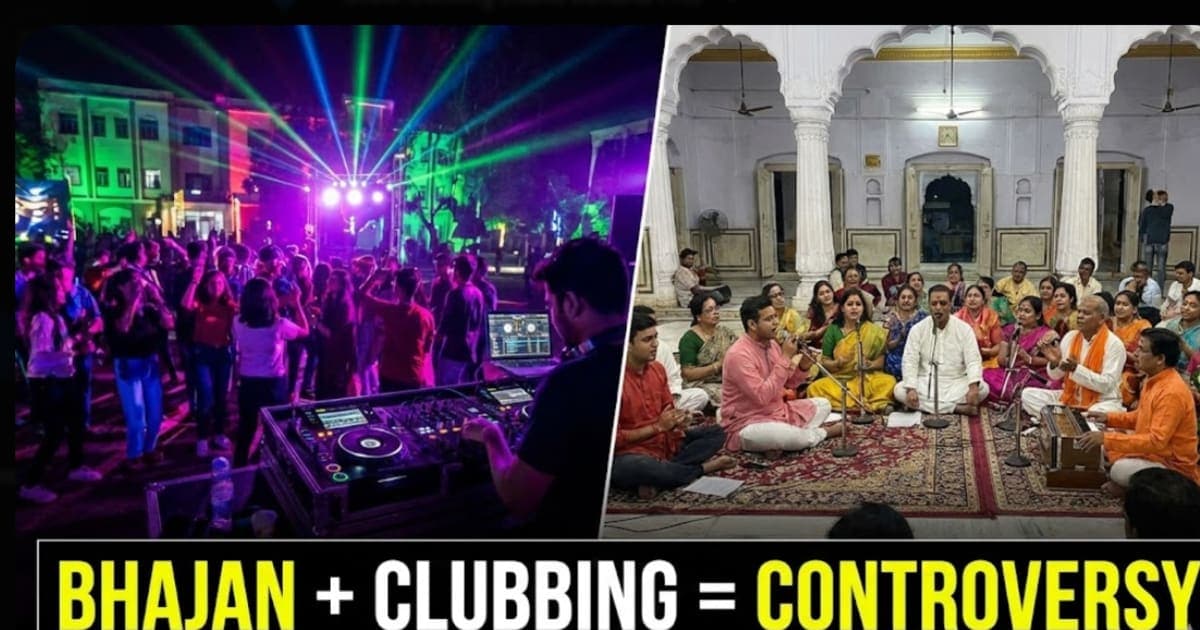
Close your eyes and picture a typical college night out. Neon lights. Bass so heavy you feel it in your chest. A crowd of students completely lost in the moment. Now open your ears — and instead of the latest EDM drop or a Bollywood remix, you're hearing thousands of voices screaming "Ram Siyaram" and "Keshavam" in unison.
That's not a thought experiment. That happened. Repeatedly. Across multiple Delhi University campuses over the last two weeks. And depending on who you ask, it was either the most exciting thing to happen to Indian youth culture in years — or a deeply uncomfortable line being crossed in a very public way.
How This Actually Started
This isn't some organic, student-led viral moment. It has a very specific origin point.
A 10-day cultural festival called Vasantotsav 2026 ran from February 10 to 19 across several DU colleges — Ramjas, Deen Dayal Upadhyaya, ARSD, and Shivaji College, among others. The initiative wasn't student-organized. It was spearheaded by the Delhi government, inaugurated by Chief Minister Rekha Gupta, and heavily promoted by Art, Culture, Language and Tourism Minister Kapil Mishra.
The format was deliberate: bring in fusion artists — the Leela Band, India Music Collective, Sadho Band, SAM Band — and have them transform traditional devotional bhajans into full concert-scale performances. Big stage, big lights, big sound. The government's stated intent was to present India's spiritual traditions in a format that actually resonates with a generation that grew up on YouTube and Spotify.
Minister Kapil Mishra framed it as bridging ancient heritage with modern sensibility. On paper, it sounds straightforward. In execution, watching a crowd of college students headbanging with tilaks on their foreheads to a DJ drop built around "Har Har Mahadev" — that's where it gets complicated.
Why Gen Z Is Completely Here For It
Talk to the students who actually attended these events, and the energy is unmistakable.
For a lot of Indian Gen Z, traditional religion comes packaged with things they find alienating — rigid rituals, strict rules about how you dress and behave, a hierarchy that tells you there's a right way and a wrong way to feel devotion. Bhajan clubbing removes all of that. You show up in jeans and sneakers. You dance. Nobody is judging your form or your faith credentials.
"It feels like a concert, but you leave feeling completely at peace instead of just exhausted," said one student in a vlog that racked up views fast. That quote keeps getting shared because it captures something real: a generation that is genuinely searching for meaning and community, but has very little patience for the institutional version of religion that was handed to them.
What Bhajan clubbing offers — whether intentionally or not — is Satsang 2.0. The collective experience, the shared emotion, the feeling of being part of something larger than yourself. All the things that religious gatherings have always provided, stripped of the parts that made young people check out. For many attendees, chanting Krishna's name in a crowd of a thousand people while music thumps through the floor is not less authentic than sitting in a temple. It might actually feel more so.
And Then There's Everyone Else
The backlash was not slow in coming.
For traditionalists and religious conservatives, the very phrase "Bhajan Clubbing" is the problem. Bhajans are devotional offerings — they carry a specific energy, a specific intention. They're not supposed to be consumed. They're supposed to be practiced. The whole point is bhakti — a quality of surrender and reverence that, critics argue, you simply cannot manufacture with strobe lights and a mosh pit.
"Devotion is not a disco," one commentator wrote online, and that line traveled far. The concern being voiced isn't just aesthetic conservatism. It's something more specific: that packaging sacred music as a party trick — even a well-intentioned one — hollows it out. That students bouncing to a remixed Shiva stuti aren't connecting with anything divine; they're consuming a trend that wears religion as costume.
It's a fair question, honestly. At what point does making faith accessible tip over into making it disposable?
The Campus Politics Nobody Wanted to Talk About
Here's where the story gets thornier.
Delhi University was already a pressure cooker before Vasantotsav began. Just days before the festival kicked off, the university administration imposed a blanket one-month ban on protests, rallies, and demonstrations on campus — this after clashes between left-wing student group AISA and right-wing ABVP over academic issues and equity regulations.
So the sequence of events, as left-leaning student organizations saw it, went like this: protests banned, demonstrations banned, student voices on academic and political matters — silenced. And then, within the same window, thousands of students gathered on campus for government-backed religious concerts, with no issues whatsoever.
The accusation of hypocrisy was immediate and loud. Why is political assembly a threat to law and order, but a government-organized religious gathering at the same venues is a cultural celebration?
Some student leaders went further, arguing that culture was being used as a Trojan horse — a way to mainstream a specific religious narrative inside secular, publicly funded educational spaces without triggering the legal and political scrutiny that an explicitly religious event would face. Whether you find that argument convincing or conspiratorial probably depends on where you stand politically. But the concern is being voiced across too many campuses to dismiss as fringe noise.
So What Actually Is This?
That's the question, isn't it. And there isn't one clean answer.
Is Bhajan Clubbing a genuinely innovative way to keep ancient traditions alive in a century where attention spans are short and temples are losing their young congregation? Possibly. The students who left those events feeling something real weren't performing devotion — they felt it.
Is it a disrespectful flattening of something sacred into entertainment? Also possibly. Not every tradition is improved by being made louder and faster.
Is it a calculated political move dressed up as cultural outreach, timed deliberately during a period of campus unrest? That one's worth sitting with.
What's not in question is this: the conversation it's started is real, and it's not going away. India's young people are actively renegotiating what faith looks like for them — demanding spaces where they can be both genuinely modern and genuinely rooted, without having to choose between the two. That negotiation was always going to be messy and loud and controversial.
The wild cultural nights at Delhi University just made sure everyone noticed it was happening.
This article is a commentary and cultural analysis piece based on publicly reported events from Vasantotsav 2026. The views of commentators and students quoted are representative of perspectives circulating in public discourse.