There are very few events left that make the whole world look in the same direction.
Not a sporting final, not a political crisis, not a product launch — those things divide as much as they unite. But on a clear night in March 2026, somewhere between dusk and midnight depending on where you're standing, the Moon is going to turn red. And for the duration of that, the planet will share something it hasn't shared enough lately: a single, wordless moment of awe.
The total lunar eclipse of March 2026 is not a niche astronomy event. It is a cultural moment dressed in orbital mechanics.
Why the Moon Turns Red
The short answer is sunsets.
When the Moon passes completely into Earth's shadow — the umbra, the darkest core of the shadow where no direct sunlight reaches — it doesn't go dark. It goes red. The reason is the same reason the sky is blue and the horizon is orange when the sun goes down: Rayleigh scattering.
Earth's atmosphere bends light. It filters out the short, blue wavelengths and lets the long, red ones curve around the planet's edge. During totality, every sunrise and every sunset happening simultaneously on Earth is projecting its light onto the surface of the Moon at once.
What you are seeing when you look at a Blood Moon is not a trick or an anomaly. You are seeing the Earth's atmosphere from the outside, lit up from within, casting its glow onto the nearest thing in the sky.
That is what makes people stop. Not just that it looks strange — it does look strange — but that once you understand what you're actually seeing, it becomes one of the most beautiful things the solar system regularly offers.
Who Can See It and How
The geography of this eclipse favors the Americas, the Pacific, and East Asia.
For viewers in those regions, the timing puts the peak in accessible hours — not 4 a.m., not a Tuesday afternoon, but the kind of hour when people are actually awake and outside is a reasonable option.
The lunar eclipse has a democratic quality that its solar counterpart doesn't. A total solar eclipse demands specialized eyewear, precise geography, and a narrow path of totality that millions of people drive hours to stand inside. Miss it by fifty miles and you see a partial eclipse. Arrive ten minutes late and it's already over.
The lunar eclipse asks nothing. No equipment. No glasses. No travel. You walk outside, let your eyes adjust, and there it is — the same view available to every person on the night side of the planet simultaneously.
That is a rare thing in astronomy: an event that doesn't reward the prepared over the curious. Anyone who happens to look up at the right hour sees exactly what the professional with the tracking mount sees.
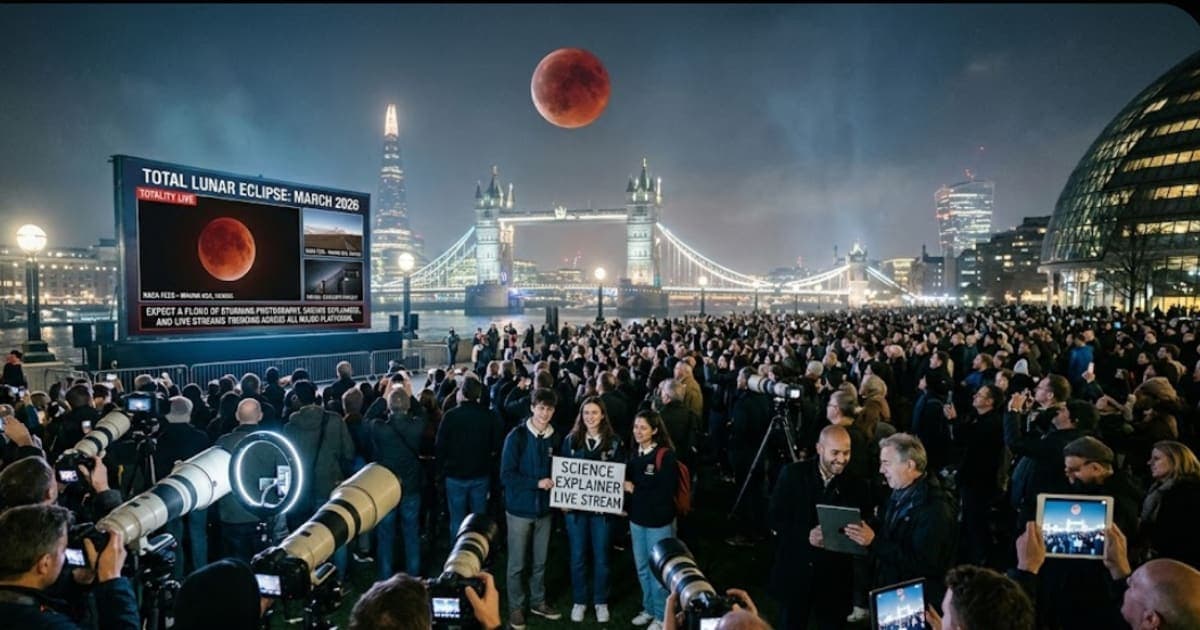
In cities, people will gather on rooftops and in public squares — not because anyone organized it, but because that's what happens when something worth seeing appears in a shared sky. In rural areas, astronomy clubs will set up telescopes. The coppery craters will resolve in sharp definition for people who have never looked through an eyepiece before.
The simple act of stepping outside and looking up becomes, briefly, synchronized across continents and time zones.
The Photography Wave
The internet will begin warming up before the eclipse does.
Equipment guides. Exposure settings for different phones. Maps of ideal viewing locations and unobstructed sight lines. The astrophotography community — which has been growing fast and shows no signs of slowing — will be ready weeks in advance.
When the partial phases begin, the visual feeds start filling. By the time totality arrives, every major platform will be in the middle of a coordinated, entirely organic image flood.
The professional captures are the ones that will be shared most widely: Blood Moon framed against a city skyline, or rising over an ancient monument, or reflected in a body of water that has no business being that still. These images do something that individual photographs rarely do — they locate the cosmic event in a human context. They remind you that the same sky is over the skyline and over you.
But the more interesting photography story in 2026 is what's happening at the amateur end.
AI-enhanced smartphone cameras have crossed a threshold. The gap between "I have a nice phone" and "I have a real camera" has narrowed enough that casual observers with the right app and a cheap tripod can produce images that would have required serious equipment five years ago.
The result is that the eclipse gets documented from every vantage point simultaneously. Not just from observatories and rooftop studios, but from backyards in suburban Ohio, apartment balconies in Manila, highway rest stops in New Mexico, and a hillside in rural Japan where one person set up their phone on a stack of books.
That breadth of documentation is what turns an astronomical event into a cultural one.
The Explainer Economy
Every Blood Moon produces the same set of questions, reliably, every single time.
Why is it red? Is it dangerous? What does it mean? How long does it last? Is this the apocalypse?
The last question is asked more often than you'd expect from a species that has observed lunar eclipses for all of recorded history.
In 2026, the content ecosystem that answers these questions is more sophisticated, more accessible, and more widely distributed than it has ever been. Science communicators on TikTok and YouTube who have spent years building the skill of making complex physics feel intuitive will have their biggest audience moment of the year.
The Rayleigh scattering explanation — which sounds technical until someone connects it to the red of a sunset and suddenly makes complete sense — will be delivered in sixty seconds by a hundred different creators in a hundred different formats.
This is the eclipse's secondary value: it is one of the best on-ramps to scientific literacy that the calendar reliably provides. A person who steps outside on a clear March night because the Moon looked strange and spends the next twenty minutes watching an explainer about atmospheric optics and orbital geometry has had a genuinely educational evening that started with curiosity and went somewhere real.
The Livestream as Digital Campfire
Weather is astronomy's oldest problem.
A total lunar eclipse visible in your city, on your calendar, prepared for over months — ruined by clouds you had no reason to expect.
In 2026, that problem is essentially solved.
NASA, the Virtual Telescope Project, and major observatories on multiple continents will activate synchronized, high-definition live feeds for the duration of the eclipse. These streams will be available on YouTube, Twitch, and news platforms — free, with expert commentary, from locations specifically chosen for reliable clear skies.
A viewer in London, where March weather offers no guarantees, can watch a crystal-clear feed from an observatory in Chile while chatting in real-time with viewers in Australia who are watching the same sky in person.
The live stream comment section during a major celestial event is one of the stranger and more genuinely moving experiences the internet offers. Strangers from opposite ends of the planet, united by the fact that they are all looking at the same thing, sharing the same timestamps, saying the same version of "it's starting" in twenty languages.
That is not a small thing.
What 90 Minutes of Totality Is
The eclipse doesn't ask for your ideology, your algorithm, your subscription, or your opinion.
It asks you to be outside on a clear night and look up.
For approximately 90 minutes of totality — the duration when the Moon sits fully inside Earth's shadow and holds its deep coppery color — the event is happening whether or not you're watching.
The people who do watch will remember it in the specific way you remember the things that were too big to process in the moment. Not as a fact — not "there was a lunar eclipse in March 2026" — but as an image. A red circle in a dark sky. Cold air. Someone next to you who said something quiet that you didn't quite catch but understood anyway.
These are the experiences that no algorithm fragments and no feed can replicate.
They just happen, in the sky, on a night in March, for anyone who remembers to look.
The total lunar eclipse of March 2026 will be visible primarily across the Americas, the Pacific, and East Asia. During totality, the Moon will appear deep red to coppery orange — the so-called "Blood Moon" effect — caused by sunlight refracting through Earth's atmosphere onto the lunar surface. No equipment is required for safe viewing. Live streams will be available from NASA and major global observatories for viewers with cloudy skies.